

Most American family offices now contend with a regulatory environment that is more intricate than ever, especially as portfolios span multiple jurisdictions. For executives and consultants managing ultra-high-net-worth wealth, the stakes are immense. Overlooking a single compliance mandate can result in multi-million dollar penalties or reputational harm that endures for generations. Gaining clarity on comparative global requirements empowers leaders to make informed decisions, safeguard family capital, and ensure sustained growth across borders.
Table of Contents
- Defining The Global Family Office Structure
- Key Variations: Single Vs. Multi-Family Offices
- Regulatory Frameworks In Major Jurisdictions
- Essential Registration And Disclosure Requirements
- Common Risks And Compliance Pitfalls
- Strategic Jurisdiction Selection For Offices
Key Takeaways
| Point | Details |
|---|---|
| Global Family Offices are Holistic Organizations | They integrate wealth management with family objectives across investment, education, and philanthropy. |
| SFOs vs. MFOs | Single Family Offices offer personalized services, while Multi-Family Offices provide cost-effective solutions through shared resources. |
| Regulatory Compliance is Crucial | Family offices must navigate complex international regulations to ensure transparency and avoid compliance pitfalls. |
| Strategic Jurisdiction Selection is Key | Choosing the right location can enhance financial performance and regulatory compliance, requiring careful evaluation of various factors. |
Defining the Global Family Office Structure
A global family office represents a sophisticated strategic platform designed to manage comprehensive wealth, legacy, and multifaceted family interests across international boundaries. These sophisticated structures have dramatically transformed from traditional back-office financial management entities into holistic, purpose-driven organizations that integrate financial strategy with broader family objectives.
Modern family offices increasingly operate as dynamic, professionally managed ecosystems that address far more than investment management. Comprehensive family wealth strategies now encompass financial assets, educational planning, professional development, wellness initiatives, and intergenerational wealth transfer mechanisms. The structural complexity varies significantly, ranging from lean, agile units managing hundreds of millions to expansive organizations overseeing billions in diversified global assets.
The typical global family office structure integrates several critical components:
- Investment Management
- Risk Assessment
- Wealth Preservation
- Philanthropic Planning
- Legal and Tax Advisory
- Next-Generation Education
Unlike traditional financial management approaches, these offices prioritize a holistic family-first philosophy that balances financial performance with long-term legacy preservation. Family office governance principles have become increasingly sophisticated, incorporating structured decision-making frameworks that ensure transparency, accountability, and strategic alignment across generations.
Pro tip: When establishing a global family office, prioritize creating a flexible governance structure that can adapt to evolving family dynamics and international regulatory landscapes.
Key Variations: Single vs. Multi-Family Offices
Single Family Offices (SFOs) and Multi-Family Offices (MFOs) represent two distinctive approaches to wealth management, each with unique characteristics tailored to different family needs and financial landscapes. Understanding the nuanced differences between these structures is crucial for ultra-high-net-worth families seeking optimal wealth preservation and growth strategies.
Single Family Offices are exclusively dedicated to serving one wealthy family, offering highly personalized wealth management strategies with unparalleled customization and privacy. These specialized entities provide comprehensive services ranging from investment management and tax planning to philanthropic coordination, ensuring that every financial decision aligns precisely with the family’s specific goals and legacy objectives.
In contrast, Multi-Family Offices operate as collaborative platforms serving multiple affluent families, creating a shared ecosystem of financial expertise and resources. The primary advantages of MFOs include:
- Reduced operational costs through resource sharing
- Access to broader investment networks
- Diversified expertise across multiple professional domains
- Enhanced scalability and flexibility
- Improved risk management through collective insights
While Single Family Offices offer maximum control and customization, Multi-Family Offices provide a more cost-effective solution for families seeking professional wealth management without bearing the entire operational expense. Navigating family office structures requires carefully evaluating individual family needs, financial complexity, and long-term strategic objectives.
Here’s a side-by-side summary of Single Family Offices and Multi-Family Offices:
| Criteria | Single Family Office (SFO) | Multi-Family Office (MFO) |
|---|---|---|
| Number of Families | Serves one family exclusively | Serves multiple unrelated families |
| Level of Customization | Fully tailored to individual needs | Standardized with some personalization |
| Privacy | Highest level of confidentiality | Strong, but shared infrastructure |
| Operational Cost | Higher, borne by one family | Lower, cost shared among families |
| Access to Expertise | Dependent on resources hired | Broader due to pooled professionals |
| Ideal For | Large, complex family wealth | Moderate-sized family portfolios |
Pro tip: Evaluate your family’s specific wealth management requirements, financial scale, and governance preferences before selecting between a Single or Multi-Family Office structure.
Regulatory Frameworks in Major Jurisdictions
Global family office registration involves navigating a complex landscape of international regulatory requirements that vary significantly across different jurisdictions. Compliance frameworks are not uniform, demanding sophisticated understanding of regional legal nuances, tax implications, and reporting standards that can dramatically impact wealth management strategies.

In the United States, family offices face rigorous regulatory oversight from multiple agencies, including the Securities and Exchange Commission (SEC) and the Internal Revenue Service (IRS). Comprehensive compliance requirements typically mandate detailed reporting, transparent investment disclosures, and adherence to strict governance protocols. The regulatory environment demands extensive documentation, regular audits, and sophisticated compliance management systems.
Key regulatory considerations across major jurisdictions include:
- Jurisdiction-specific registration requirements
- Anti-money laundering (AML) compliance
- Tax reporting and transparency obligations
- Investment disclosure regulations
- Cross-border wealth transfer restrictions
- Philanthropic activity reporting
European jurisdictions present a more nuanced regulatory landscape, with countries like Switzerland, Luxembourg, and the United Kingdom offering distinct frameworks that balance regulatory rigor with investor-friendly environments. These jurisdictions often provide more flexible structures while maintaining robust compliance standards, creating attractive options for international family offices seeking strategic positioning.
Pro tip: Engage specialized legal counsel with international expertise to develop a comprehensive compliance strategy that addresses regulatory requirements across multiple jurisdictions.
Essential Registration and Disclosure Requirements
Navigating the complex landscape of global registration and disclosure requirements demands meticulous attention to international regulatory frameworks that govern family office operations. These intricate compliance mechanisms extend far beyond simple administrative procedures, representing critical safeguards for financial transparency and regulatory accountability.
Family offices must implement comprehensive reporting and due diligence mechanisms that address multiple international standards, including Foreign Account Tax Compliance Act (FATCA) and Common Reporting Standard (CRS) regulations. These frameworks require detailed documentation of financial accounts, asset ownership, and cross-border transactions, with significant penalties for non-compliance.
Key registration and disclosure requirements typically encompass:
- Comprehensive financial account reporting
- Detailed asset ownership documentation
- International tax compliance declarations
- Beneficial ownership transparency
- Cross-border transaction disclosures
- Anti-money laundering (AML) verification processes
The registration process involves multiple layers of scrutiny, requiring family offices to provide extensive documentation that demonstrates financial integrity, legitimate wealth sources, and ongoing compliance with international regulatory standards. Jurisdictions worldwide have increasingly sophisticated verification mechanisms that demand not just initial registration but continuous monitoring and periodic re-certification of compliance status.
Pro tip: Develop a centralized compliance management system that automatically tracks and updates regulatory requirements across different jurisdictions to minimize registration and disclosure risks.
Common Risks and Compliance Pitfalls
Family offices operate in an increasingly complex regulatory environment where the consequences of non-compliance can be catastrophically expensive. Compliance risks extend far beyond simple administrative challenges, representing potential existential threats to family wealth and long-term financial stability.
Compliance risks for family offices encompass multiple intricate dimensions that demand sophisticated, proactive management strategies. The most critical vulnerabilities include navigating multi-jurisdictional regulatory landscapes, maintaining comprehensive documentation, and ensuring consistent adherence to evolving international standards.
Key compliance pitfalls that family offices must vigilantly avoid include:
- Inadequate staff training on regulatory requirements
- Outdated technological infrastructure
- Inconsistent documentation practices
- Poor communication with regulatory authorities
- Insufficient internal audit mechanisms
- Failure to adapt to changing regulatory environments
- Lack of transparent beneficial ownership reporting
Ultra-high-net-worth families face significant reputational risks beyond mere financial penalties. Regulatory breaches can damage carefully constructed family legacies, undermining decades of wealth accumulation and strategic positioning. Understanding these potential pitfalls requires continuous education, robust compliance frameworks, and a commitment to maintaining the highest standards of financial governance.
Pro tip: Implement a quarterly compliance review process that systematically audits regulatory alignment and identifies potential risk areas before they become critical issues.
Strategic Jurisdiction Selection for Offices
Selecting an optimal jurisdiction represents a critical strategic decision that can dramatically impact a family office’s long-term financial performance, regulatory compliance, and operational effectiveness. Jurisdictional selection is not merely an administrative task but a nuanced strategic process that requires comprehensive evaluation of multiple complex factors.
Strategic jurisdictional considerations encompass a multifaceted assessment of regulatory environments, tax implications, political stability, and financial infrastructure. Family offices must conduct rigorous due diligence to identify locations that offer the most advantageous combination of legal protections, tax efficiency, professional talent pools, and strategic positioning.
Key evaluation criteria for jurisdiction selection include:
- Regulatory transparency and stability
- Tax optimization opportunities
- Privacy and asset protection laws
- Quality of financial service infrastructure
- Access to professional talent and expertise
- Geopolitical and economic risk factors
- Technological and digital finance capabilities
Leading global family office jurisdictions offer distinctive advantages. Switzerland provides exceptional privacy and regulatory stability, Luxembourg specializes in sophisticated onshore wealth management, while Asian centers like Singapore and Hong Kong provide strategic geographic proximity to emerging wealth markets. The optimal jurisdiction balances compliance ease, operational flexibility, and long-term strategic objectives for the family’s wealth preservation and growth.
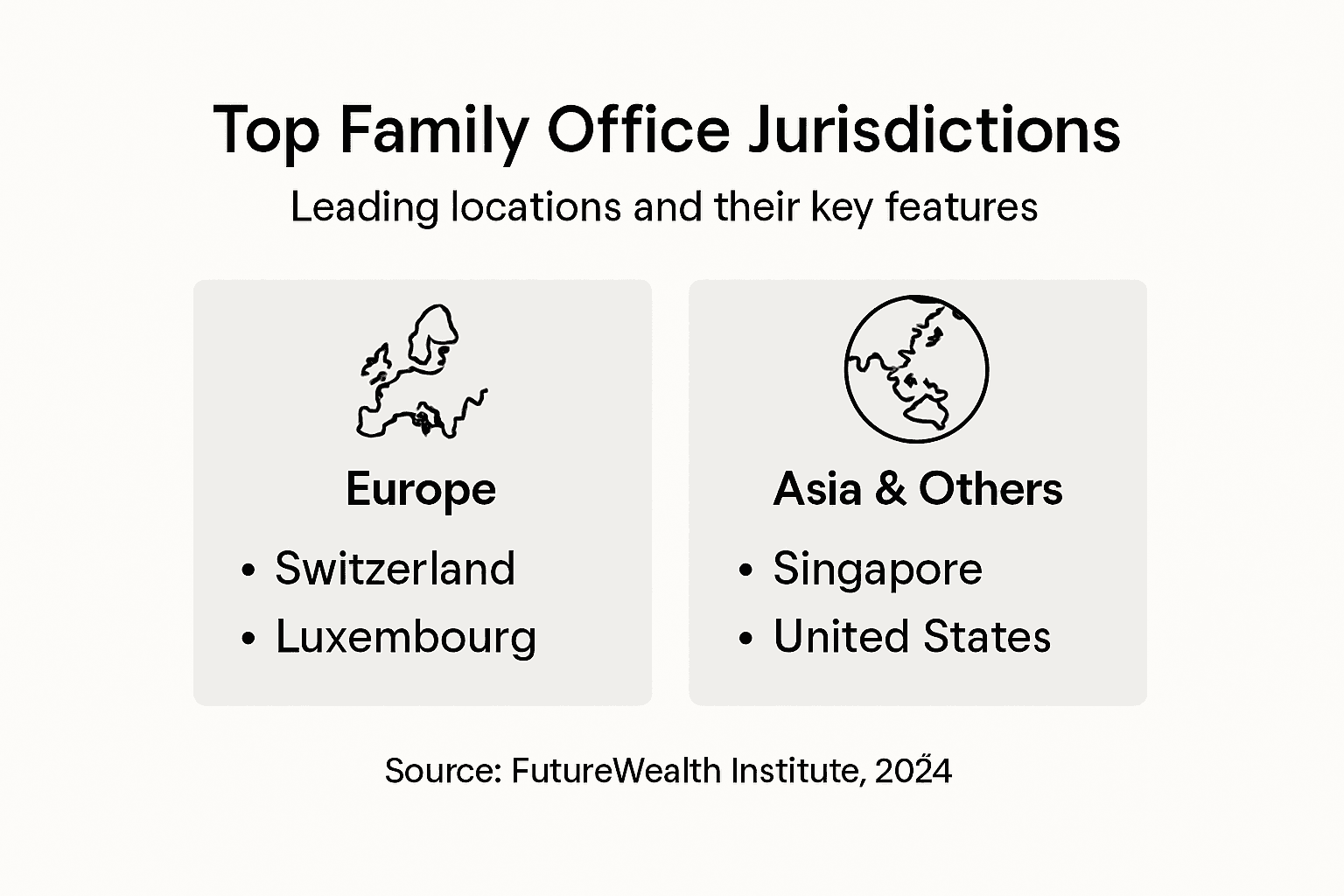
Key considerations for selecting a jurisdiction are outlined below:
| Factor | Why It Matters | Variations by Country |
|---|---|---|
| Regulatory Transparency | Ensures stable legal framework | US: rigorous, CH: predictable |
| Tax Efficiency | Impacts long-term wealth growth | SG: favorable, UK: evolving |
| Talent Pool | Supports office capabilities | LU: strong finance sector |
| Privacy and Asset Laws | Protects family confidentiality | CH: strict, US: moderate |
Pro tip: Conduct a comprehensive, multi-year jurisdictional analysis that goes beyond immediate tax considerations and evaluates long-term strategic alignment with your family office’s evolving goals.
Navigate Global Family Office Compliance With Confidence
Building a compliant global family office requires mastering complex regulatory frameworks, understanding multi-jurisdictional registration demands, and proactively managing disclosure and reporting risks. If you feel overwhelmed by evolving tax laws, documentation obligations, and operational transparency, you are not alone. The challenge is to create a comprehensive, flexible governance structure that balances privacy, compliance, and strategic growth for your family’s legacy.

Unlock access to expert insights, specialized service providers, and a vibrant network of global family offices at Future Family Office. Our platform is designed to help ultrahighnetworth families and their advisors streamline compliance, share knowledge on investment and regulatory trends, and connect with trusted professionals who understand the nuances of jurisdictions like the United States, Switzerland, and Singapore. Visit Future Family Office today and take the next step toward securing your family’s wealth with confidence and clarity.
Frequently Asked Questions
What is a global family office?
A global family office is a sophisticated platform designed to manage wealth, legacy, and family interests across international boundaries, integrating financial strategy with broader family objectives.
What are the key components of a global family office structure?
The typical structure includes investment management, risk assessment, wealth preservation, philanthropic planning, legal and tax advisory, and next-generation education.
What are the regulatory frameworks governing family offices?
Global family office registration involves compliance with various international regulatory requirements, which include registration necessities, tax reporting, investment disclosures, and anti-money laundering (AML) obligations.
What common risks do family offices face regarding compliance?
Common compliance risks for family offices include inadequate staff training, outdated technology, inconsistent documentation practices, and failure to adapt to changing regulatory environments.
Recommended
- Family Office Compliance Essentials for 2025 – Future Family Office
- Family Office Compliance Checklist for Effective Risk Management – Future Family Office
- 7 Essential Family Office Compliance Tips for Executives – Future Family Office
- Governance in Family Offices: Complete Guide for 2025 – Future Family Office