

Family offices have, for the first time, placed a majority of their assets in alternative investments, according to research from BNY Wealth.
BNY Wealth’s 2026 Investment Insights for Single Family Offices, produced with The Harris Poll and now in its third year, surveyed investment decision-makers at 290 single family offices with at least $250 million in assets under management. The online survey ran from 5 January to 3 February 2026. Respondents were split almost evenly between the US (51%) and other countries (49%), and 46% are responsible for more than $1 billion in assets, up from 34% last year.
Alternatives take the lead
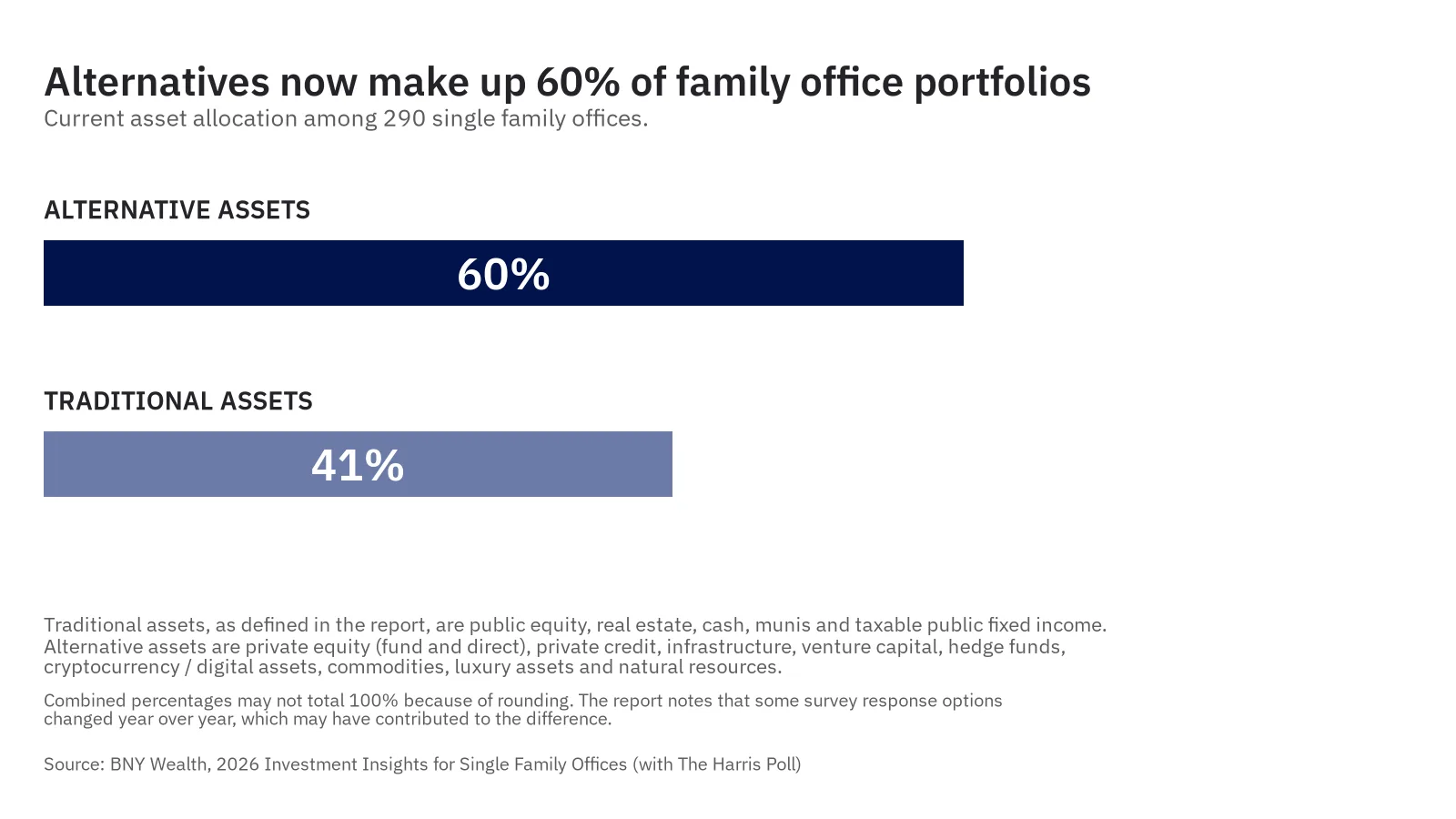
Allocations to alternatives have risen 12 percentage points over the past year to 60%, surpassing traditional assets, which stand at 41%. Combined figures may not total 100% because of rounding, and the report notes that some survey response options changed year over year, which may have contributed to the difference.
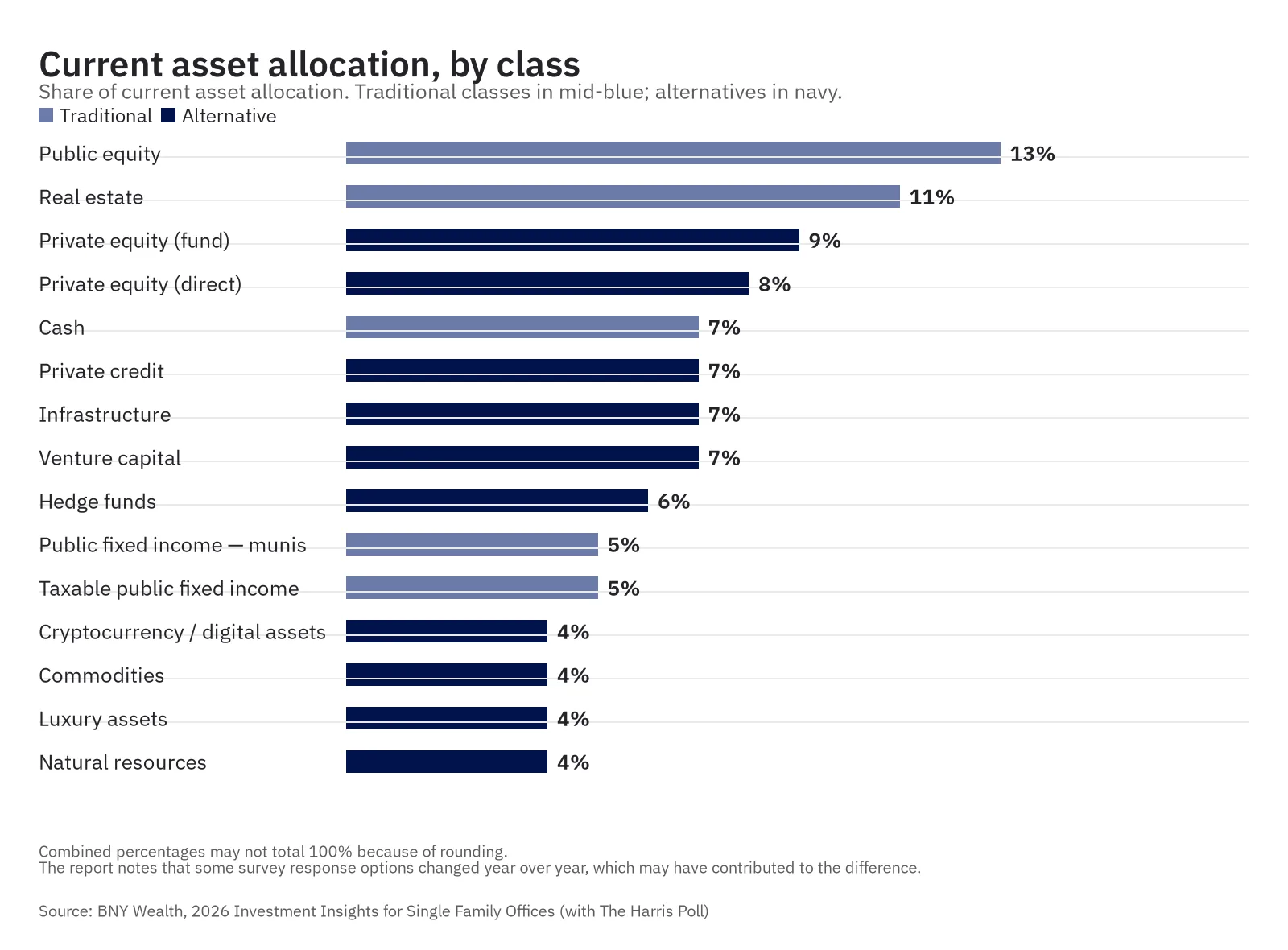
Public equity remains the single largest holding, but accounts for only 13% of portfolios, followed by real estate at 11%. Within alternatives, private equity funds account for 9%, direct private equity 8%, and private credit, infrastructure and venture capital 7% each. Venture capital allocations rose 40% year over year to 7% of portfolios.
Infrastructure rises up the agenda
Infrastructure is the top investment priority for the coming 12 months. Some 56% of family offices plan to increase their exposure, a shift the report ties to the global build-out of artificial intelligence (AI) data centres, power systems and semiconductor capacity. Private equity remains the leading asset class over the next five years, with infrastructure moving into second place.
Private credit is also gaining ground. The share of family offices selecting it as a top asset class over the next five years rose 46%, or 11 percentage points. Among non-US offices, allocations now almost match real estate, at 8% versus 9%. The report cautions that private credit’s return profile partly reflects an illiquidity premium, highlighted in early 2026 by heightened redemptions at some semi-liquid funds.
For the year ahead in private markets, growth equity remains the leading priority. Non-US offices put more weight on infrastructure and buyouts than their US peers.
| Private-market priority | Global | US | All other countries |
|---|---|---|---|
| Private equity — growth equity | 40% | 42% | 38% |
| Private infrastructure | 15% | 9% | 21% |
| Private equity (buyout) | 14% | 9% | 20% |
| Private credit | 13% | 15% | 11% |
| Private real estate | 12% | 16% | 8% |
| Do not intend to prioritise any of these | 6% | 9% | 2% |
Direct investing keeps its momentum
Direct investing remains a priority. Some 51% of family offices report making six or more direct investments in the past year, and 56% plan to do so over the coming 12 months. The leading challenge, identified by 48% of respondents, is that the work is time-consuming.
| Number of direct investments | Past year | Coming 12 months |
|---|---|---|
| 1–5 | 46% | 41% |
| 6–10 | 43% | 41% |
| 11 or more | 8% | 15% |
AI shapes both portfolios and operations
For the third year running, AI is ranked the most interesting investment theme for the next five years, cited by 68% of respondents, although that share is 15 percentage points lower than a year earlier as other themes, including healthcare, gain ground.
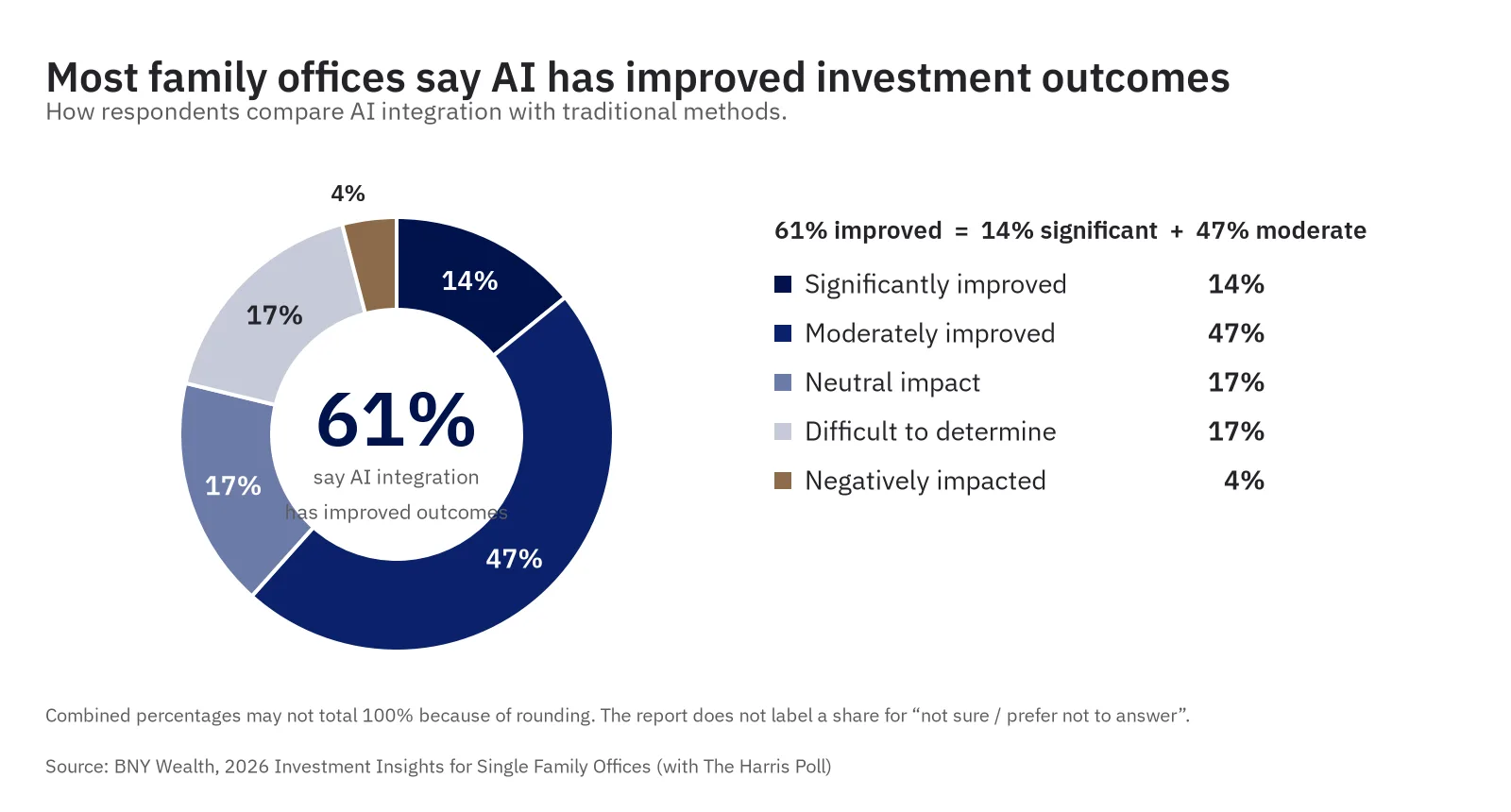
AI is also moving into day-to-day work. Fifty-one percent of decision-makers use data analytics and predictive modelling, often augmented by AI, in their investment process. A clear majority (61%) say AI integration has improved investment outcomes, including 14% who report a significant improvement and 47% a moderate one. Only 8% say AI is extensively integrated into investment decision-making; 40% have integrated it experimentally and 29% have done so for specific asset classes or decisions. The most common uses already in place or being piloted are reporting automation and investment research (each 72%), followed by market insights (71%) and portfolio analytics (70%).
Inflation remains the main concern
Inflation is still the leading perceived threat over the next five years, alongside concern about central bank policy mistakes. Nearly two-thirds (62%) of investors report holding assets uncorrelated to their broader investment programme — almost double the 37% recorded 12 months earlier — including luxury holdings such as jewellery and fine art. Digital assets have also become more widely accepted: 83% of family offices report involvement or interest in cryptocurrency, up from 74% last year, although the share planning to increase exposure has fallen 24 percentage points, to 51%.
The findings portray family offices widening the range of assets they hold and beginning to apply AI more systematically, while remaining alert to inflation and the practical limits of less liquid markets.
Source: BNY Wealth.