

Most American family businesses do not survive beyond the second generation, with only about 30 percent making it that far. This reality highlights just how challenging transition dynamics can be as families pass leadership to the next generation. Understanding the unique blend of emotional ties and business strategy at play offers a crucial edge for those aiming to protect their family’s legacy and long-term wealth.
Table of Contents
- Defining Family Business Transition Dynamics
- Types of Transitions and Common Scenarios
- Succession Planning and Leadership Selection
- Legal Structures and Governance Mechanisms
- Financial, Tax, and Emotional Impacts
- Mistakes to Avoid in Business Succession
Key Takeaways
| Point | Details |
|---|---|
| Effective Transition Planning | Create a multi-generational transition roadmap at least 5-7 years before leadership changes to minimize conflicts and ensure continuity. |
| Strategic Leadership Development | Implement structured mentorship programs to prepare future leaders by aligning their skills with the family’s business philosophy. |
| Holistic Assessment Approach | Use comprehensive evaluations that balance technical and emotional intelligence to choose successors effectively. |
| Legal and Governance Frameworks | Develop a family governance charter to clarify roles and decision-making, ensuring better management of transitions and family dynamics. |
Defining Family Business Transition Dynamics
Family business transition represents a complex, multifaceted process where ownership, management, and strategic leadership shift between generations. More than a simple leadership handover, this transition involves intricate dynamics that can profoundly impact the organization’s long-term sustainability and wealth preservation.
According to KPMG’s comprehensive report on family business dynamics, successful transitions require understanding the unique interplay between family systems and business operations. The process demands strategic planning that goes beyond traditional succession models, recognizing that family relationships, emotional connections, and individual aspirations significantly influence organizational continuity.
The core components of effective family business transitions typically include several critical elements:
- Comprehensive leadership development
- Clear governance structures
- Transparent communication protocols
- Robust financial and strategic planning
- Alignment of individual family member goals with organizational objectives
These transitions are rarely linear or predictable. They require sophisticated approaches that balance emotional intelligence with strategic business acumen. Family members must navigate complex interpersonal dynamics while simultaneously maintaining professional performance standards and long-term economic objectives.
Pro Strategic Planning Tip: Create a multi-generational transition roadmap at least 5-7 years before anticipated leadership changes, involving all potential stakeholders in collaborative strategic discussions to minimize potential conflicts and ensure smooth organizational continuity.
Pro Leadership Development Tip: Implement structured mentorship and professional development programs that prepare next-generation leaders with both technical skills and deep understanding of the family’s business philosophy and values.
Types of Transitions and Common Scenarios
Family business transitions encompass diverse scenarios that reflect the complex nature of generational leadership changes. Research from the Telfer School of Management outlines four fundamental transition strategies that capture the nuanced approaches families adopt when managing business continuity.
These primary transition strategies include:
- Rejuvenation: Revitalizing the existing business model through innovative approaches and next-generation perspectives
- Rebirth: Fundamentally transforming the business to adapt to changing market conditions
- Exit: Strategically selling or dissolving the business when continued operation is no longer viable
- Exaptation: Creatively repurposing existing business capabilities to enter new markets or industries
Scientific research on family business transitions reveals that successful intergenerational transfers depend on multiple interconnected factors. These include clear communication, well-defined governance structures, alignment of family values with business objectives, and a structured approach to leadership development.
Each transition scenario presents unique challenges. Some families maintain strict hereditary succession models, while others prioritize meritocratic selection based on individual capabilities. External factors like market volatility, technological disruption, and economic shifts further complicate these transitions, requiring adaptive strategies and comprehensive planning.
The following table compares the four primary family business transition strategies to help clarify their approaches and potential outcomes:
| Transition Strategy | Core Approach | Potential Benefit | Main Challenge |
|---|---|---|---|
| Rejuvenation | Modernizes business model | Drives innovation | May face resistance to change |
| Rebirth | Transforms business fundamentally | Adapts to new markets | Risk of cultural disruption |
| Exit | Sells or dissolves business | Maximizes short-term value | Ends family legacy |
| Exaptation | Repurposes business assets | Opens new opportunities | Needs flexible mindset |
Pro Strategic Evaluation Tip: Conduct comprehensive skills assessments of potential successors, mapping their competencies against the business’s future strategic requirements to ensure the most capable family member assumes leadership.
Pro Transition Planning Tip: Develop a flexible transition framework that allows for multiple scenarios, recognizing that no single approach guarantees success in every family business context.
Succession Planning and Leadership Selection
Succession planning in family businesses is a sophisticated process that extends far beyond simple leadership replacement. Research examining family governance mechanisms reveals that structured frameworks are critical for navigating the complex dynamics of intergenerational leadership transitions.
Effective leadership selection involves several key strategic considerations:
- Objective assessment of potential successors’ skills and capabilities
- Alignment of individual talents with organizational strategic objectives
- Comprehensive understanding of both technical competencies and emotional intelligence
- Recognition of individual family members’ unique strengths and potential
- Balanced approach between merit-based selection and family relationship dynamics
Case studies from family business transition research demonstrate that successful succession goes beyond technical qualifications. Cultural factors, family dynamics, personal motivations, and individual leadership potential play equally significant roles in determining effective leadership transitions.

The selection process requires a holistic approach that balances emotional intelligence, strategic thinking, and deep understanding of the family’s business philosophy. Potential leaders must demonstrate not just professional competence, but also a genuine commitment to the organization’s long-term vision and values. This multifaceted evaluation ensures that the selected successor can maintain the family business’s legacy while driving future innovation and growth.
Pro Leadership Evaluation Tip: Implement a comprehensive 360-degree assessment process that includes input from family members, current leadership, external advisors, and potential successors to ensure a thorough and unbiased leadership selection approach.
Pro Succession Strategy Tip: Develop a transparent, multi-year leadership development program that provides potential successors with structured opportunities to gain diverse experiences across different business functions and strategic roles.
Legal Structures and Governance Mechanisms
Comprehensive research on family business transitions reveals that legal structures and governance mechanisms are critical frameworks that determine the long-term sustainability and success of family enterprises. These intricate systems go beyond traditional corporate governance, addressing the unique intersection of family dynamics, business strategy, and legal compliance.
Key components of effective family business governance typically include:
- Clearly defined roles and responsibilities
- Transparent decision-making processes
- Conflict resolution mechanisms
- Equitable distribution of ownership and control
- Structured communication protocols
- Independent advisory board considerations
- Comprehensive succession planning frameworks
Research from the WIFU Foundation highlights that successful governance mechanisms must balance formal legal requirements with the emotional and interpersonal complexities inherent in family-owned enterprises. This requires developing flexible yet robust structures that can adapt to changing family and business circumstances while maintaining strategic continuity.
The most sophisticated governance models integrate multiple layers of complexity, including shareholder agreements, family constitutions, and carefully designed ownership transfer mechanisms. These frameworks must address potential scenarios such as divergent family member interests, varying levels of involvement in the business, and potential conflicts between family relationships and professional responsibilities.
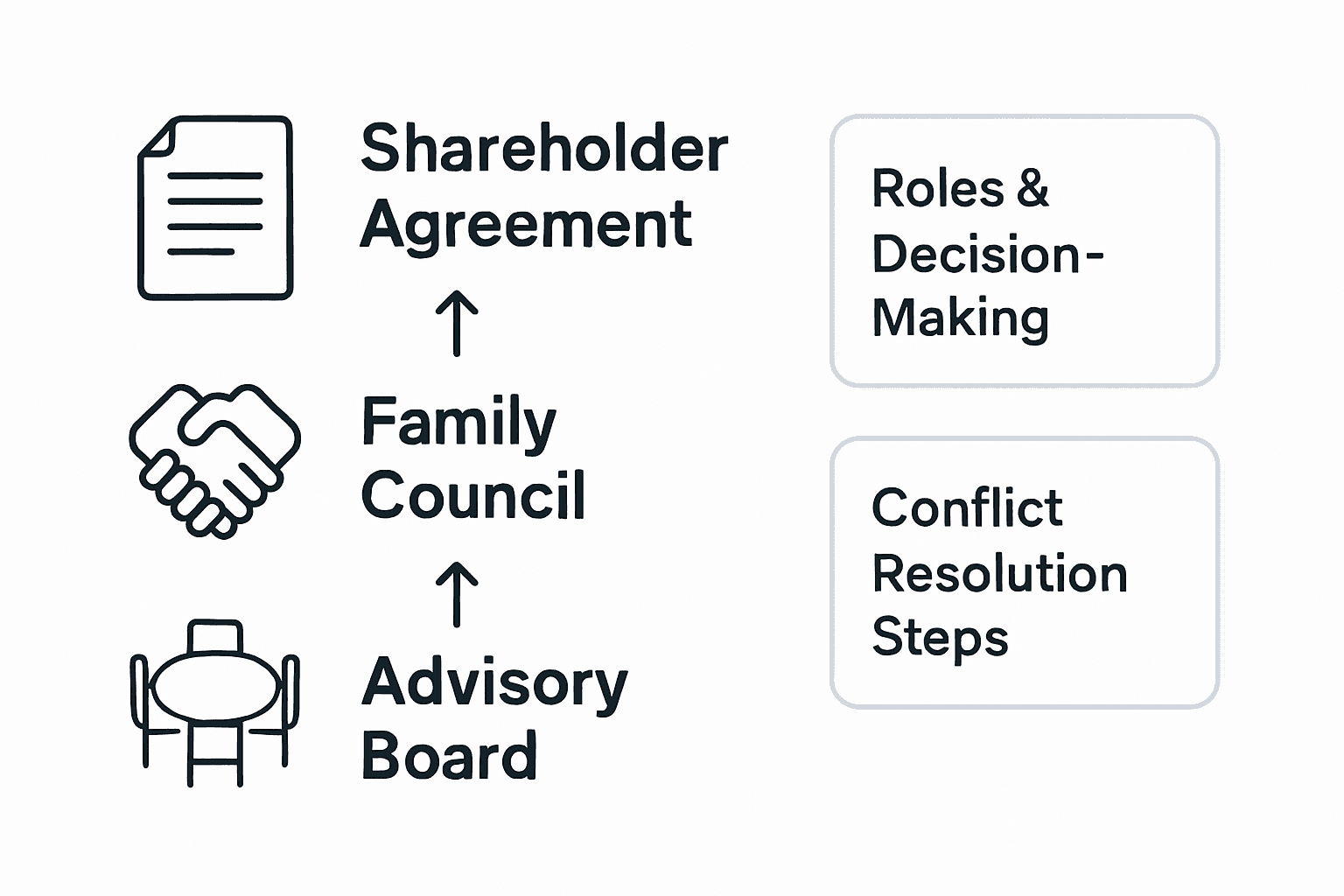
Pro Governance Design Tip: Create a comprehensive family governance charter that explicitly outlines roles, decision-making processes, and conflict resolution strategies, ensuring clarity and reducing potential future disputes.
Pro Legal Structuring Tip: Engage specialized legal and financial advisors who understand the nuanced dynamics of family businesses to design customized governance structures that protect both family harmony and business interests.
Here’s a summary table outlining key differences between governance mechanisms and succession planning in family businesses:
| Aspect | Governance Mechanisms | Succession Planning |
|---|---|---|
| Primary Purpose | Establish decision rules | Select next leader |
| Focus | Roles, conflict, ownership | Skills, values, vision |
| Stakeholder Involvement | All family members | Successors, advisors |
| Typical Time Horizon | Ongoing, long-term | 5-10 years before transition |
Financial, Tax, and Emotional Impacts
Research on family business dynamics reveals that family business transitions represent a complex intersection of financial, tax, and emotional challenges that extend far beyond simple financial calculations.
The multifaceted impacts of business transitions include:
- Financial Complexity: Managing wealth transfer, inheritance taxation, and investment restructuring
- Tax Implications: Navigating intricate tax strategies for minimizing liability
- Emotional Dynamics: Addressing psychological challenges of leadership change
- Interpersonal Relationships: Maintaining family cohesion during significant transitions
- Wealth Preservation: Protecting generational assets and long-term financial stability
Comprehensive studies on family business transitions demonstrate that emotional factors often carry equal or greater weight compared to financial considerations. Successful transitions require a holistic approach that balances technical financial planning with nuanced understanding of family relationship dynamics, individual aspirations, and potential emotional triggers.
The most effective transition strategies integrate sophisticated financial modeling with empathetic communication, recognizing that wealth transfer is fundamentally a human process involving trust, legacy, and shared family vision. This approach demands comprehensive planning that addresses potential conflicts, establishes clear expectations, and creates flexible frameworks adaptable to changing family and business circumstances.
Pro Financial Planning Tip: Develop a comprehensive transition strategy that includes both quantitative financial modeling and qualitative emotional intelligence assessments to create a holistic approach to wealth transfer.
Pro Emotional Management Tip: Create structured family communication protocols that provide transparent, respectful channels for discussing financial transitions, ensuring all stakeholders feel heard and valued throughout the process.
Mistakes to Avoid in Business Succession
Comprehensive succession planning research reveals that family businesses frequently encounter critical errors that can undermine their long-term sustainability and generational wealth transfer. Understanding these potential pitfalls is essential for developing robust transition strategies that protect both family dynamics and business continuity.
The most common and potentially destructive mistakes in business succession include:
- Lack of formal, documented succession planning
- Inadequate skills assessment of potential successors
- Ignoring emotional and psychological dimensions of leadership transition
- Failing to establish clear governance structures
- Avoiding difficult conversations about leadership expectations
- Overlooking professional development and training for next-generation leaders
- Neglecting tax and financial planning implications
Strategic insights from family business transition experts emphasize that successful transitions require a holistic approach that goes beyond technical considerations. The most critical mistake is treating succession as a singular event rather than a complex, multiyear process involving continuous communication, strategic planning, and intentional leadership development.
Effective succession planning demands a proactive, transparent approach that balances professional competence with emotional intelligence. Family businesses must create structured frameworks that allow for objective evaluation of potential leaders, provide clear pathways for professional growth, and maintain open channels of communication across generations. This requires a delicate balance of respecting family traditions while simultaneously embracing innovation and adaptability.
Pro Risk Mitigation Tip: Implement a comprehensive, multi-year succession assessment program that includes external professional evaluations, standardized performance metrics, and transparent feedback mechanisms for potential successors.
Pro Communication Strategy Tip: Establish regular family business forums that create safe spaces for discussing leadership transitions, allowing all stakeholders to express concerns, aspirations, and potential challenges openly and constructively.
Secure Your Family Business Legacy with Expert Support
Family business transitions bring complex challenges that blend emotional dynamics with strategic leadership changes. From succession planning to governance design, the stakes are high when protecting both legacy and wealth. If you are navigating this multifaceted process of leadership selection, managing intergenerational wealth, or crafting transparent governance structures, accessing trusted resources and expert connections is essential.

Discover how Future Family Office empowers families facing these exact challenges by offering a centralized platform for connections, insights, and service providers dedicated to family enterprise continuity. Explore our extensive directory and community tools to find specialized advisors who understand the nuances of family business transitions. Act now and gain the clarity and support needed to transform complexity into confident decision making. Begin your journey toward a smooth and successful transition by visiting Future Family Office today.
Frequently Asked Questions
What are the key components of a successful family business transition?
Successful family business transitions typically involve comprehensive leadership development, clear governance structures, transparent communication protocols, robust financial and strategic planning, and alignment of individual family member goals with organizational objectives.
How can emotional dynamics affect family business transitions?
Emotional dynamics can significantly impact leadership changes in family businesses. Addressing psychological challenges, maintaining family cohesion, and understanding individual aspirations are essential for ensuring a smooth transition and preserving the family legacy.
What are common mistakes to avoid in family business succession planning?
Common mistakes include lack of formal succession planning, inadequate assessment of potential successors’ skills, ignoring emotional dimensions, and failing to establish clear governance structures. Treating succession as a complex, multiyear process rather than a singular event is critical for success.
Why is governance important in family business transitions?
Governance structures are crucial in family businesses as they establish rules for decision-making, conflict resolution, and equitable distribution of ownership. Effective governance ensures clarity and reduces disputes, facilitating a smoother transition between generations.
Recommended
- The Essential Guide to Wealth Transfer Planning – Future Family Office
- Succession and wealth transfer in family businesses – Future Family Office
- Legacy Planning: Securing Wealth and Family Values – Future Family Office
- Optimize Your Wealth Transfer Planning Workflow Effectively – Future Family Office