

Multi-family offices (MFOs) in Canada rank cybersecurity as their biggest operational challenge, yet none plan to make it their next major technology investment, according to new research from Canadian Family Offices. Hiring and keeping the right talent comes second on their list of worries.
The findings come from the publication’s latest study, The Multi-Family Office Landscape in Canada 2026. It is based on a survey of 79 MFO representatives, who answered 24 questions about their firms’ characteristics, client wealth, investment allocations, top priorities and challenges, and revenue models. The response base is up from about 50 in 2024, when the survey was first launched, and for the first time the online responses were complemented by one-on-one interviews with MFO leaders. A multi-family office serves several wealthy families, rather than a single family, with investment, planning and wider family-wealth services.
The study also changed the way it asked about concerns. Earlier editions gauged how worried MFOs were about external factors, from tax policy to geopolitical turmoil, with tax policy the perennial top concern. This year the macro discussion was set aside, and respondents were asked instead about the most pressing challenges to their own operations and growth prospects, and about the most significant challenges facing their client families.
Cybersecurity: a gap between threat and response
MFO leaders were asked to rank nine issues on a scale from “not a concern” to “critical”, and the responses were converted into a weighted average on a five-point scale. Cybersecurity and data privacy infrastructure emerged as the top concern. The study says this is hardly surprising given the growing number of information breaches, tech outages and AI deepfakes, and the fact that more than one in five respondents said their office had been the target of a cyber incident over the past year. One MFO leader said their firm’s doors were being knocked on daily, apparently by hundreds of scammers.
| Rank | Most significant challenges for Canadian MFOs |
|---|---|
| 1 | Cybersecurity and data protection |
| 2 | Talent recruitment and retention |
| 3 | Scaling personalised service |
| 4 | Technology and reporting infrastructure cost |
Investment has not kept pace with the concern. Asked where they had made their most significant technology investments over the past two years, about 40% of MFOs cited cybersecurity and data protection technology, fifth out of seven areas, with AI-driven analytics and personalisation tools on top at 71%. Asked where they expect to make their next major technology investment for client service, none chose cybersecurity enhancement. AI came out on top again, at 44%.
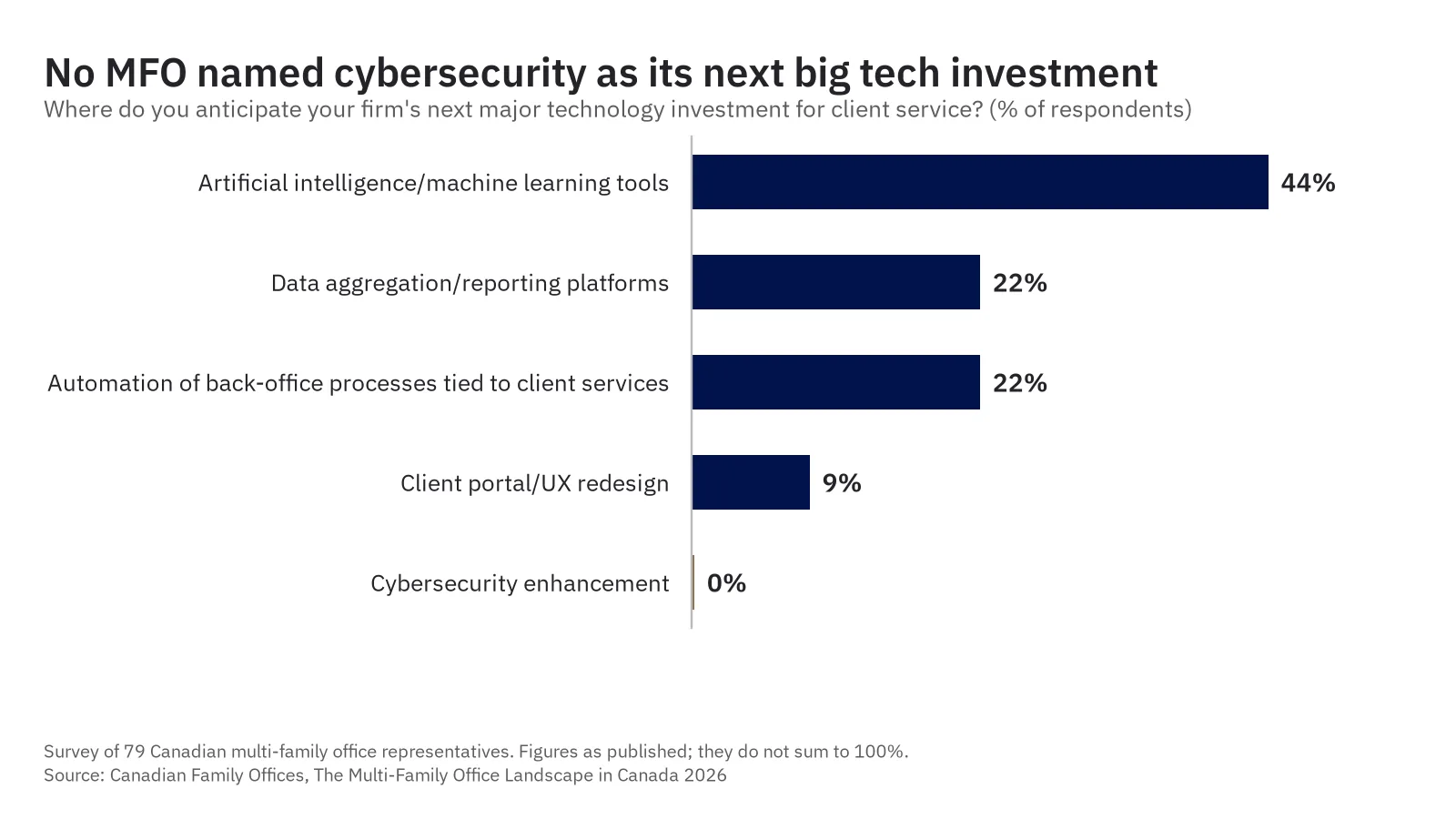
Given the severity of the threat, and the rapidly evolving capabilities of cyber criminals, fuelled in large part by AI, the study describes these levels of past and planned investment as remarkably low.
The talent crunch
Talent recruitment and retention ranked as the second most significant challenge, which the study calls something of a surprise. It came ahead of scaling personalised service, technology and reporting infrastructure costs, and fee and margin pressure. In interviews, several MFO leaders pointed to sharp competition from other financial services firms, especially for technical talent. One accounting-centric MFO noted that its young employees are perennially poached by the Big Five firms.
The challenge is also about finding the right mix of technical and people skills. MFO leaders said they look for employees who not only hold the right credentials, for instance in investment management, but who can also navigate family dynamics and communicate effectively across generations. One executive said their firm is particular about who it hires, because its people have to be very good with people and cannot simply be good technicians.
That selectivity is linked to the third-ranked challenge, scaling personalised service. As family offices grow, technical services are relatively easy to scale, but managing complex interactions and providing high levels of service become harder. One MFO leader said scaling service levels feeds into talent recruitment and retention: a high-touch approach works well with the right people, but candidates with skills across several different disciplines are very difficult to find.
The next generation tops family concerns
When MFOs were asked to identify the most significant of nine challenges facing their client families, the answers covered a wide range, but the top responses shared one characteristic: they all relate to intergenerational family dynamics and the next generation. Preparing the next generation to take on the responsibilities of family wealth was cited as the most pressing challenge, and the top five also included intergenerational wealth transfer, estate and trust planning, and business succession.
| Rank | Most significant challenges facing MFO client families |
|---|---|
| 1 | Preparing the next generation |
| 2 | Intergenerational wealth transfer and succession |
| 3 | Estate and trust planning |
| 4 | Business succession or liquidity events |
| 5 | Family governance and decision-making |
| 6 | Cross-border/US person exposure |
| 7 | Tax complexity/changing tax policy |
| 8 | Privacy, security and reputation management |
| 9 | Philanthropy and legacy planning |
The study notes that a lack of planning for succession and next-generation preparation is a common finding even in surveys of single-family offices, pointing to UBS’s most recent Global Family Office Report, and that its own results may imply a similar need among MFO client families. In interviews, MFO leaders said many families are unprepared for the conversations needed on next-generation readiness and the transfer of wealth and control. While every family is different, one executive said, these discussions tend to happen later rather than sooner.
MFOs are working to address the need. Family governance and education was the service most often offered in-house, by 78% of respondents, followed closely by estate and succession planning. More than 90% of the MFOs surveyed offer these services either in-house or on an outsourced basis, a higher share than offer investment management and advisory.
The full study also covers MFO staffing, client family wealth, assets under management and administration, revenue models, services offered and investment allocations. Canadian Family Offices says the results are intended to be directional rather than definitive, and aim to round out understanding of Canadian MFOs, a part of the family office landscape that is often overlooked in industry research.
Source: Canadian Family Offices.