


Most American family offices now control more than half of all private wealth in North America, yet even experienced global investors face challenges when pinpointing the right niche opportunities. In a world where market uncertainty and complex dynamics shape every decision, defining a clear investment path becomes crucial. Uncover strategies that equip you to assess risk, align family objectives, and make informed choices that foster sustainable long-term growth across generations.
Table of Contents
- Step 1: Define Investment Objectives And Risk Profile
- Step 2: Gather Essential Financial And Market Data
- Step 3: Conduct Thorough Due Diligence And Analysis
- Step 4: Assess Alignment With Long-Term Goals
- Step 5: Verify Investment Quality And Make Decisions
Quick Summary
| Main Insight | Explanation |
|---|---|
| 1. Define clear investment goals | Establish specific financial goals and risk profiles to guide all investment strategies and decisions. |
| 2. Gather extensive market data | Utilize a systematic approach to compile financial and market data for informed investment opportunities. |
| 3. Conduct thorough due diligence | Evaluate potential investments meticulously, considering both quantitative and qualitative factors. |
| 4. Align investments with family values | Assess potential investments against the family’s long-term goals and core values for better coherence. |
| 5. Verify quality and create decision protocols | Develop structured evaluation protocols for investment decisions to ensure consistency and transparency. |
Step 1: Define investment objectives and risk profile
Defining your family office’s investment objectives and risk profile is a foundational step that determines your entire investment strategy. This process involves comprehensively understanding the financial goals, risk tolerance, and long-term vision of the family wealth.
Start by conducting a detailed assessment of your family’s financial characteristics, including current wealth position, generational wealth transfer goals, and specific return expectations. Investment management best practices emphasize the importance of aligning these characteristics with robust governance structures that can adapt to changing market conditions. Consider creating a comprehensive questionnaire that captures key dimensions such as liquidity needs, investment time horizons, risk appetite, and specific sector or geographic preferences.
The risk profiling process requires a nuanced approach that goes beyond traditional risk assessment models. Evaluate not just financial risk tolerance but also the family’s philosophical stance on investments, including ethical considerations, sustainability goals, and potential legacy impacts. Map out different risk scenarios to understand potential portfolio performance under various economic conditions, ensuring your investment strategy provides both growth potential and downside protection.
Pro tip: Conduct periodic family meetings to reassess investment objectives and update your risk profile, recognizing that financial goals and risk tolerance can shift with changing family dynamics and broader economic landscapes.
Step 2: Gather essential financial and market data
Gathering comprehensive financial and market data is a critical step in developing a robust investment strategy for your family office. This process involves collecting and analyzing a wide range of information that will inform your investment decision-making and help you identify potential opportunities.
Begin by establishing a systematic approach to total portfolio data collection that covers multiple dimensions of market intelligence. This includes macroeconomic indicators, sector performance reports, global market trends, financial statements of potential investment targets, economic forecasts, and geopolitical risk assessments. Leverage multiple data sources such as financial databases, market research platforms, economic publications, and specialized investment research services to ensure comprehensive coverage. Pay particular attention to gathering granular data that reveals not just surface-level market movements but underlying trends and potential future developments.
Develop a robust data management system that allows for real-time tracking and analysis of your collected information. Implement advanced data visualization tools and analytics platforms that can help you transform raw data into actionable insights. Consider creating customized dashboards that provide a holistic view of your investment landscape, enabling quick identification of emerging opportunities and potential risks across different asset classes and geographic regions.
Here is a comparison of critical data sources for family office investment analysis:
| Data Source Type | Main Benefit | Typical Use Case |
|---|---|---|
| Financial Databases | Comprehensive historical information | Company financial analysis |
| Market Research Platforms | Industry trend identification | Sector performance assessments |
| Economic Publications | Macroeconomic context | Economic forecasting |
| Investment Research Firms | Deep-dive strategic insights | Specialized asset evaluation |
Pro tip: Invest in high-quality data subscription services and consider hiring a dedicated research analyst who can continuously monitor and interpret complex market information for your family office.
Step 3: Conduct thorough due diligence and analysis
Conducting comprehensive due diligence is a critical phase in the investment process for family offices. This step requires a meticulous and systematic approach to evaluating potential investment opportunities, ensuring that each potential investment meets your carefully defined criteria and risk parameters.

Implement a systematic investment review process that encompasses multiple layers of analysis. Begin by examining the financial fundamentals of potential investments, including historical performance, current financial statements, cash flow projections, and underlying business models. Conduct in-depth research into the management team, evaluating their track record, expertise, and alignment with your family office’s investment philosophy. Perform rigorous risk assessments that go beyond surface-level metrics, diving into potential regulatory challenges, market volatility, competitive landscape, and potential geopolitical risks that could impact the investment.
Establish a comprehensive due diligence framework that includes both quantitative and qualitative analysis. This means not just crunching numbers but also understanding the strategic positioning, innovation potential, and long-term sustainability of potential investments. Develop a standardized scorecard or evaluation matrix that allows for consistent and objective assessment across different investment opportunities. Engage external experts and specialists when necessary to provide independent insights, particularly for complex or specialized investment sectors that require deep domain expertise.
Pro tip: Create a dedicated due diligence checklist that covers financial, operational, legal, and strategic dimensions, ensuring no critical aspect of the potential investment is overlooked during your analysis.
Step 4: Assess alignment with long-term goals
Assessing the alignment of investment opportunities with your family office’s long-term goals is a nuanced process that requires deep strategic thinking and holistic evaluation. This critical step goes beyond immediate financial returns to ensure that potential investments support your broader family legacy, values, and intergenerational wealth objectives.
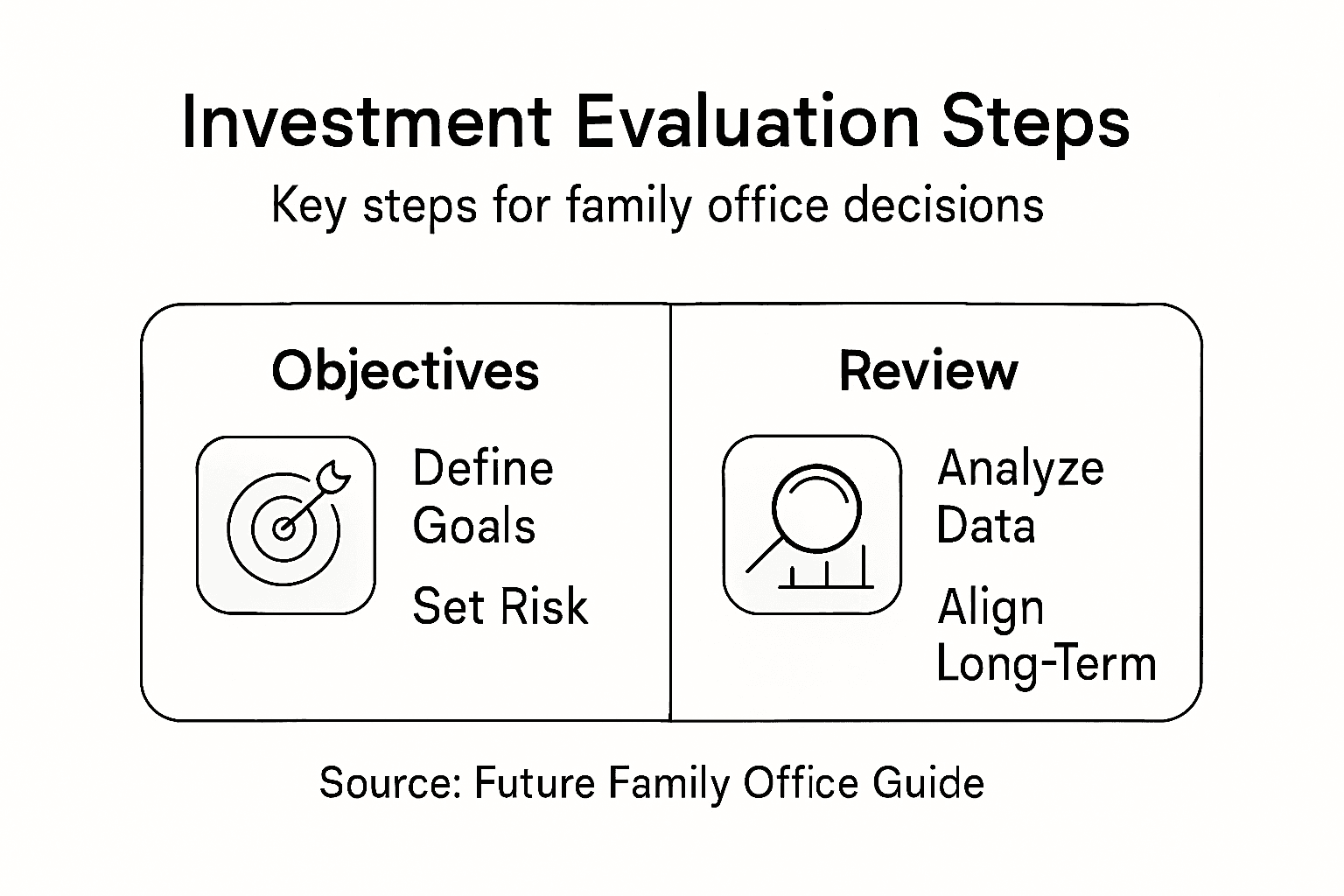
Begin by conducting a comprehensive review of your family’s core values, mission statement, and multi generational strategic vision. Create a detailed framework that maps potential investments against key strategic criteria such as financial performance, social impact, sustainability, innovation potential, and alignment with family values. Consider the broader implications of each investment not just in financial terms but in how they contribute to your family’s long-term prosperity, knowledge transfer, and potential for creating meaningful societal impact.
Develop a sophisticated decision matrix that allows for objective and comprehensive assessment of investment opportunities. This matrix should incorporate both quantitative metrics and qualitative considerations that reflect the unique characteristics of your family office. Include factors such as potential for generational wealth transfer, alignment with emerging technological trends, adaptability to changing economic landscapes, and the potential to create educational or entrepreneurial opportunities for future family generations. Regularly revisit and update this assessment framework to ensure it remains responsive to evolving family dynamics and broader economic shifts.
Below is a summary of key evaluation factors used in a family office investment decision matrix:
| Factor | Description | Long-Term Impact |
|---|---|---|
| Financial Performance | Projected returns and profitability | Supports wealth preservation |
| Strategic Alignment | Fit with family’s mission and values | Reinforces legacy objectives |
| Sustainability Potential | Environmental and social effects | Enhances future opportunities |
| Generational Wealth Transfer | Ability to benefit future generations | Secures intergenerational growth |
Pro tip: Schedule annual strategic planning sessions with key family stakeholders to realign investment strategies and ensure continuous coherence between individual investment decisions and overarching family goals.
Step 5: Verify investment quality and make decisions
Verifying investment quality and making strategic decisions represents the culmination of your comprehensive evaluation process for family office investment opportunities. This critical stage demands precision, objectivity, and a systematic approach to transforming your extensive research into actionable investment choices.
Implement a robust investment review workflow that incorporates multiple layers of rigorous assessment. Develop a comprehensive evaluation framework that includes detailed financial performance analysis, comprehensive risk assessment, compliance verification, and strategic alignment checks. Construct a multi tiered decision making process that involves independent review by different team members or external advisors, ensuring that no single perspective dominates the investment evaluation. Systematically score potential investments against predefined criteria, creating a transparent and objective methodology for comparing different opportunities.
Establish a structured decision making protocol that balances quantitative metrics with qualitative insights. This involves creating a sophisticated scoring system that assigns weighted values to different investment attributes such as financial performance, growth potential, risk profile, strategic alignment, and long term sustainability. Implement a decision matrix that allows for nuanced comparison across multiple dimensions, enabling your family office to make informed choices that go beyond simple financial return calculations. Build in mechanisms for ongoing monitoring and periodic reassessment, ensuring that your investment decisions remain adaptive and responsive to changing market conditions.
Pro tip: Create a standardized investment decision documentation template that captures all critical evaluation criteria, rationale, and potential risks to ensure transparency and facilitate future performance reviews.
Unlock Smarter Investment Decisions for Your Family Office
Evaluating investment opportunities requires precision and access to the right insights. This article explores key challenges like defining investment objectives, gathering essential financial data, and verifying investment quality. These critical steps highlight the need for transparency, real-time market knowledge, and strategic alignment to protect and grow your family wealth successfully.
Future Family Office is your trusted partner in overcoming these challenges. Our platform connects you with a global network of family offices, service providers, and industry experts. Gain access to curated resources, up-to-date market trends, and expert thought leadership that empower informed decision-making. By leveraging our comprehensive directory and community tools, you can streamline due diligence processes and ensure your investments align with your long-term goals.
Take action today to reinforce your family office strategy with unparalleled access and collaboration. Discover how to elevate your investment evaluation by visiting Future Family Office. Explore expert insights and connect with key players in the wealth management community through our online platform. Start your journey with the best in private wealth management at Future Family Office.

Unlock your family office’s full potential now by joining a dynamic network designed to support your unique investment challenges and ambitions.
Frequently Asked Questions
How can I define my family office’s investment objectives?
To define your family office’s investment objectives, start by assessing current financial goals, risk tolerance, and generational wealth transfer aspirations. Create a comprehensive questionnaire that addresses factors like liquidity needs, investment time horizons, and sector preferences to guide your strategy.
What kind of data should I gather for evaluating investment opportunities?
Gather comprehensive financial and market data, including macroeconomic indicators, sector performance reports, and potential investment targets’ financial statements. Establish a systematic approach to collect and analyze this data to identify opportunities and inform your investment decision-making.
What steps should I take for conducting due diligence on potential investments?
Conduct thorough due diligence by implementing a systematic investment review process that evaluates financial fundamentals, management teams, and potential risks. Create a checklist that covers financial, operational, legal, and strategic dimensions to ensure a comprehensive analysis.
How do I assess if an investment aligns with my family’s long-term goals?
Assess alignment by reviewing your family’s core values and strategic vision, then create a decision matrix to evaluate potential investments against these criteria. Ensure that each investment supports broader family objectives, like legacy preservation and intergenerational wealth transfer.
What processes should I follow to verify investment quality before making decisions?
To verify investment quality, develop an evaluation framework that includes financial analysis, risk assessments, and compliance checks. Use a multi-tiered decision-making protocol that balances quantitative metrics with qualitative insights to ensure informed investment choices.
How often should I reassess my investment strategy?
Reassess your investment strategy periodically, ideally through scheduled family meetings or strategic planning sessions. Make it a point to review and update your objectives and risk profile at least annually to remain aligned with changing family dynamics and market conditions.
Recommended
- What Is a Family Office? And Who Might Need One? – Future Family Office
- How to Evaluate Alternative Investments for Family Offices – Future Family Office
- Family Offices Take the Wheel in Private Investments – Future Family Office
- Beyond the Pitch Deck: What Family Offices Really Want to See – Future Family Office