

Most american family office executives now recognize that successful collaboration is no longer an option but a necessity. The rise of global partnerships means that wealth preservation depends on access to shared intelligence, joint investment opportunities, and trusted networks. More than 60 percent of ultra high net worth investors credit collaborative models for expanding deal flow and reducing risk exposure. This article explores how family office collaboration shapes resilient investment strategies and empowers smarter wealth management for the modern era.
Table of Contents
- Defining Family Office Collaboration Today
- Collaboration Models And Key Distinctions
- Strategic Benefits For UHNW Investors
- Enhancing Deal Sourcing And Due Diligence
- Managing Risks, Compliance, And Confidentiality
Key Takeaways
| Point | Details |
|---|---|
| Family Office Collaboration | Collaborative approaches among family offices enhance investment opportunities and operational effectiveness by pooling resources and expertise. |
| Collaboration Models | Different collaboration models exist such as informal networks and joint investment platforms, each suited for various strategic goals. |
| Benefits for UHNW Investors | Collaboration offers UHNW investors financial advantages, knowledge sharing, and improved risk management, creating more resilient investment ecosystems. |
| Risk Management and Compliance | Effective risk management, compliance strategies, and confidentiality frameworks are essential for successful collaborative environments in family offices. |
Defining Family Office Collaboration Today
Family office collaboration represents a strategic approach where private wealth management entities combine resources, insights, and networks to enhance collective investment opportunities and operational effectiveness. Unlike traditional financial models, this collaborative framework transforms how understanding family office structure creates mutually beneficial relationships across ultra high net worth (UHNW) investment ecosystems.
At its core, family office collaboration involves sophisticated knowledge sharing, joint investment strategies, and coordinated risk management. Successful collaborations often emerge through shared geographic regions, complementary investment philosophies, or aligned generational wealth transfer objectives. These partnerships enable smaller family offices to access larger deal flows, conduct more comprehensive due diligence, and mitigate individual investment risks by pooling expertise and capital.
The modern collaboration landscape encompasses multiple engagement models. Some family offices form informal networks through exclusive conferences and professional associations, while others establish more structured partnerships with defined governance frameworks. Technological platforms and secure communication channels have dramatically expanded collaboration possibilities, allowing global connections that transcend traditional geographic limitations. These digital ecosystems enable real-time information exchange, joint research initiatives, and coordinated investment strategies across international boundaries.
Pro tip: Develop a robust digital communication infrastructure and establish clear confidentiality protocols before initiating any collaborative investment strategies to protect each family office’s unique intellectual property and strategic interests.
Collaboration Models and Key Distinctions
Family offices have developed sophisticated collaboration models and strategic partnerships that transcend traditional investment approaches. These models range from informal networking arrangements to highly structured joint ventures, each designed to address specific strategic objectives within the ultra high net worth (UHNW) investment ecosystem. The complexity of these collaboration frameworks reflects the nuanced requirements of wealthy families seeking strategic advantages through collective knowledge and resource deployment.
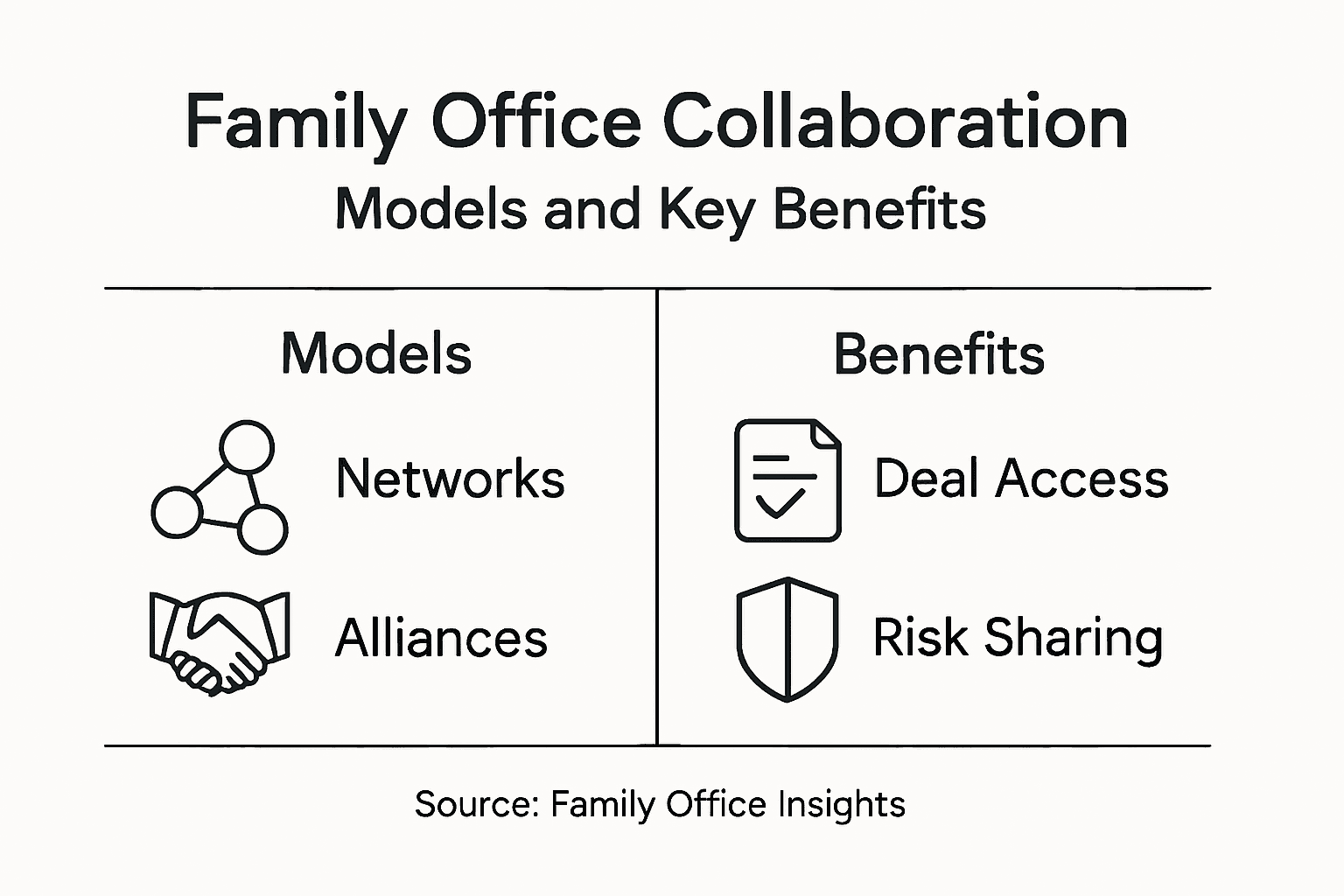
The primary collaboration models can be categorized into distinct typologies: informal networks, strategic alliances, joint investment platforms, and specialized consortiums. Informal networks typically involve knowledge sharing through exclusive conferences and professional associations, allowing family offices to exchange insights without formal commitments. Strategic alliances represent more structured partnerships with defined governance frameworks, often focusing on specific investment domains or geographic regions. Joint investment platforms enable collective capital deployment, allowing smaller family offices to access larger deal flows and conduct more comprehensive due diligence by pooling financial resources and expertise.
Technological advancements have significantly transformed collaboration dynamics, creating digital ecosystems that facilitate global connections and real-time information exchange. These platforms enable family offices to overcome traditional geographic limitations, establishing sophisticated communication channels that support secure, compliant, and efficient collaborative strategies. The evolution of these technological infrastructures has democratized access to investment opportunities, allowing family offices to create more flexible and adaptive partnership models that can rapidly respond to changing market conditions.
Here’s a comparison of collaboration models used by family offices:
| Collaboration Model | Structure Level | Typical Purpose | Key Communication Method |
|---|---|---|---|
| Informal Network | Low | Knowledge exchange, idea sharing | Private meetings, conferences |
| Strategic Alliance | Moderate | Focused investment or asset strategies | Regular calls, board meetings |
| Joint Investment Platform | High | Collective capital deployment | Collaborative digital platforms |
| Specialized Consortium | Very High | Access niche markets, leverage expertise | Custom-built secure systems |
Pro tip: Develop a comprehensive due diligence protocol that standardizes information sharing and establishes clear confidentiality boundaries before initiating any collaborative investment strategy.
Strategic Benefits for UHNW Investors
Ultra high net worth (UHNW) investors increasingly recognize collaboration as a transformative strategy for wealth management, with capital preservation strategies becoming increasingly sophisticated and interconnected. Collaborative approaches enable these investors to leverage collective intelligence, diversify investment risks, and access exclusive opportunities that would be challenging to pursue independently. By forming strategic partnerships, UHNW investors can create powerful synergies that extend beyond traditional investment methodologies, generating value through shared expertise and coordinated resource allocation.
The strategic benefits of collaboration for UHNW investors manifest across multiple dimensions. Financial advantages include expanded deal flow, reduced individual investment risks, and enhanced due diligence capabilities through pooled research resources. Intellectual benefits emerge from knowledge sharing, where family offices can exchange insights about emerging markets, technological innovations, and complex investment landscapes. These collaborative networks also provide access to specialized expertise across different investment domains, enabling more nuanced and comprehensive investment strategies that can adapt quickly to global economic shifts.

Beyond financial considerations, collaborative models offer UHNW investors significant qualitative advantages. These include improved governance frameworks, more robust risk management protocols, and opportunities for generational knowledge transfer. Collaborative platforms enable investors to develop more resilient investment ecosystems that can navigate complex global economic challenges. By creating flexible, interconnected networks, UHNW investors can maintain their competitive edge while simultaneously mitigating potential vulnerabilities associated with isolated investment approaches.
Pro tip: Develop a structured framework for evaluating potential collaborative partnerships, focusing on alignment of investment philosophies, complementary expertise, and clear communication protocols.
Enhancing Deal Sourcing and Due Diligence
Family offices are revolutionizing investment strategies through collaborative approaches to global family office deal sourcing. By pooling resources and expertise, these sophisticated investment entities can dramatically improve their ability to identify, evaluate, and secure high-potential investment opportunities. The traditional model of independent deal sourcing is rapidly giving way to more interconnected and intelligent approaches that leverage collective intelligence and shared market insights.
Collaborative deal sourcing provides multiple strategic advantages. Family offices can expand their investment networks beyond individual limitations, accessing deal flows that would otherwise remain unavailable. This approach enables more comprehensive market intelligence gathering, with each participating office contributing unique perspectives and research capabilities. The collective due diligence process becomes more robust, allowing for deeper analysis through combined expertise, more extensive background checks, and more nuanced risk assessments that draw from diverse professional experiences and specialized knowledge domains.
Technological platforms and secure communication channels have transformed how family offices collaborate on deal sourcing and due diligence. Digital ecosystems now enable real-time information sharing, sophisticated data analytics, and collaborative research tools that transcend traditional geographic and institutional boundaries. These advanced platforms facilitate rapid knowledge exchange, allowing family offices to conduct more comprehensive investment evaluations, identify emerging market trends more quickly, and make more informed investment decisions through aggregated insights and collective intelligence.
Pro tip: Develop a standardized due diligence framework that allows for seamless information sharing while maintaining strict confidentiality protocols among collaborative partners.
Managing Risks, Compliance, and Confidentiality
Family offices increasingly recognize the critical importance of managing risks, compliance, and confidentiality through sophisticated global family office governance mechanisms. The complexity of multi-jurisdictional wealth management demands robust frameworks that protect sensitive information while enabling strategic collaboration. Effective risk management has become a cornerstone of successful family office operations, requiring comprehensive approaches that balance transparency with stringent privacy protections.
Compliance strategies now encompass multilayered protocols that address technological, legal, and operational risks. Modern family offices implement advanced cybersecurity measures, including encrypted communication channels, secure data storage systems, and comprehensive staff training programs designed to prevent information breaches. These strategies extend beyond traditional security measures, incorporating sophisticated risk assessment methodologies that evaluate potential vulnerabilities across investment ecosystems, technological infrastructures, and collaborative networks.
Confidentiality remains paramount in collaborative family office environments. Successful partnerships develop intricate governance frameworks that establish clear boundaries for information sharing, utilizing technological solutions and legal agreements to protect each participant’s strategic interests. These frameworks often include detailed memorandums of understanding, strict non-disclosure agreements, and tiered access protocols that enable controlled information exchange while maintaining the highest standards of privacy and intellectual property protection.
Below is a summary of major risks and mitigation strategies for collaborative family office environments:
| Risk Type | Potential Impact | Common Mitigation Strategy |
|---|---|---|
| Data Breach | Loss of sensitive information | Encryption, regular audits |
| Regulatory Noncompliance | Legal penalties, reputational damage | Ongoing legal review, training |
| Partner Misalignment | Operational conflicts, failed ventures | Pre-collaboration due diligence |
| Confidentiality Breach | Loss of competitive advantage | Strict NDAs, tiered access |
Pro tip: Develop a comprehensive confidentiality framework that includes granular access controls, regular security audits, and mandatory training programs for all collaborative partners.
Unlock Powerful Collaboration with Future Family Office
The challenges of managing confidentiality, navigating complex compliance requirements, and accessing reliable deal flow are real pain points for family offices seeking strategic collaboration. This article highlights the critical need for robust governance, secure communication, and aligned investment philosophies to successfully partner across the ultra high net worth community. If you want to transform these challenges into growth opportunities, specialized platforms that connect you with vetted family offices and expert service providers are essential.

Discover a world where family office collaboration becomes simpler and more impactful. At Future Family Office, you can build your network, tap into exclusive investment insights, and access dedicated resources designed for professionals aiming to enhance deal sourcing and due diligence. Take control of your strategic partnerships today by visiting Future Family Office. Explore our comprehensive directory and community tools that support privacy-conscious collaboration and align with your long-term capital preservation goals. Start elevating your investment strategy now.
Frequently Asked Questions
What are the main reasons family offices choose to collaborate?
Family offices collaborate to leverage collective intelligence, diversify investment risks, access exclusive opportunities, and enhance governance and risk management through shared expertise and pooled resources.
How do family offices typically collaborate on investment strategies?
Family offices collaborate through various models, including informal networks, strategic alliances, joint investment platforms, and specialized consortiums, which allow them to share knowledge, conduct joint investments, and improve due diligence through pooled resources.
What technological tools facilitate collaboration among family offices?
Technological platforms and secure communication channels play a crucial role in facilitating collaboration by enabling real-time information exchange, digital data analytics, and coordinated investment strategies across geographic and institutional boundaries.
How do family offices manage risks during collaborations?
Family offices implement comprehensive risk management strategies that include advanced cybersecurity measures, compliance protocols, and strict confidentiality frameworks, ensuring that sensitive information remains protected while allowing for effective collaboration.
Recommended
- 3 Tips To Effectively Connect And Raise Investment From Family Offices. – Future Family Office
- 8 Trillion and Growing: The Evolution and Influence of Family Offices in the Investment World – Future Family Office
- Family Offices Take the Wheel in Private Investments – Future Family Office
- The Importance Of Separating Ownership And Management; 3 Steps To Get Families Started – Future Family Office
- 7 Essential Collaboration Tips for Leaders and Teams – Tariq Juneja