

More than 60 percent of American investors say managing multiple accounts causes unnecessary stress. With so many options and platforms, keeping track of your complete financial picture can seem impossible. Investment consolidation matters because it offers clarity and control that scattered holdings simply cannot deliver. Discover how a smarter approach to consolidating assets could reshape your decision making and set your investments on a path to better outcomes.
Table of Contents
- What Investment Consolidation Really Means
- Common Methods For Consolidating Investments
- Key Benefits For Family Offices And UHNW Investors
- Risks And Challenges Of Consolidating Portfolios
- Choosing Platforms And Service Providers Wisely
Key Takeaways
| Point | Details |
|---|---|
| Investment Consolidation Definition | It is a strategic process that organizes and manages investment portfolios for better clarity and optimized returns. |
| Key Strategies Involved | Consolidation involves reducing investment accounts, centralizing assets, and improving transparency to streamline management. |
| Benefits for UHNW Investors | Consolidated investments enhance risk management, operational efficiency, and strategic alignment with financial goals. |
| Risks and Challenges | Investors must navigate potential information asymmetry, concentration risks, and operational complexities when consolidating portfolios. |
What Investment Consolidation Really Means
Investment consolidation is far more than just clustering your financial assets into a single account. At its core, consolidation represents a strategic approach to organizing and managing your investment portfolio with precision and clarity. Sophisticated investors understand this process goes beyond mere simplification and enters the realm of comprehensive wealth management.
The fundamental goal of investment consolidation involves streamlining your financial holdings to gain enhanced visibility, reduce administrative complexity, and optimize potential returns. By centralizing investments across different asset classes, investors can develop a holistic view of their financial landscape. This approach allows for more nuanced decision making, better risk assessment, and improved alignment with long term financial objectives.
Typically, investment consolidation involves several key strategies:
- Reducing the number of investment accounts
- Centralizing assets under a single investment management platform
- Eliminating redundant or underperforming investment vehicles
- Creating a more transparent and manageable investment structure
- Minimizing unnecessary transaction costs and administrative fees
While the process might seem straightforward, investment consolidation requires careful planning and strategic execution. Investors must consider factors like tax implications, potential transaction costs, and the specific performance characteristics of each investment before making consolidation decisions. Professional wealth management advisors can provide critical guidance in navigating these complex considerations.
Pro Tip – Strategic Portfolio Assessment: Before consolidating, conduct a comprehensive review of your existing investments, analyzing their individual performance, correlation, and alignment with your overall financial goals to ensure a truly optimized investment strategy.
Common Methods for Consolidating Investments
Investment consolidation is a nuanced process requiring strategic planning and precise execution. Family offices and sophisticated investors employ multiple approaches to streamline their investment portfolios, each designed to address specific financial objectives and operational complexities. Wealth management intermediaries often manipulate information access during this process, making careful navigation essential.
The primary methods for consolidating investments typically include:
- Account Aggregation: Centralizing multiple investment accounts under a single management platform
- Portfolio Rebalancing: Systematically redistributing assets to maintain optimal risk and return profiles
- Custodial Consolidation: Transferring assets to a single financial institution for comprehensive oversight
- Digital Portfolio Management: Utilizing technology platforms that provide unified investment tracking
- Strategic Asset Allocation: Restructuring investments to align with long term financial goals
Unique consolidation strategies vary significantly across different contexts. Embedded family offices in Asia demonstrate how personal financial management can be integrated within business structures, presenting both opportunities and potential challenges for investment consolidation. This approach requires careful consideration of potential conflicts and operational inefficiencies.

Here’s a summary of how different investment consolidation methods impact efficiency and control:
| Consolidation Method | Efficiency Impact | Control Impact |
|---|---|---|
| Account Aggregation | Reduces account management time | Centralizes oversight |
| Portfolio Rebalancing | Optimizes resource allocation | Maintains risk levels |
| Custodial Consolidation | Streamlines reporting processes | Enhances asset monitoring |
| Digital Portfolio Management | Enables real-time tracking | Improves decision responsiveness |
Successful investment consolidation demands a holistic approach that balances simplification with strategic flexibility. Investors must remain adaptable, continuously evaluating their consolidated portfolio’s performance and making adjustments as market conditions and personal financial objectives evolve.
Pro Tip – Systematic Review: Conduct a comprehensive quarterly review of your consolidated investment portfolio, analyzing performance metrics, correlation between assets, and alignment with your evolving financial strategy to ensure ongoing optimization and risk management.
Key Benefits for Family Offices and UHNW Investors
Investment consolidation offers transformative advantages for family offices and ultra-high-net-worth (UHNW) investors seeking sophisticated wealth management strategies. By strategically unifying investment portfolios, these sophisticated financial entities can unlock unprecedented levels of control, transparency, and strategic flexibility. Family office software enhances wealth management through centralized platforms that provide efficient communication and robust data security, creating a comprehensive ecosystem for financial oversight.
The key benefits of investment consolidation for family offices and UHNW investors include:
- Enhanced Risk Management: Comprehensive visibility across investment portfolios
- Operational Efficiency: Reduced administrative complexity and streamlined reporting
- Strategic Alignment: Better integration of investment strategies with long term objectives
- Cost Optimization: Minimizing redundant fees and transaction expenses
- Advanced Performance Tracking: Real time insights and comprehensive analytics
Beyond operational advantages, investment consolidation enables more nuanced financial decision making. By breaking down traditional investment silos, family offices can develop more holistic approaches to wealth preservation and growth. This integrated methodology allows for more sophisticated asset allocation, dynamic risk assessment, and proactive portfolio management strategies that adapt quickly to changing market conditions.
UHNW investment strategies increasingly depend on comprehensive, integrated financial frameworks that transcend traditional investment management models. The ability to consolidate investments provides these sophisticated investors with unprecedented levels of control, enabling more precise wealth engineering and legacy planning approaches.
Pro Tip – Strategic Consolidation: Develop a comprehensive mapping of your current investment ecosystem before consolidation, identifying potential synergies, redundancies, and strategic opportunities to maximize the effectiveness of your integrated investment approach.
Risks and Challenges of Consolidating Portfolios
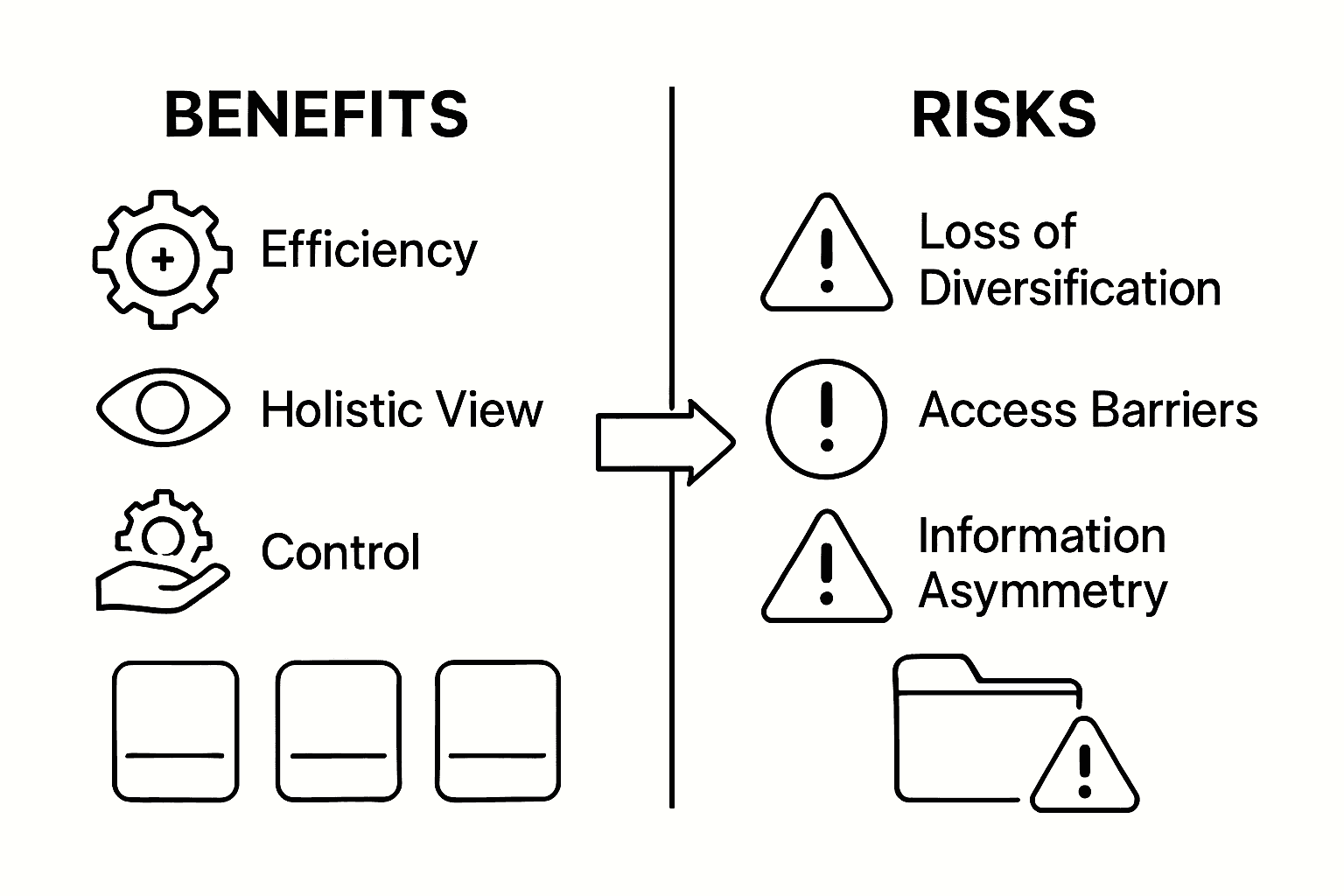
Investment portfolio consolidation, while strategically powerful, presents a complex landscape of potential risks and challenges that sophisticated investors must carefully navigate. Commingling personal and business wealth can create significant financial vulnerabilities, undermining the very stability these investors seek to achieve through consolidation strategies.
The primary risks associated with investment portfolio consolidation include:
- Information Asymmetry: Potential loss of diversified knowledge sources
- Concentration Risk: Overexposure to specific market sectors or investment strategies
- Operational Complexity: Increased administrative and compliance challenges
- Reduced Flexibility: Potential limitations in rapid asset reallocation
- Technology Integration Challenges: Potential data migration and system compatibility issues
Wealth management intermediaries often manipulate information channels, creating artificial scarcity and selective disclosure that can significantly impact investment decision making. This systematic information control represents a profound challenge for investors attempting to consolidate their portfolios with maximum transparency and effectiveness.
Successful portfolio consolidation demands a nuanced approach that balances strategic integration with maintaining sufficient investment diversification. Investors must develop robust risk management frameworks that account for potential systemic vulnerabilities, ensuring that consolidation enhances rather than compromises overall financial resilience.
Pro Tip – Risk Mitigation Strategy: Implement a comprehensive due diligence process that systematically evaluates potential consolidation risks, including thorough technological compatibility assessments, comprehensive compliance reviews, and detailed scenario planning before executing portfolio integration.
Choosing Platforms and Service Providers Wisely
Selecting the right platforms and service providers represents a critical strategic decision for family offices and sophisticated investors pursuing comprehensive investment consolidation. Family offices must address increasingly complex operational challenges that demand modernized technological solutions, requiring a methodical and rigorous selection process that goes far beyond surface level evaluations.
Critical factors to consider when evaluating investment platforms and service providers include:
- Technological Infrastructure: Advanced integration capabilities and scalable architecture
- Data Security: Robust protection protocols and comprehensive compliance frameworks
- Reporting Capabilities: Sophisticated analytics and customizable reporting tools
- Operational Flexibility: Adaptable systems that can evolve with changing investment strategies
- Cost Structure: Transparent pricing models with clear value proposition
Traditional asset pricing models and legacy systems frequently create significant barriers to selecting appropriate investment platforms, limiting investors’ ability to implement sophisticated consolidation strategies. Sophisticated family offices must look beyond marketing materials and conduct comprehensive due diligence that evaluates technological capabilities, integration potential, and long term strategic alignment.
Successful platform selection requires a holistic approach that balances technological sophistication with practical usability. Investors should prioritize solutions offering comprehensive integration capabilities, advanced security protocols, and flexible reporting mechanisms that can adapt to increasingly complex investment ecosystems.
The table below highlights important considerations when choosing an investment platform or service provider:
| Evaluation Factor | Why It Matters | Example Consideration |
|---|---|---|
| Technological Fit | Supports smooth integration and scalability | Can handle varied asset classes |
| Data Security | Safeguards sensitive financial information | Follows top encryption standards |
| Reporting Quality | Allows clear, actionable investment insights | Customizable analytics dashboards |
| Cost Transparency | Avoids hidden fees and unexpected charges | Provides full fee breakdown |
Pro Tip – Strategic Evaluation Framework: Develop a structured scoring matrix that objectively assesses potential platforms across multiple dimensions, including technological capabilities, security protocols, integration potential, and alignment with your specific investment philosophy and operational requirements.
Take Control of Your Wealth with Strategic Investment Consolidation
The challenge of unifying diverse investments into a cohesive portfolio is a pivotal step toward unlocking greater financial clarity and control. As the article explores, investment consolidation is not just about simplification but about enhancing risk management, streamlining operations, and aligning strategies with your long-term goals. Sophisticated investors like family offices and ultra-high-net-worth individuals face complex decisions around technological integration, cost optimization, and maintaining flexibility amidst market changes.
At Future Family Office, we understand these critical needs. Our platform offers a comprehensive ecosystem designed to empower you through transparent access to top-tier service providers, cutting-edge family office software solutions, and curated expert insights. By connecting you with a global community dedicated to effective wealth oversight, you gain the tools to refine your consolidation strategy and mitigate risks.

Discover how consolidating your investments can redefine your financial future. Visit Future Family Office now to explore our directory of service providers and access thought leadership articles that help you execute consolidation with confidence. Start your journey to greater control, transparency, and strategic flexibility today.
Frequently Asked Questions
What are the main benefits of consolidating investments?
Investment consolidation offers enhanced risk management, operational efficiency, strategic alignment, cost optimization, and advanced performance tracking, allowing for a more comprehensive view of your financial landscape.
How does investment consolidation improve decision-making?
By centralizing investments, investors gain a holistic view of their financial situation, facilitating nuanced decision-making, better risk assessment, and alignment with long-term financial objectives.
What are the common methods for consolidating investments?
Common methods include account aggregation, portfolio rebalancing, custodial consolidation, digital portfolio management, and strategic asset allocation, each tailored to meet specific financial goals.
What risks should I consider before consolidating my investment portfolio?
Investors should be aware of risks such as information asymmetry, concentration risk, operational complexity, reduced flexibility, and potential technology integration challenges before proceeding with consolidation.
Recommended
- Portfolio Diversification Step by Step for Smarter Investing – Future Family Office
- Mastering the Portfolio Diversification Workflow for Success – Future Family Office
- Why Diversify Assets: Complete Guide for Investors – Future Family Office
- Greater than the sum of their parts – Future Family Office