

More than 60 percent of American family office executives cite transparency as their top challenge in wealth management. As global families diversify assets and navigate complex regulations, clear communication becomes vital for risk mitigation and sustained trust. This overview breaks down the current standards, revealing how strategic transparency not only meets compliance pressures but also reinforces relationships across generations, safeguarding your legacy with informed, well-aligned decision making.
Table of Contents
- Transparency In Family Offices Defined Clearly
- Levels And Forms Of Transparency In Practice
- Trust, Governance, And Stakeholder Alignment
- Regulatory Pressures And Compliance Risks
- Common Transparency Pitfalls To Avoid
Key Takeaways
| Point | Details |
|---|---|
| Importance of Transparency | Clear and consistent communication about wealth management enhances trust among family members and stakeholders. |
| Diverse Transparency Levels | Family offices should adopt a multi-layered approach to transparency tailored to different stakeholders, balancing information sharing with confidentiality. |
| Trust and Governance | Effective governance structures promote strategic alignment and robust decision-making, fostering trust among family members. |
| Avoiding Transparency Pitfalls | Standardized reporting and streamlined communication can prevent misunderstandings and ensure all stakeholders are adequately informed. |
Transparency in Family Offices Defined Clearly
Transparency in family offices represents a comprehensive approach to open, clear communication about wealth management, governance, and strategic decision-making. Unlike traditional financial institutions, family offices manage complex, multifaceted assets that extend beyond pure financial metrics. Understanding evolving family office roles reveals why transparency has become a critical organizational standard in modern wealth management.
At its core, transparency involves clear, consistent communication about how family assets are managed, invested, and aligned with broader family objectives. Family offices today must provide insight into their operational frameworks, investment strategies, risk management approaches, and governance protocols. This openness helps build trust among family members, external stakeholders, and potential investment partners. The goal is not just financial disclosure, but creating a comprehensive understanding of how wealth is preserved, grown, and strategically deployed across generations.
The landscape of family office transparency has dramatically shifted in recent years. Increased global regulatory scrutiny, evolving societal expectations, and more sophisticated investment ecosystems demand unprecedented levels of clarity. Complex family office functions now encompass financial management, socio-emotional asset coordination, and strategic planning. This holistic approach requires robust communication mechanisms that provide meaningful insights without compromising privacy or competitive advantages.
Pro tip: Develop a standardized quarterly reporting framework that balances comprehensive information sharing with strategic confidentiality, ensuring stakeholders feel informed without revealing sensitive operational details.
Levels and Forms of Transparency in Practice
Transparency in family offices is not a one-size-fits-all approach, but rather a nuanced strategy that adapts to each organization’s unique structure and goals. Transparency dimensions vary significantly across different family office models, reflecting the complex interplay between privacy, accountability, and strategic communication. The primary levels of transparency typically include financial reporting, operational disclosure, governance frameworks, and strategic communication.
Financial transparency represents the most fundamental level, involving comprehensive reporting of investment performance, asset allocation, and financial strategies. This goes beyond traditional accounting, encompassing detailed insights into portfolio composition, risk management approaches, and long-term financial planning. Operational transparency extends this concept, providing stakeholders with clear views of decision-making processes, investment selection criteria, and the overall governance mechanisms that guide family office activities. Effective governance practices require a delicate balance between providing meaningful information and protecting sensitive strategic interests.
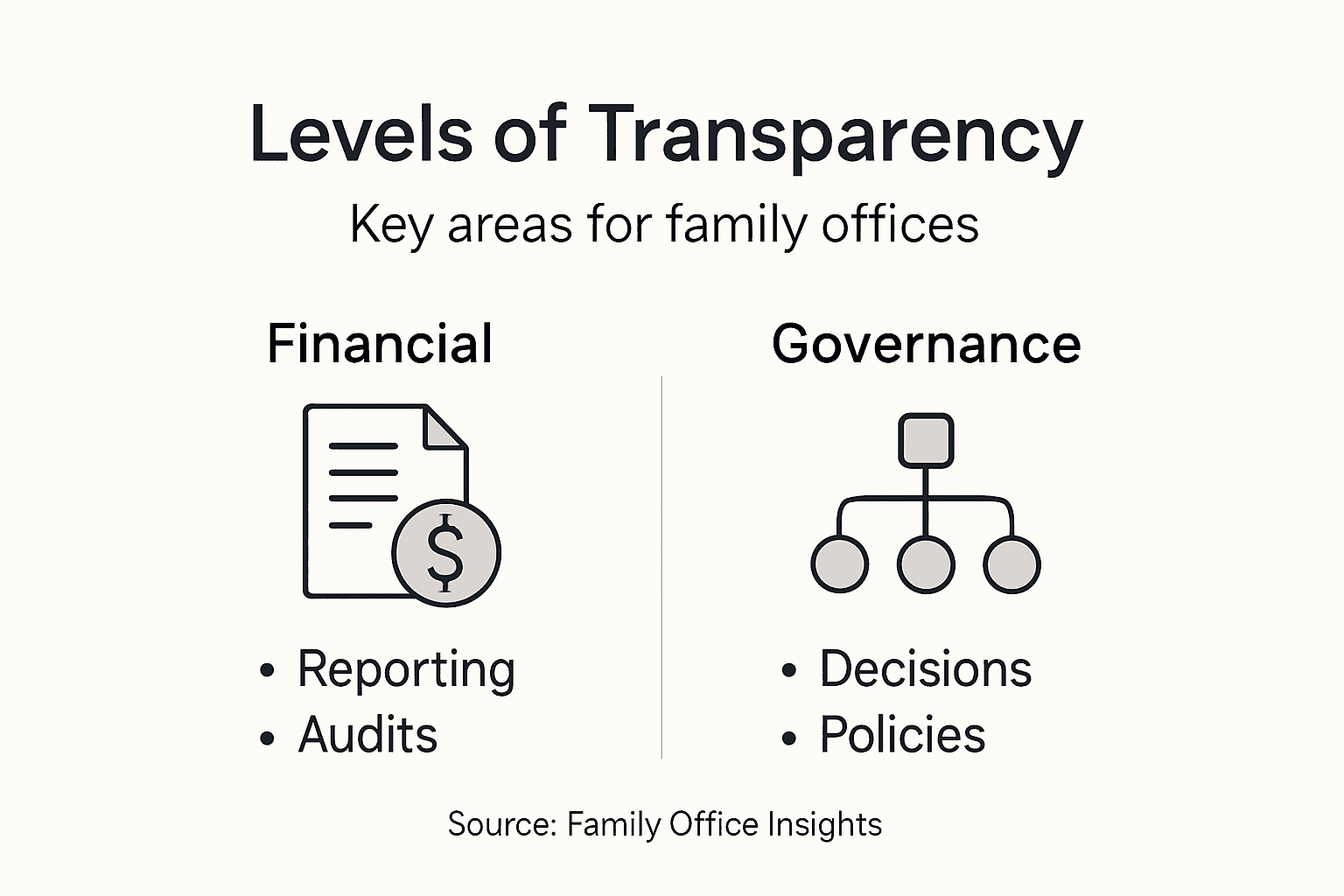
The most sophisticated family offices develop multi-layered transparency models that adapt to different stakeholder groups. Internal transparency might involve comprehensive reporting to family members, while external transparency focuses on strategic communication with potential partners, regulatory bodies, and investment networks. This approach recognizes that transparency is not about complete disclosure, but about building trust through strategic, purposeful communication. Key elements include regular performance updates, clear risk management protocols, ethical investment guidelines, and mechanisms for ongoing stakeholder engagement.
Here is a summary of core transparency levels and their impact on family offices:
| Transparency Level | Main Focus | Business Impact |
|---|---|---|
| Financial Reporting | Investment performance details | Builds trust through clear asset tracking |
| Operational Disclosure | Decision-making transparency | Enhances accountability |
| Governance Frameworks | Roles and protocols clarity | Ensures stable leadership and oversight |
| Strategic Communication | Stakeholder engagement | Fosters stronger external relationships |
Pro tip: Create a tiered information-sharing framework that provides different levels of detail for internal family members, external advisors, and potential investment partners, ensuring appropriate information access while maintaining strategic confidentiality.
Trust, Governance, and Stakeholder Alignment
Trust represents the foundational cornerstone of successful family office operations, extending far beyond simple financial management. Effective governance structures create a robust framework that promotes transparency, accountability, and strategic alignment among multiple stakeholders. This intricate process involves establishing clear communication channels, defining explicit roles and responsibilities, and developing mechanisms that ensure consistent, predictable decision-making across generations.
The governance model in family offices must balance multiple complex dynamics, including generational perspectives, diverse family member interests, and sophisticated financial strategies. Stakeholder alignment requires creating comprehensive frameworks that accommodate individual family member goals while maintaining an overarching collective vision. This means developing decision-making protocols that are flexible enough to adapt to changing family circumstances yet structured enough to provide stability and predictability. Successful alignment involves regular family meetings, transparent reporting mechanisms, and clearly articulated investment philosophies that reflect shared family values.

Modern family offices recognize that trust is not a static concept but a dynamic process requiring continuous cultivation. This involves implementing robust risk management protocols, maintaining rigorous financial controls, and creating transparent communication strategies that keep all stakeholders informed without compromising strategic confidentiality. The most effective governance models incorporate formal and informal feedback loops, allowing family members to participate meaningfully in strategic discussions while respecting professional management expertise.
Pro tip: Develop a comprehensive family governance charter that explicitly outlines decision-making processes, communication expectations, and conflict resolution mechanisms, ensuring all stakeholders understand their roles and responsibilities.
Regulatory Pressures and Compliance Risks
The contemporary family office landscape is increasingly defined by complex and evolving regulatory requirements that demand unprecedented levels of transparency and accountability. Regulatory compliance frameworks have transformed from optional considerations to critical operational imperatives, compelling family offices to implement sophisticated compliance strategies that span global jurisdictions and intricate financial regulations.
Anti-money laundering regulations, tax reporting standards, and international financial disclosure requirements create a multilayered compliance environment that requires continuous adaptation. Family offices must develop robust internal mechanisms to track and respond to regulatory changes across different jurisdictions, ensuring that their investment strategies, reporting processes, and governance models remain fully compliant. This involves maintaining detailed documentation, implementing advanced risk management protocols, and creating flexible operational frameworks that can quickly adjust to emerging regulatory expectations.
The stakes of non-compliance are dramatically high, encompassing potential financial penalties, reputational damage, and legal challenges that could fundamentally disrupt family wealth management strategies. Sophisticated family offices are increasingly investing in specialized compliance infrastructure, including advanced technological solutions, dedicated compliance officers, and ongoing professional training programs. These proactive approaches transform regulatory compliance from a potential liability into a strategic advantage, demonstrating institutional maturity and commitment to ethical financial management.
Pro tip: Establish a dedicated quarterly regulatory review process that systematically evaluates emerging compliance requirements across all relevant jurisdictions, ensuring your family office remains proactively aligned with evolving legal standards.
Common Transparency Pitfalls to Avoid
Navigating transparency challenges requires strategic awareness of the most common pitfalls that can undermine family office effectiveness. Ineffective governance structures often emerge from well-intentioned but misguided attempts to manage information, creating complex communication barriers that erode trust and operational efficiency. Family offices frequently struggle with finding the delicate balance between maintaining privacy and providing sufficient information to stakeholders.
One significant transparency pitfall involves uneven information distribution among family members, which can create internal tensions and perceived inequities. Some family members might feel systematically excluded from critical decision-making processes, leading to mistrust and potential conflicts. This challenge is particularly pronounced in multigenerational family offices where different generations may have varying expectations about communication, financial management, and strategic planning. The risk intensifies when informal communication channels replace structured, documented reporting mechanisms, creating information silos that fragment family unity.
Additionally, many family offices inadvertently create transparency challenges by overcorrecting their approach. Complex transparency frameworks that produce excessive documentation can become counterproductive, overwhelming stakeholders with unnecessary details and obscuring meaningful insights. The most effective transparency strategies are nuanced, providing clear, digestible information that offers genuine understanding without inundating recipients with superfluous data. This requires developing sophisticated communication protocols that adapt to different stakeholder needs while maintaining consistent core messaging and strategic coherence.
Below is a comparison of common transparency pitfalls and actionable solutions:
| Pitfall | Potential Consequence | Recommended Solution |
|---|---|---|
| Uneven info distribution | Internal conflicts and mistrust | Standardized reporting for all members |
| Overly complex documentation | Stakeholder confusion | Streamlined, tiered communication |
| Reliance on informal channels | Information silos and fragmentation | Formal feedback mechanisms |
| Excessive confidentiality | Stakeholder disengagement | Balanced transparency |
Pro tip: Implement a standardized quarterly reporting template that provides consistent, clear information across different family office domains, ensuring comprehensive transparency without information overload.
Build Trust and Transparency with the Future Family Office Network
Managing the complex transparency demands highlighted in the article requires more than just good intentions. Family offices must tackle challenges like balancing privacy with meaningful disclosure and creating governance frameworks that foster trust across generations. At Future Family Office, we understand these pain points and provide a dedicated platform designed to support family offices and ultra-high-net-worth investors in navigating transparency, compliance, and stakeholder alignment effectively.

Explore our comprehensive directory and networking hub to connect with trusted service providers, compliance experts, and peer family offices who share your commitment to transparent, ethical wealth management. Get access to the latest industry insights, benchmark your governance approaches, and discover tailored solutions that help you avoid common transparency pitfalls. Take control of your family office’s future today by visiting Future Family Office and join a community focused on making private wealth management more open, accessible, and collaborative.
Frequently Asked Questions
What is transparency in family offices?
Transparency in family offices refers to open and clear communication regarding wealth management, governance, and strategic decision-making to build trust among family members and stakeholders.
Why is transparency important for family offices?
Transparency is crucial for family offices as it enhances trust, accountability, and alignment among stakeholders, ultimately leading to more effective wealth management and sustainable growth across generations.
What are the different levels of transparency in family offices?
The primary levels of transparency include financial reporting, operational disclosure, governance frameworks, and strategic communication, each addressing specific stakeholder needs and concerns.
How can family offices maintain transparency while ensuring confidentiality?
Family offices can maintain transparency by developing a standardized reporting framework that balances the provision of comprehensive information with the need to protect sensitive operational details.
Recommended
- Structuring, Transparency And Societal Pressure; How To Choose A Family Office Jurisdiction In 2020 – Future Family Office
- The Hidden Risks Behind the Rise of Family Offices – Future Family Office
- Privacy in Family Offices: Protecting Wealth and Identity – Future Family Office
- 8 Trillion and Growing: The Evolution and Influence of Family Offices in the Investment World – Future Family Office