

Over 60 percent of family offices admit their current risk management frameworks leave major gaps, a finding that resonates whether your team is American, European, or Asian. Faced with today’s complex economic climate and rising cyber threats, understanding risk management is mission critical for protecting ultra-high-net-worth family assets. This guide unpacks what makes family office risk strategies unique, highlighting pitfalls and proven methods to secure your long-term legacy.
Table of Contents
- Defining Risk Management in Family Offices
- Types of Risks Facing Family Offices
- Core Processes and Strategic Frameworks
- Best Practices for Family Office Risk Management
- Common Mistakes and How to Avoid Them
Key Takeaways
| Point | Details |
|---|---|
| Risk Management Framework | Family offices require a strategic risk management framework that addresses financial, technological, and non-financial risks to ensure wealth preservation and family cohesion. |
| Best Practices | Implementing best practices such as robust governance, technological resilience, and continuous learning improves adaptability and minimizes vulnerabilities. |
| Common Pitfalls | Avoid governance failures and investment concentration by establishing clear decision-making processes and diversifying investments to enhance risk mitigation. |
| Proactive Approach | Conducting regular risk audits and maintaining open communication among family members fosters proactive identification and management of potential threats. |
Defining Risk Management in Family Offices
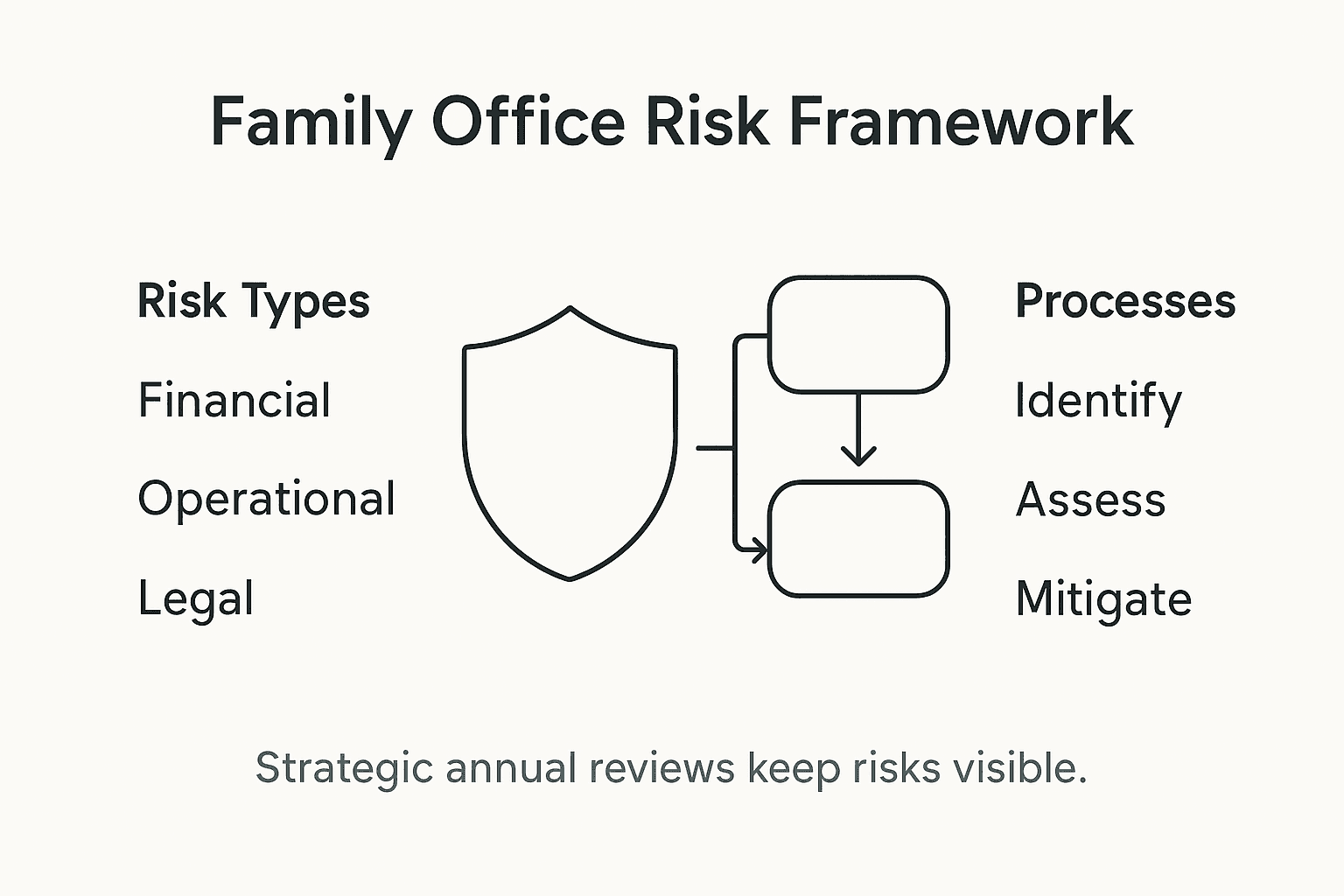
Risk management represents a strategic framework through which family offices systematically identify, assess, and mitigate potential threats to their wealth, reputation, and long-term financial sustainability. Unlike traditional corporate risk management approaches, family offices require a nuanced methodology that considers both financial metrics and intricate family dynamics.
At its core, risk management in family offices involves a comprehensive process of understanding complex organizational vulnerabilities across multiple dimensions. These dimensions include financial risks such as investment portfolio volatility, market fluctuations, and asset concentration, as well as non-financial risks like succession planning, generational wealth transfer, governance structures, and potential interpersonal conflicts that could destabilize the family’s financial ecosystem.
The fundamental objectives of risk management in family offices center on preserving intergenerational wealth, maintaining family cohesion, and creating sustainable strategies that protect and grow financial resources. Professional risk assessment frameworks help family offices develop structured approaches that enable proactive identification of potential disruptions. These strategies typically involve:
- Comprehensive risk mapping and scenario planning
- Regular portfolio stress testing
- Continuous monitoring of global economic trends
- Implementing robust governance protocols
- Developing adaptive investment strategies
Pro Tip – Strategic Risk Assessment: Conduct annual comprehensive risk audits that involve all family stakeholders, ensuring transparent communication and collaborative strategy development to maintain unified financial objectives across generations.
Types of Risks Facing Family Offices
Family offices operate within a complex risk landscape that demands sophisticated, multifaceted risk management strategies. Comprehensive risk assessment frameworks reveal a nuanced spectrum of potential threats that extend far beyond traditional financial considerations, encompassing technological, operational, and reputational dimensions.

The primary risk categories confronting family offices can be systematically categorized into several critical domains. Financial risks remain paramount, including market volatility, investment portfolio concentration, and asset allocation challenges. Technological risks have emerged as increasingly significant, with cybersecurity threats, data privacy concerns, and digital infrastructure vulnerabilities presenting substantial potential disruptions. Strategic risk surveys indicate that family offices must now prioritize digital defense mechanisms alongside traditional financial protections.
Beyond financial and technological domains, family offices must also navigate complex non-financial risks that can profoundly impact long-term sustainability:
Here’s a summary table comparing the main risk categories and their typical impact in family offices:
| Risk Category | Common Threats | Business Impact | Key Mitigation Tactics |
|---|---|---|---|
| Financial | Market volatility, asset concentration | Loss of wealth, missed targets | Diversification, stress testing |
| Technological | Cybersecurity, data breaches | Data loss, reputational damage | Advanced security, staff training |
| Governance | Decision conflicts, lack of oversight | Disputes, stalled initiatives | Clear protocols, defined hierarchy |
| Succession | Poor leadership planning | Uncertain future, instability | Structured programs, clear roles |
- Governance Risks: Potential conflicts in family decision-making processes
- Succession Risks: Challenges in transferring leadership and wealth across generations
- Reputational Risks: Potential damage from public perception or individual family member actions
- Operational Risks: Internal process failures or inefficiencies
- Human Capital Risks: Challenges in talent retention and expertise development
Pro Tip – Risk Mapping: Develop an annual, comprehensive risk assessment matrix that dynamically tracks and scores potential threats across all identified risk categories, ensuring proactive and adaptive risk management strategies.
Core Processes and Strategic Frameworks
Risk management in family offices demands a sophisticated, integrated approach that transforms traditional risk mitigation into a dynamic, holistic strategic framework. Strategic frameworks represent the architectural blueprint through which family offices systematically identify, assess, evaluate, and proactively address potential threats across multiple organizational dimensions.
The core processes underlying effective risk management typically encompass a comprehensive, cyclical methodology that enables continuous adaptation and refinement. This approach involves several interconnected stages: risk identification, quantitative and qualitative assessment, mitigation strategy development, implementation, monitoring, and periodic reevaluation. Each stage requires meticulous attention to detail, leveraging both quantitative data analytics and nuanced understanding of family-specific contextual factors.
Key components of robust risk management strategic frameworks include:
- Comprehensive Risk Mapping
- Identifying potential risks across financial, operational, technological domains
- Creating detailed risk probability and impact matrices
- Governance Protocols
- Establishing clear decision-making hierarchies
- Defining roles and responsibilities for risk oversight
- Technological Infrastructure
- Implementing advanced risk monitoring systems
- Developing secure data management processes
- Continuous Learning Mechanisms
- Regular risk assessment workshops
- Periodic external expert consultations
- Adaptive Strategy Development
- Scenario planning and stress testing
- Dynamic strategy refinement based on emerging trends
Pro Tip – Strategic Framework Design: Develop a living, adaptive risk management framework that treats risk assessment as an ongoing dialogue rather than a static checklist, ensuring continuous evolution and responsiveness to changing family and market dynamics.
Best Practices for Family Office Risk Management
Comprehensive governance frameworks form the foundation of effective risk management strategies in family offices, requiring a holistic approach that transcends traditional financial risk assessment. Successful risk management demands an integrated methodology that combines strategic planning, technological infrastructure, and adaptive organizational protocols.
The most sophisticated family offices implement multilayered risk management practices that address both quantitative and qualitative dimensions. Best practices emphasize creating robust, flexible systems that can rapidly identify, assess, and mitigate potential threats across financial, operational, technological, and reputational domains. Strategic risk management protocols involve developing documented controls, implementing cross-functional communication strategies, and establishing regular comprehensive risk review mechanisms.
Key best practices for family office risk management include:
Below is a reference table outlining best practice domains and their practical advantages for family office risk management:
| Best Practice Domain | Main Focus | Organizational Benefit | Example Initiative |
|---|---|---|---|
| Governance Excellence | Transparent structure | Enhanced accountability | Written charters |
| Technological Resilience | Data protection | Reduced risk of breaches | Cybersecurity protocols |
| Continuous Learning | Ongoing education | Quick adaptation to change | Regular workshops |
| Transparent Communication | Open dialogue | Unified intergenerational strategy | Reporting mechanisms |
- Governance Excellence
- Develop clear organizational charters
- Establish transparent decision-making hierarchies
- Create comprehensive written risk management policies
- Technological Resilience
- Implement advanced cybersecurity protocols
- Utilize sophisticated risk monitoring systems
- Develop secure data management infrastructure
- Continuous Learning
- Conduct regular risk assessment workshops
- Engage external expert consultations
- Maintain ongoing professional development programs
- Comprehensive Risk Assessment
- Create detailed risk probability matrices
- Perform regular stress testing scenarios
- Develop adaptive risk mitigation strategies
- Transparent Communication
- Foster open dialogue across family generations
- Establish clear reporting mechanisms
- Promote collaborative risk management approaches
Pro Tip – Strategic Risk Integration: Create a dynamic, living risk management framework that treats risk assessment as an ongoing strategic dialogue, ensuring continuous evolution and proactive adaptation to emerging challenges.
Common Mistakes and How to Avoid Them
Systematic identification of risk management mistakes represents a critical strategy for family offices seeking to protect and optimize their wealth through proactive prevention and strategic intervention. Understanding these common pitfalls enables family offices to develop more robust, adaptive risk management frameworks that anticipate and neutralize potential vulnerabilities before they escalate.
The most prevalent mistakes in family office risk management typically stem from structural weaknesses, inadequate governance, and reactive rather than proactive approaches. Systematic errors often emerge from informal decision-making processes, insufficient technological infrastructure, and a lack of comprehensive risk assessment mechanisms. Comprehensive risk management demands addressing investment concentration risks, technological vulnerabilities, and operational inefficiencies through strategic, multilayered prevention strategies.
Key mistakes and their targeted prevention strategies include:
- Governance Failures
- Mistake: Informal, undocumented decision-making processes
- Prevention: Develop clear organizational charters
- Implement transparent reporting mechanisms
- Investment Concentration
- Mistake: Over-reliance on limited investment categories
- Prevention: Diversify investment portfolios
- Conduct regular portfolio stress testing
- Technological Vulnerabilities
- Mistake: Inadequate cybersecurity infrastructure
- Prevention: Implement advanced security protocols
- Conduct regular technological risk assessments
- Operational Risks
- Mistake: Inconsistent risk monitoring
- Prevention: Create comprehensive risk tracking systems
- Establish continuous learning and adaptation mechanisms
- Communication Breakdown
- Mistake: Siloed information management
- Prevention: Foster cross-generational dialogue
- Develop transparent reporting frameworks
Pro Tip – Strategic Prevention: Implement a dynamic, iterative risk management approach that treats potential mistakes as opportunities for continuous improvement and organizational learning.
Strengthen Your Family Office Risk Management with Future Family Office
Navigating the complex challenges of risk management in family offices requires clarity, strategic insight, and trusted connections. From safeguarding investments against market volatility to tackling governance and succession risks, the need for a comprehensive, adaptive approach is clear. This article highlights how proactive frameworks and continuous learning are essential to preserving generational wealth and family harmony. If you are seeking resources and expert guidance that empower you to manage these risks effectively, you are in the right place.

Discover how Future Family Office serves as a vital hub for family offices and UHNW investors looking to elevate their risk management strategies. Our platform provides access to an extensive directory of service providers who specialize in cybersecurity, governance, investment diversification, and succession planning. Engage with thought leadership articles, industry reports, and a global community focused on transparency and collaboration. Take the next step in protecting and growing your family legacy by browsing our curated resources today.
Frequently Asked Questions
What is the main objective of risk management in family offices?
The primary objective of risk management in family offices is to preserve intergenerational wealth, maintain family cohesion, and create sustainable strategies to protect and grow financial resources.
What types of risks do family offices face?
Family offices face a variety of risks, including financial risks (market volatility, asset concentration), technological risks (cybersecurity threats), non-financial risks (succession planning, governance), operational risks, and reputational risks.
How can family offices identify and assess potential risks?
Family offices can identify and assess potential risks through comprehensive risk mapping, scenario planning, regular portfolio stress testing, continuous monitoring of global economic trends, and implementing robust governance protocols.
What are some best practices for effective risk management in family offices?
Best practices for effective risk management in family offices include governance excellence, technological resilience, continuous learning, comprehensive risk assessment, and transparent communication across family generations.