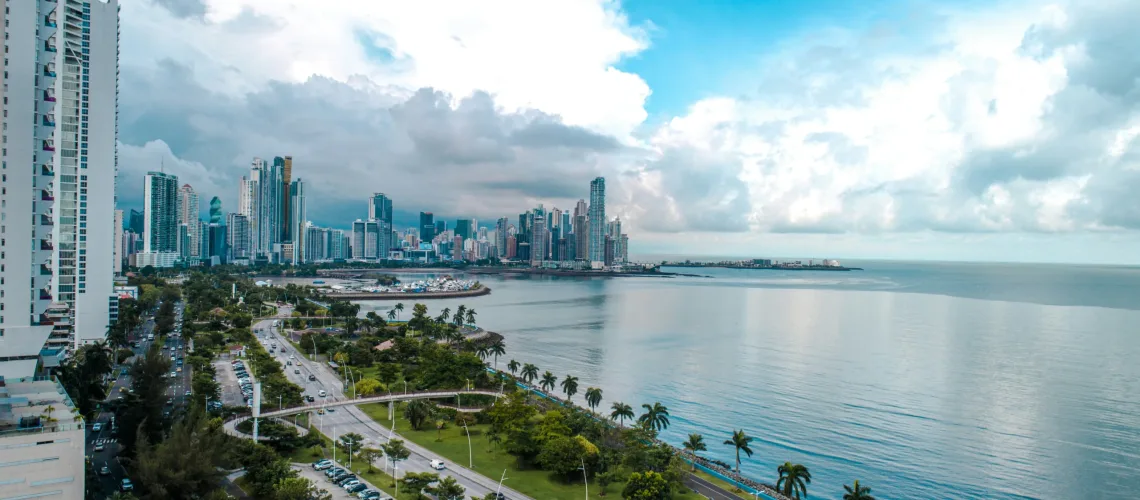

Panama’s residency-by-investment framework has become increasingly relevant to globally mobile leaders who evaluate jurisdictions through the lens of risk management, optionality, and long-term positioning rather than simple relocation. Sitting at the crossroads of international trade, finance, and logistics, Panama combines geographic advantage with a pragmatic tax and legal environment. For senior executives, family offices, and founders, the appeal lies in how residency integrates with broader portfolio, platform, and succession strategies.
Anchored by the Panama Canal, the country has long functioned as a connective artery for global commerce. This role has shaped a services-oriented ecosystem that supports international business, from shipping and logistics to banking, legal, and corporate administration. As a result, Panama offers both physical connectivity, through ports and air routes, and institutional connectivity, through a mature professional services infrastructure that links investors to Central and South American markets.
For many high-net-worth individuals, Panama is not a destination for permanent relocation but a strategic safeguard. Residency operates as a form of geopolitical and fiscal insurance, offering flexibility in the face of political shifts, regulatory uncertainty, or changing tax regimes elsewhere. Over time, this secondary residency can mature into citizenship, adding an additional layer of global mobility without disrupting existing income streams or business interests.
Geography and infrastructure underpin Panama’s value proposition more than immigration policy alone. Located at the junction of North, Central, and South America, Panama City has evolved into a regional headquarters base for multinational firms and financial institutions. The canal remains one of the world’s most important shipping corridors, reinforcing Panama’s position as a logistics and maritime services hub. For investors and corporate leaders, residency can therefore support regional expansion, whether by coordinating Latin American operations, establishing holding or trading entities, or gaining efficient access to both Atlantic and Pacific supply routes.
This strategic positioning is reinforced by Tocumen International Airport’s extensive regional connections, the canal’s expanded capacity, and a well-developed ecosystem of advisors and service providers. Together, these elements allow Panama to function as an operational pivot point rather than merely a lifestyle jurisdiction.
A central pillar of Panama’s attractiveness is its territorial tax system. Only income sourced within Panama is subject to local taxation, while foreign-source income is generally excluded, irrespective of the individual’s nationality or residency status. For globally diversified executives and families, this distinction is structural rather than incremental. Dividends, interest, capital gains, and business profits generated abroad typically fall outside the Panamanian tax net, provided they are properly structured.
At the same time, income derived from activities or assets located in Panama remains taxable, enabling investors to ring-fence local operations while preserving efficiency on global portfolios. In practical terms, this allows a family office to establish residency in Panama without pulling worldwide income into domestic taxation. Certain digital, advisory, or service businesses may also qualify as foreign-source if their economic use is outside Panama, subject to careful structuring and documentation.
For citizens of countries that tax on a worldwide basis, Panama does not eliminate home-country obligations. However, it can still enhance overall planning when combined with treaty analysis, entity structuring, and selective relocation of functions or management activity.
Panama’s investor programmes are explicitly designed to accommodate families, not just individual applicants. Most routes allow the inclusion of spouses, minor children, dependent adult children under specific conditions, and dependent parents, with provisions in some cases for disabled relatives. This makes the residency framework suitable for multi-generational planning, covering education, succession, and contingency relocation.
Notably, Panama offers immediate or accelerated permanent residency under certain investment routes, avoiding prolonged temporary stages that are common in other jurisdictions. A pathway to citizenship is generally available after five years of legal residency, subject to language, integration, and presence requirements. Successful applicants may ultimately gain access to a passport that provides visa-free or visa-on-arrival entry to more than 140 destinations. For senior decision-makers, this transforms a one-time capital allocation into a long-dated hedge against mobility and geopolitical risk.
The Qualified Investor Visa is the centrepiece of Panama’s residency-by-investment framework and is often referred to as its Golden Visa. It is structured for applicants seeking swift permanent residency with clearly defined investment thresholds. Approval grants immediate permanent resident status without a preliminary temporary phase, with eligibility for citizenship after five years of maintained residency, assuming all naturalisation criteria are met. Investors are typically required to hold their qualifying assets for at least five years, after which divestment or reallocation is generally permitted.
The programme offers several investment routes. Real estate remains the most common, with a minimum investment of approximately USD 300,000 in approved Panamanian property, free of liens and held for the required period. An alternative is investment in securities listed on the Panama Stock Exchange, requiring around USD 500,000 and execution through a licensed local brokerage. A third option involves placing roughly USD 750,000 in a fixed-term deposit with a licensed Panamanian bank, often with interest exempt from local income tax. These options allow investors to align residency with their preferred mix of real assets, financial instruments, or capital preservation.
Alongside the Qualified Investor route, the Friendly Nations Visa provides a more accessible entry point for citizens of designated countries with established ties to Panama. While once a low-threshold programme, it has evolved into a more structured pathway involving temporary residency followed by permanent status. Typically, applicants receive a two-year temporary residence permit, after which they may qualify for permanent residency by meeting investment and presence requirements.
The programme has demonstrated strong approval rates and growing demand, reflecting its institutional reliability. Applicants may qualify through a USD 200,000 investment in real estate or a fixed-term bank deposit held for at least three years, or through formal employment with a Panamanian company combined with basic financial and documentation criteria. For entrepreneurs, senior managers, or executives seeking flexibility before committing larger capital, this route offers a practical way to establish a foothold.
Panama also offers a Forestry Investor Visa, which links residency to reforestation and sustainable forestry investments. This option appeals to investors seeking alignment between mobility planning and environmental or ESG objectives. Investment tiers vary, ranging from higher-value commitments that grant temporary residence to mid-range investments that provide immediate permanent residency and national identification. Certain tiers allow progression to citizenship after the standard five-year residency period. For boards integrating nature-based solutions into capital allocation, this category offers a distinctive blend of sustainability and strategic residency.
Investor residency approvals in Panama have accelerated in recent years, underscoring its emergence as a mainstream option for globally mobile capital. Investor visas now represent a meaningful share of overall residence permits, with particularly strong growth in the Qualified Investor and fixed-deposit categories. Friendly Nations approvals have also rebounded sharply, reflecting sustained demand from mid- to high-net-worth applicants.
From a governance standpoint, Panama’s programmes operate within a regulated framework. Applicants must meet robust compliance standards, including source-of-funds verification, bank references, criminal record checks, and comprehensive KYC documentation. Licensed local legal representation is effectively standard, particularly where real estate, securities, or corporate structuring is involved. Processing timelines vary by route, with the Qualified Investor Visa typically offering the fastest turnaround, while other programmes may involve staged approvals and presence requirements.
For senior executives and family offices, Panama’s residency options are best viewed as regulated migration products rather than static entitlements. Investment thresholds, compliance standards, and policy parameters may evolve, reinforcing the importance of ongoing oversight and professional advice.
Strategically, Panama serves multiple use cases. It provides mobility insurance in the event of adverse political or fiscal changes elsewhere, a base for coordinating regional operations across Latin America, and a tool for aligning residency with territorial taxation. Its family-friendly framework also supports next-generation planning, positioning heirs for education, entrepreneurship, and career development in the Americas.
For globally minded leaders, Panama’s Golden Visa is less an immigration programme than a strategic asset. When integrated into a broader residency and citizenship architecture, it enables the alignment of mobility, taxation, and regional opportunity with long-term capital preservation and growth objectives.