

Most American family offices now oversee over $100 million in assets, yet effective investment allocation remains more challenging than ever for Ultra-High-Net-Worth clients. These unique families demand sophisticated strategies that balance global diversification, risk management, and generational goals. Understanding the complexities of asset allocation models, compliance factors, and evolving trends can empower you to design resilient portfolios tailored for long-term success.
Table of Contents
- Defining Investment Allocation for UHNW Families
- Types of Asset Classes and Allocation Models
- How Investment Allocation Strategies Work
- Global Trends and Regulatory Compliance
- Risks, Costs, and Common Pitfalls in Allocation
Key Takeaways
| Point | Details |
|---|---|
| Investment Allocation for UHNW Families | Tailored investment strategies are essential for Ultra-High-Net-Worth families to optimize returns and manage risks while considering unique family dynamics and long-term goals. |
| Diverse Asset Classes | A robust portfolio includes a mix of traditional (equities, fixed income) and alternative investments (private equity, cryptocurrencies) to enhance diversification and resilience. |
| Strategic Investment Approaches | Different allocation strategies like tactical, strategic, and core-satellite allow investors to align their portfolios with evolving market conditions and personal objectives. |
| Risk Management Essentials | Regular portfolio reviews and diversification are crucial for protecting against concentration risk and optimizing overall performance amidst market volatility. |
Defining Investment Allocation for UHNW Families
Investment allocation for Ultra-High-Net-Worth (UHNW) families represents a sophisticated financial strategy that transcends traditional wealth management approaches. Unlike standard investment models, these specialized portfolios demand intricate planning that integrates multiple asset classes, risk management techniques, and long-term generational objectives.
At its core, investment allocation for UHNW families involves strategically distributing financial resources across diverse investment vehicles to maximize returns while minimizing potential risks. Professional advisory services tailor portfolios to accommodate unique family dynamics, incorporating complex elements such as tax optimization, estate planning, and multigenerational wealth preservation. Typical allocations might include a sophisticated mix of global equities, fixed-income securities, real estate investments, private equity, hedge funds, and alternative investment instruments.
The primary objective of strategic investment allocation for UHNW families centers on creating a resilient financial ecosystem that can withstand market volatilities while generating sustainable wealth. This requires a dynamic approach that balances aggressive growth opportunities with conservative preservation strategies. Key considerations include maintaining appropriate liquidity, managing tax implications, and ensuring investments align with the family’s specific philosophical and financial goals.
Pro tip: Engage a specialized family office advisor who understands the nuanced requirements of UHNW investment allocation and can provide customized, holistic wealth management strategies.
Types of Asset Classes and Allocation Models
Asset classes represent fundamental building blocks of investment portfolios, each bringing unique characteristics and performance dynamics to the overall investment strategy. Major asset classes are categorized based on shared risk, return, and liquidity profiles, encompassing traditional and alternative investment vehicles that serve distinct purposes in wealth management.
Traditional asset classes typically include equities, fixed income, cash equivalents, and real estate. Each plays a critical role in portfolio construction: equities offer potential growth and capital appreciation, fixed-income securities provide steady income and stability, cash equivalents ensure liquidity, and real estate serves as an inflation hedge and potential appreciation asset. Alternative asset classes such as private equity, hedge funds, commodities, and cryptocurrencies have gained significant traction among Ultra-High-Net-Worth (UHNW) investors seeking diversification and enhanced return potential.
Here’s a comparison of key traditional and alternative asset classes for UHNW portfolios:
| Asset Class | Primary Benefit | Typical Risk Profile |
|---|---|---|
| Equities | Long-term capital growth | High volatility |
| Fixed Income | Stable income stream | Lower market risk |
| Cash Equivalents | Immediate liquidity | Minimal investment risk |
| Real Estate | Inflation hedge, stability | Moderate to low liquidity |
| Private Equity | Enhanced return potential | Illiquidity, high risk |
| Hedge Funds | Diversification, alpha | Strategy-dependent risk |
| Commodities | Portfolio diversification | High price fluctuation |
| Cryptocurrencies | Non-correlated potential | Extreme volatility |
Investment allocation models provide sophisticated frameworks for strategically determining asset class weights and portfolio composition. These models range from mean-variance optimization to more complex stochastic approaches, enabling investors to design portfolios that balance risk and potential returns. Sophisticated allocation strategies consider factors like correlation between assets, expected returns, volatility, and individual investor risk tolerance. Advanced models might incorporate complex mathematical techniques to optimize portfolio performance while managing potential downside risks.
Pro tip: Consider working with a specialized wealth management professional who can develop a customized asset allocation model that precisely matches your family’s unique financial objectives and risk profile.
How Investment Allocation Strategies Work
Investment allocation strategies represent sophisticated approaches for constructing portfolios that precisely align with an investor’s unique financial objectives, risk tolerance, and long-term goals. These strategies serve as comprehensive frameworks that guide decision-making processes, transforming abstract financial goals into concrete investment pathways.

Multiple strategic models exist for implementing investment allocation, each with distinct characteristics and potential benefits. Strategic allocation establishes baseline asset class targets based on long-term expected returns and risks, maintaining a relatively stable portfolio composition. Tactical allocation allows more dynamic adjustments to capitalize on short-term market opportunities, while constant-weighting strategies aim to maintain fixed proportions across different asset classes through periodic rebalancing. More advanced models like the core-satellite approach combine passive core investments with actively managed satellite positions, providing both stability and potential for enhanced returns.
Below is a summary of common investment allocation strategies and their distinctive features:
| Strategy Type | Approach Description | Main Advantage |
|---|---|---|
| Strategic Allocation | Sets long-term target allocations | Consistent portfolio structure |
| Tactical Allocation | Adjusts based on market outlook | Exploit short-term opportunities |
| Constant Weighting | Regular rebalancing to set weights | Maintains risk discipline |
| Core-Satellite | Combines passive and active positions | Balance of stability and growth |
Successful implementation of investment allocation strategies requires continuous monitoring and adaptive management. This involves regularly assessing portfolio performance, understanding evolving market conditions, and making calculated adjustments to maintain alignment with the investor’s changing financial landscape. Key considerations include analyzing asset correlations, evaluating risk-adjusted returns, managing tax implications, and ensuring the portfolio remains resilient across different economic environments. Ultra-High-Net-Worth (UHNW) families often leverage sophisticated quantitative models and professional advisory services to optimize these complex allocation strategies.
Pro tip: Develop a comprehensive investment policy statement that clearly defines your allocation strategy, risk parameters, and performance benchmarks to provide a structured framework for consistent decision-making.
Global Trends and Regulatory Compliance
UHNW individuals are experiencing profound shifts in global mobility and wealth preservation strategies driven by increasing geopolitical uncertainty and complex international regulatory environments. These transformative dynamics require sophisticated investment approaches that transcend traditional geographic and financial boundaries, compelling wealthy families to develop more nuanced, adaptable wealth management frameworks.
The contemporary regulatory landscape demands unprecedented levels of strategic compliance and cross-border financial planning. Global regulatory frameworks now emphasize transparency, requiring detailed reporting mechanisms across multiple jurisdictions. Emerging trends include heightened scrutiny of international asset transfers, more rigorous anti-money laundering protocols, and increasingly complex tax reporting requirements. Ultra-High-Net-Worth families must navigate these intricate regulations by developing comprehensive compliance strategies that integrate legal, financial, and technological considerations.
Technological advancements and digital transformation are reshaping regulatory compliance approaches for global wealth management. Advanced digital platforms now enable real-time tracking of international financial transactions, automated compliance monitoring, and sophisticated risk assessment tools. These technological solutions help UHNW families maintain compliance while preserving the flexibility needed to manage complex, internationally distributed investment portfolios. The convergence of regulatory technology, artificial intelligence, and blockchain innovations is creating more transparent, secure, and efficient wealth management ecosystems.
Pro tip: Engage multijurisdictional legal and financial experts who specialize in international wealth management to develop a proactive, comprehensive compliance strategy that anticipates regulatory changes.
Risks, Costs, and Common Pitfalls in Allocation
UHNW investors navigate a complex landscape of investment risks that require sophisticated management strategies and proactive risk mitigation techniques. The sophisticated nature of high-level wealth management demands a nuanced approach to identifying, understanding, and neutralizing potential financial vulnerabilities that could compromise long-term wealth preservation and growth objectives.
Key risks in investment allocation include portfolio concentration risk, which emerges when substantial capital becomes disproportionately allocated to limited asset classes or geographic regions. Ultra-High-Net-Worth families must implement comprehensive diversification strategies that spread investments across multiple sectors, international markets, and uncorrelated asset types. These strategies help mitigate potential losses from market volatility, geopolitical disruptions, and unexpected economic shifts. Transaction costs represent another critical consideration, with complex investment structures potentially generating significant expenses that can erode overall portfolio performance.
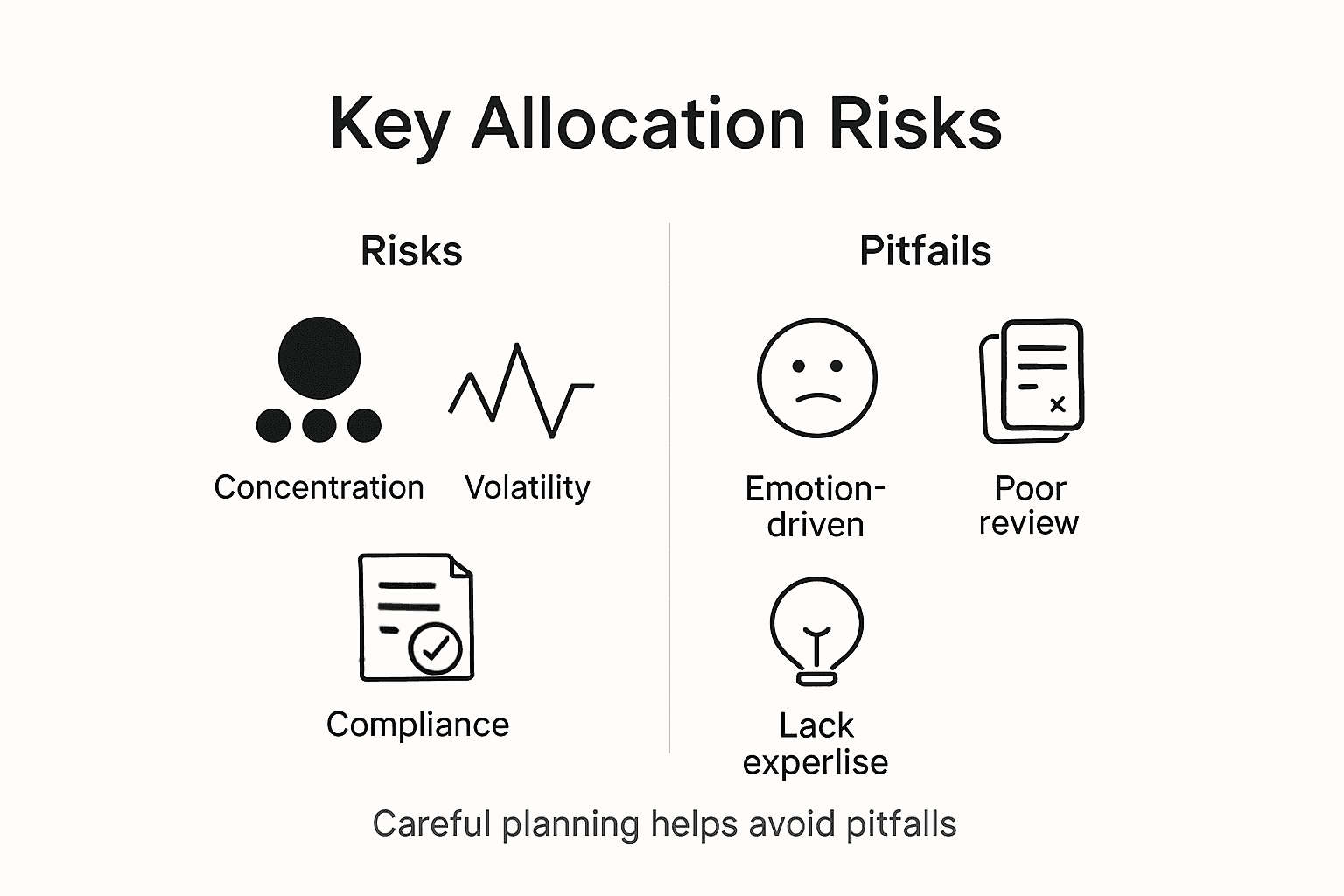
Common allocation pitfalls often stem from emotional decision-making, inadequate professional guidance, and failure to adapt to changing market conditions. Strategic allocation requires continuous monitoring and periodic rebalancing to maintain optimal risk-return profiles. Potential missteps include overlooking tax efficiency, neglecting estate planning implications, becoming overly concentrated in illiquid alternative investments, and failing to integrate comprehensive wealth management perspectives that consider generational wealth transfer objectives. Successful UHNW investors distinguish themselves by maintaining flexibility, leveraging professional expertise, and implementing systematic risk management protocols.
Pro tip: Conduct a comprehensive annual portfolio review with independent financial advisors to identify potential allocation vulnerabilities and proactively adjust investment strategies.
Transform Your UHNW Family Investment Allocation with Future Family Office
Strategic investment allocation is essential for Ultra-High-Net-Worth families aiming to preserve and grow wealth across generations while managing complex risks like portfolio concentration and regulatory compliance. Managing diverse asset classes such as private equity, hedge funds, and real estate requires expert insight and trusted connections. If you want to avoid common pitfalls and implement tailored allocation strategies supported by a network of professionals, Future Family Office is your gateway to success.

Explore the comprehensive family office directory and connect with trusted service providers and advisers who specialize in UHNW investment allocation and wealth management. Stay informed with the latest industry trends, market insights, and thought leadership that empower you to navigate evolving global regulations and sophisticated portfolio strategies. Take control of your family’s financial future today—visit Future Family Office and unlock the powerful tools and connections designed just for UHNW families.
Frequently Asked Questions
What is investment allocation for Ultra-High-Net-Worth families?
Investment allocation for UHNW families involves strategically distributing financial resources across various asset classes, including equities, fixed income, real estate, and alternative investments, to maximize returns and minimize risks as part of a sophisticated financial strategy.
What are the common asset classes used in UHNW investment allocation?
Common asset classes for UHNW investment allocation include equities, fixed income, cash equivalents, real estate, private equity, hedge funds, commodities, and cryptocurrencies. Each class provides unique benefits and risk profiles.
What strategies are commonly used for investment allocation?
Common investment allocation strategies include strategic allocation, which sets long-term targets; tactical allocation, which allows for dynamic adjustments based on market conditions; and core-satellite allocation, which combines passive and active investments to balance stability and potential growth.
What are the risks associated with UHNW investment allocation?
Key risks in UHNW investment allocation include portfolio concentration risk, transaction costs, and emotional decision-making. It is essential to implement diversification strategies, manage expenses, and continuously monitor and adapt investment strategies to mitigate these risks.
Recommended
- UHNW Investment Strategies: Tailoring Wealth for Legacy – Future Family Office
- 7 Essential Capital Preservation Strategies for UHNW Investors – Future Family Office
- Pandemic sparks prudence among Asia’s family offices – Future Family Office
- For Family Offices, Private Equity Became Collateral for Cash in the Coronavirus Crisis – Future Family Office
- A Business Leader’s Guide to IT Investment Optimization: What Houston CEOs, CFOs and Owners Need to Know – CinchOps, Inc.
- Master Investing in Graphic Novels for Future Gains – The Mansion Press
- How to Safeguard Rental Investment: A Step-by-Step Guide – Rental Income Insurance