

Most American family offices now monitor more than just investment returns, with over 60 percent integrating strategic KPIs that track everything from wealth preservation to generational knowledge transfer. In today’s dynamic financial world, aligning these measures with family priorities can mean the difference between enduring legacy and missed opportunity. Discover actionable strategies for shaping key performance indicators that reflect both organizational goals and the evolving values of American families.
Table of Contents
- Family Office KPIs: Purpose And Principles
- Key Categories Of Family Office KPIs
- Essential Features Of Effective KPIs
- Benchmarking And Industry Comparisons
- Common Pitfalls In KPI Management
Key Takeaways
| Point | Details |
|---|---|
| Comprehensive KPI Framework | Family office KPIs should capture financial, governance, operational, and family value metrics to ensure holistic performance evaluation. |
| Dynamic KPI Management | KPIs must evolve with changing family goals and economic contexts, requiring regular review and refinement for continued relevance. |
| Effective Benchmarking | Employing internal, competitive, and best practice benchmarking strategies allows family offices to identify strengths and align performance with industry standards. |
| Critical Pitfalls to Avoid | Focus should be on outcomes rather than just activities, maintaining long-term strategies over short-term results, and ensuring data quality for meaningful insights. |
Family Office KPIs: Purpose And Principles
Family offices represent sophisticated wealth management ecosystems designed to preserve and grow generational assets through strategic performance measurement. Performance indicators in these private financial organizations serve a critical purpose beyond traditional financial metrics, encompassing broader objectives of family legacy, governance, and long-term strategic alignment.
The fundamental principles driving family office KPIs revolve around comprehensive value creation that transcends pure financial return. These principles include maintaining confidentiality, ensuring intergenerational wealth transfer, aligning investment strategies with evolving family values, and creating adaptable frameworks that can respond to complex family dynamics. Key performance indicators must reflect both organizational goals and family-centric values, emphasizing the unique nature of family office management.
Effective family office KPIs typically incorporate multidimensional performance metrics across several critical domains:
- Financial performance and wealth preservation
- Risk management and compliance
- Investment portfolio diversification
- Generational knowledge transfer
- Family governance and strategic planning
- Philanthropic impact and social responsibility
Pro tip: Develop a balanced scorecard approach that integrates quantitative financial metrics with qualitative family values to create a holistic performance measurement system.
Key Categories Of Family Office KPIs
Family office key performance indicators (KPIs) encompass a comprehensive framework that goes far beyond traditional financial measurements. The Balanced Scorecard approach reveals four critical perspectives essential for holistic performance evaluation: financial, stakeholder, internal processes, and organizational capacity. These perspectives ensure that family offices can track and optimize their performance across multiple strategic dimensions.
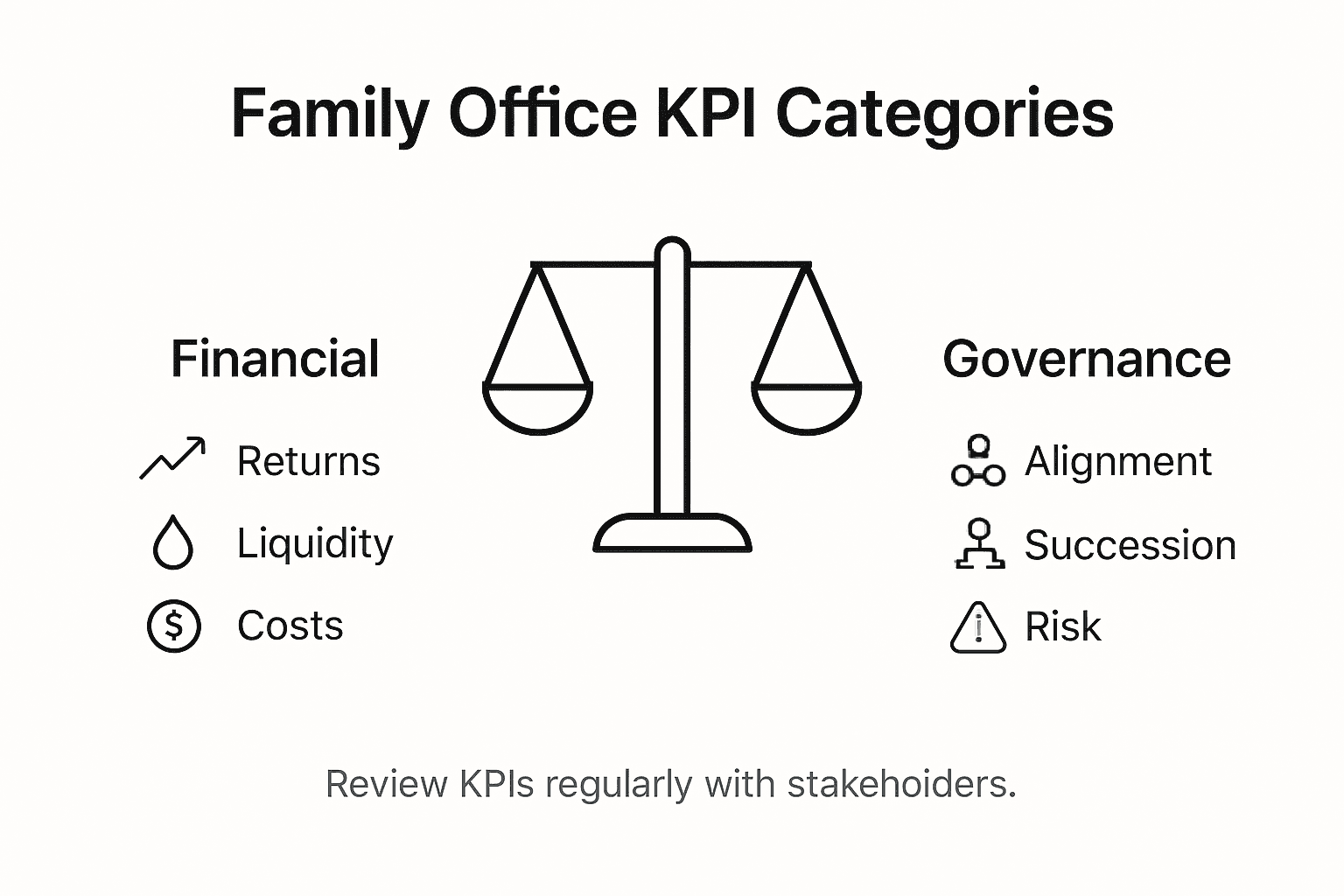
Within these perspectives, family office KPIs typically span several core categories that capture the nuanced nature of wealth management and family governance. Comprehensive KPI frameworks include intricate measures that address financial, compliance, and qualitative performance metrics:
-
Financial Performance Indicators
- Investment returns
- Asset allocation efficiency
- Cost management and expense ratios
- Long-term wealth preservation metrics
-
Governance and Compliance Indicators
- Regulatory adherence
- Risk management scores
- Succession planning effectiveness
- Family decision-making transparency
-
Operational Performance Indicators
- Investment process efficiency
- Technology and infrastructure optimization
- Reporting accuracy and timeliness
- Strategic alignment metrics
-
Family Value and Impact Indicators
- Intergenerational wealth transfer success
- Philanthropic engagement metrics
- Family member satisfaction
- Educational and skill development tracking
Pro tip: Develop a dynamic KPI dashboard that integrates quantitative financial metrics with qualitative family values, enabling real-time performance tracking and strategic adaptation.
Essential Features Of Effective KPIs
Effective key performance indicators for family offices represent far more than simple numerical measurements. Critical characteristics define the quality and utility of KPIs, ensuring they provide meaningful insights into organizational performance and strategic alignment. These indicators must transcend basic reporting to become dynamic tools for strategic decision making and continuous improvement.

Fundamental Features of Robust KPIs include several essential characteristics that distinguish high-quality performance metrics:
The following table contrasts essential features of effective family office KPIs with their practical business impact:
| KPI Feature | Description | Business Impact |
|---|---|---|
| Relevance | Tied directly to strategic goals | Ensures focus on core objectives |
| Actionability | Drives measurable improvements | Facilitates operational enhancements |
| Comparability | Allows benchmarking over time | Empowers continuous performance gains |
| Timeliness | Provides up-to-date insights | Supports proactive decision-making |
- Relevance: Directly connected to strategic objectives
- Clarity: Easily understood by all stakeholders
- Measurability: Quantifiable and precise
- Actionability: Capable of driving specific improvements
- Comparability: Allowing benchmarking across time periods
- Timeliness: Providing current and forward-looking insights
Academic research on KPI development highlights the importance of creating metrics that are sensitive to organizational culture and adaptable to evolving family priorities. Effective KPIs must balance quantitative precision with qualitative understanding, recognizing that family offices operate within complex human systems that extend beyond simple financial calculations.
The most sophisticated family office KPIs integrate multiple dimensions of performance, including financial outcomes, governance effectiveness, family member satisfaction, and long-term strategic alignment. These comprehensive metrics enable leadership to make nuanced, data-driven decisions that support generational wealth preservation and family legacy development.
Pro tip: Develop a periodic KPI review process that involves multiple family stakeholders, ensuring continuous refinement and alignment with evolving strategic objectives.
Benchmarking And Industry Comparisons
Comprehensive benchmarking strategies provide critical insights for family offices seeking to understand their performance relative to industry standards. By systematically comparing key metrics across similar organizations, family offices can identify strategic strengths, potential improvement areas, and validate their operational effectiveness through objective, data-driven analysis.
Benchmarking in family offices encompasses multiple sophisticated approaches:
-
Internal Benchmarking
- Comparing performance across different investment portfolios
- Tracking historical performance trends
- Evaluating different business units or investment strategies
-
Competitive Benchmarking
- Analyzing performance against similar family offices
- Comparing investment returns and operational efficiency
- Assessing risk management strategies
-
Best Practice Benchmarking
- Identifying industry-leading performance standards
- Understanding innovative investment and governance approaches
- Learning from top-performing family office models
The Chartered Quality Institute emphasizes that effective benchmarking requires a structured, systematic approach to performance comparison, recognizing that each family office has unique characteristics and objectives. Successful benchmarking goes beyond simple numerical comparisons, incorporating qualitative insights that capture the nuanced nature of family wealth management.
Key considerations for meaningful benchmarking include demographic matching, investment strategy alignment, and recognition of each family office’s distinct cultural and strategic context. This approach ensures that comparisons provide actionable insights rather than misleading or superficial evaluations.
Here is a summary table showcasing different benchmarking approaches used by family offices and what they help evaluate:
| Benchmarking Approach | Main Focus | Key Benefit |
|---|---|---|
| Internal Benchmarking | Compare internal portfolios | Highlights internal strengths |
| Competitive Benchmarking | Analyze similar family offices | Reveals market positioning |
| Best Practice Benchmarking | Identify industry-leading models | Drives adoption of innovations |
Pro tip: Develop a customized benchmarking framework that balances quantitative metrics with qualitative assessments, allowing for nuanced performance understanding beyond raw numerical comparisons.
Common Pitfalls In KPI Management
Family offices frequently encounter complex challenges in KPI management that can significantly undermine their strategic effectiveness. Understanding these potential pitfalls is crucial for developing robust performance measurement systems that provide genuine insights and drive meaningful organizational improvement.
Critical KPI Management Mistakes include:
-
Measuring Activity Instead of Results
- Focusing on process metrics rather than outcome impacts
- Tracking superficial indicators that don’t reflect true performance
- Mistaking busyness for productivity
-
Short-Term Objective Fixation
- Overemphasizing quarterly or annual performance
- Neglecting long-term wealth preservation strategies
- Sacrificing sustainable growth for immediate gains
-
Data Quality and Relevance Issues
- Collecting excessive, irrelevant performance data
- Failing to validate metric accuracy and reliability
- Using outdated or incomplete information sources
Comprehensive academic research highlights the critical importance of strategic alignment and stakeholder engagement in avoiding KPI management failures. Successful family offices recognize that KPIs are dynamic tools requiring continuous refinement, not static measurement instruments.
The most sophisticated family offices approach KPI management as an adaptive process, regularly reassessing metrics to ensure they remain relevant to evolving family goals, investment strategies, and broader economic contexts. This requires a flexible, nuanced approach that balances quantitative precision with qualitative understanding.
Pro tip: Implement a quarterly KPI review process that includes multiple stakeholders, ensuring metrics remain aligned with strategic objectives and reflect the family’s changing priorities.
Elevate Your Family Office Performance with Clear KPIs and Strategic Insights
Setting and managing the right key performance indicators is essential to unlocking growth and clarity for your family office. This article highlights common challenges like aligning KPIs with long-term wealth preservation, balancing financial metrics with family values, and avoiding pitfalls such as focusing on short-term results instead of sustainable goals. By embracing a dynamic KPI framework that addresses governance, investment performance, and intergenerational success, family offices can truly enhance decision-making and legacy building.
At Future Family Office, we understand these unique complexities facing ultra-high-net-worth families and provide a specialized platform to empower your journey. From curated industry reports to a comprehensive directory connecting you with trusted service providers, our online community fosters collaboration and knowledge sharing tailored to your needs. Whether you seek trusted experts in performance measurement or the latest thought leadership on operational best practices, our resources help you drive meaningful improvements aligned with your strategic objectives.
Discover how to transform KPI management challenges into opportunities for sustainable growth. Take the next step by exploring our offerings at Future Family Office and start engaging with professionals who share your commitment to transparency and excellence in wealth stewardship.

Unlock the power of effective KPIs today and ensure your family office performs at its fullest potential. Visit Future Family Office now to connect, learn, and lead with confidence.
Frequently Asked Questions
What are Family Office KPIs?
Family Office KPIs (Key Performance Indicators) are metrics used to measure the effectiveness and performance of family offices in managing wealth, investments, and family governance. They include financial performance, risk management, operational efficiency, and family value indicators.
Why are KPIs important for family offices?
KPIs are essential for family offices because they help track performance against strategic goals, ensure alignment with family values, assess the effectiveness of governance, and drive continuous improvement within the wealth management ecosystem.
How can family offices develop effective KPIs?
To develop effective KPIs, family offices should integrate quantitative financial metrics with qualitative family values, ensure the indicators are relevant and actionable, and conduct regular reviews involving multiple family stakeholders to adapt to changing goals and circumstances.
What are common pitfalls in KPI management for family offices?
Common pitfalls include focusing on activity rather than results, prioritizing short-term objectives over long-term goals, and issues with data quality and relevance. It’s important to regularly reassess KPIs to keep them aligned with family objectives and to ensure they provide actionable insights.
Recommended
- Understanding Family Office Value Creation Explained – Future Family Office
- How to Optimize Family Office Operations for Efficiency – Future Family Office
- 7 Essentials for a Complete Family Office Governance Checklist – Future Family Office
- Understanding the Family Offices Group: Purpose and Function – Future Family Office