


American family offices now manage assets exceeding $5 trillion, revealing just how vital portfolio managers have become in shaping global wealth strategies. With multi-generational goals, diverse investments, and distinct family values at stake, the pressure to deliver nuanced financial guidance is rising fast. This article unpacks the evolving portfolio manager role, spotlighting the specialized skills needed to navigate regulatory challenges, risk management, and targeted investment solutions for ultra-high-net-worth families.
Table of Contents
- Defining The Portfolio Manager In Family Offices
- Types Of Portfolio Managers And Their Specializations
- Core Responsibilities And Investment Strategies
- Regulatory Compliance And Fiduciary Duties
- Risk Management And Performance Evaluation
Key Takeaways
| Point | Details |
|---|---|
| Role of Portfolio Managers | Portfolio managers are essential in family offices, serving as both financial strategists and wealth architects to align investment strategies with family values and goals. |
| Specialization Types | Family offices utilize specialized portfolio managers for different investment domains, which helps in addressing unique financial objectives and enhancing family wealth. |
| Core Responsibilities | Key responsibilities include strategic asset allocation, risk management, and estate planning to ensure sustainable wealth preservation across generations. |
| Regulatory Compliance | Portfolio managers must navigate complex regulatory landscapes while adhering to fiduciary duties, ensuring both ethical stewardship and protection of family assets. |
Defining the Portfolio Manager in Family Offices
The portfolio manager represents a strategic linchpin within family offices, responsible for navigating complex investment landscapes and preserving generational wealth. These financial professionals go far beyond traditional investment management, serving as comprehensive wealth architects who craft tailored investment strategies that align with each family’s unique objectives and risk profile.
At their core, portfolio managers function as sophisticated financial strategists who integrate multiple disciplines. Their responsibilities encompass comprehensive asset allocation, rigorous investment selection, advanced risk management, tax optimization, and estate planning. Unlike standard wealth managers, family office portfolio managers must balance sophisticated financial techniques with deeply personalized understanding of each family’s multigenerational goals, cultural dynamics, and long-term vision.
The role requires an exceptional blend of technical financial expertise and interpersonal intelligence. Portfolio managers must translate complex financial concepts into actionable strategies that resonate with family members across different generations. This means understanding not just investment metrics, but also family values, philanthropic intentions, entrepreneurial aspirations, and potential legacy planning considerations. They serve as trusted advisors who can navigate both financial markets and intricate family relationships.

Pro tip: Successful portfolio managers in family offices cultivate deep relationship management skills, treating each investment strategy as a customized financial blueprint unique to the family they serve.
Types of Portfolio Managers and Their Specializations
Family offices employ a diverse array of portfolio managers with specialized expertise tailored to complex investment ecosystems. Specialized managers cover distinct investment domains, ranging from public market investments to intricate private market strategies, each focusing on unique asset classes and financial objectives.
The primary portfolio manager specializations include:
- Public Equities Managers: Focus on publicly traded stocks, analyzing market trends, company fundamentals, and global economic indicators
- Fixed Income Specialists: Manage bond portfolios, government securities, and debt instruments, prioritizing stable income generation
- Alternative Investment Managers: Handle sophisticated assets like hedge funds, private equity, venture capital, and real estate investments
- Philanthropic Portfolio Managers: Design investment strategies that align financial returns with social impact and charitable goals
- Venture Capital and Private Equity Managers: Identify and manage high-potential investment opportunities in emerging companies and private markets
Each specialization requires a nuanced understanding of risk management, asset allocation, and the family’s unique multi-generational financial vision. Unlike traditional investment advisors, family office portfolio managers must integrate financial strategies with broader family objectives, considering not just monetary returns but also long-term legacy planning, tax efficiency, and generational wealth preservation.
Here’s a comparison of family office portfolio manager specializations and their typical business impact:
| Specialization | Primary Focus | Typical Impact on Family Wealth |
|---|---|---|
| Public Equities Manager | Stocks and global trends | Growth and liquidity enhancement |
| Fixed Income Specialist | Bonds and debt instruments | Income stability and capital preservation |
| Alternative Investment Manager | Hedge funds, real estate | Diversification and inflation hedging |
| Philanthropic Portfolio Manager | Social impact investing | Aligning investments with family values |
| Venture Capital/Private Equity | Emerging/private companies | Potential for high long-term returns |
Pro tip: Successful portfolio managers cultivate deep cross-disciplinary knowledge, allowing them to seamlessly navigate between different investment specializations and create holistic wealth management strategies.
Core Responsibilities and Investment Strategies
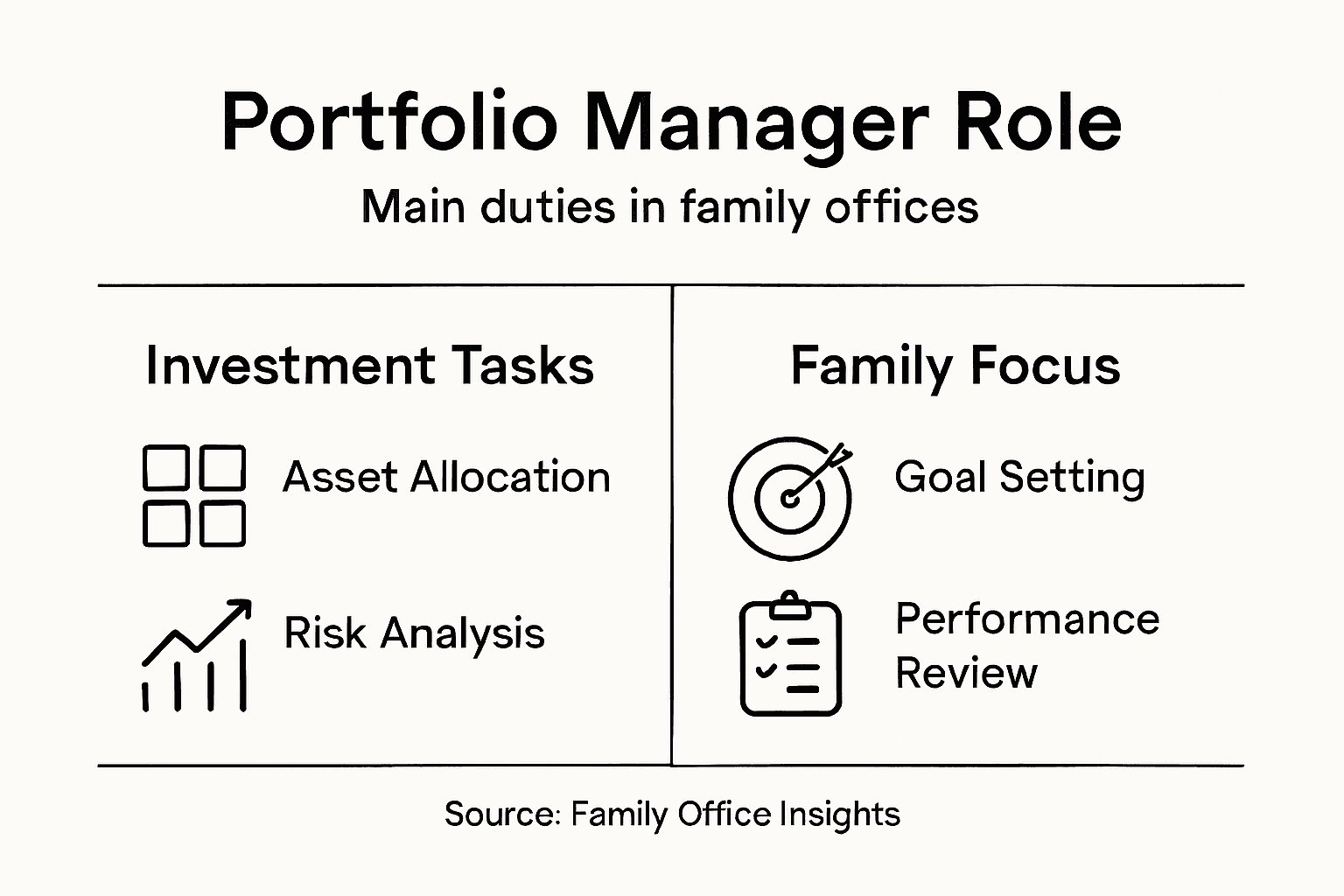
Portfolio managers in family offices bear a comprehensive set of critical responsibilities that extend far beyond traditional investment management. Core responsibilities encompass strategic asset allocation and intricate financial planning designed to preserve and grow multi-generational wealth.
Their core responsibilities typically include:
- Strategic Asset Allocation: Designing investment portfolios that balance risk and potential returns
- Due Diligence: Rigorously evaluating potential investments across multiple asset classes
- Risk Management: Implementing sophisticated strategies to mitigate potential financial vulnerabilities
- Performance Monitoring: Continuously tracking investment performance and making data-driven adjustments
- Tax Optimization: Developing tax-efficient investment strategies that minimize liability
- Estate Planning Integration: Aligning investment decisions with long-term family wealth transfer objectives
Successful portfolio managers recognize that investment strategies must be dynamically tailored to each family’s unique financial landscape. This requires a holistic approach that considers not just financial metrics, but also the family’s risk tolerance, generational goals, philanthropic interests, and evolving market conditions. They must balance aggressive growth strategies with prudent capital preservation, creating flexible investment frameworks that can adapt to changing economic environments.
The following table outlines how portfolio manager responsibilities support long-term family office goals:
| Responsibility | Strategic Benefit | Relevance for Multi-generational Wealth |
|---|---|---|
| Asset Allocation | Balances risk and returns | Sustains growth over generations |
| Due Diligence | Ensures informed decisions | Protects family assets |
| Tax Optimization | Minimizes liability | Preserves wealth across generations |
| Estate Planning | Aligns investment with legacy | Supports smooth family wealth transfer |
Pro tip: Develop a comprehensive understanding of your family clients’ complete financial ecosystem, including their personal values, long-term objectives, and unique risk preferences.
Regulatory Compliance and Fiduciary Duties
Portfolio managers in family offices operate within a complex landscape of legal and ethical responsibilities that demand extraordinary precision and integrity. Regulatory compliance involves navigating intricate global frameworks designed to protect family wealth and maintain institutional transparency.
The core fiduciary duties of portfolio managers encompass multiple critical dimensions:
- Prudent Investment Management: Making financially sound decisions that prioritize the family’s long-term interests
- Legal Adherence: Complying with local and international financial regulations
- Ethical Stewardship: Maintaining absolute confidentiality and avoiding conflicts of interest
- Transparent Reporting: Providing comprehensive and accurate financial disclosures
- Risk Mitigation: Implementing robust governance mechanisms to protect family assets
- Intergenerational Responsibility: Preserving and growing wealth for current and future family generations
Successful portfolio managers understand that regulatory compliance is not merely a legal requirement but a fundamental trust mechanism. They must continuously adapt to evolving legal landscapes, integrating sophisticated compliance strategies that balance aggressive wealth management with rigorous risk control. This requires an intricate understanding of international financial regulations, tax laws, investment guidelines, and ethical standards that can vary significantly across different jurisdictions.
Pro tip: Develop a proactive compliance framework that anticipates regulatory changes and integrates continuous learning and adaptation into your portfolio management strategy.
Risk Management and Performance Evaluation
Portfolio managers in family offices deploy sophisticated risk management frameworks designed to protect and optimize family wealth through comprehensive strategic planning. Performance evaluation involves intricate multi-dimensional assessments that extend far beyond traditional financial metrics.
Key components of robust risk management include:
- Quantitative Risk Analysis: Utilizing advanced statistical models to predict potential financial vulnerabilities
- Geopolitical Risk Monitoring: Tracking global economic and political trends that might impact investment strategies
- Scenario Planning: Developing multiple investment scenarios to prepare for potential market disruptions
- Liquidity Risk Assessment: Ensuring adequate financial flexibility across different market conditions
- Concentration Risk Management: Preventing over-exposure to specific sectors or investment classes
- Intergenerational Risk Considerations: Balancing current family needs with long-term wealth preservation objectives
Successful portfolio managers understand that risk management is a dynamic, continuous process requiring constant adaptation. They leverage sophisticated analytical tools, deep market insights, and comprehensive understanding of both macro and micro economic indicators to create resilient investment strategies. This approach demands not just financial expertise, but also forward-thinking strategic planning that anticipates potential market shifts and family-specific financial dynamics.
Pro tip: Develop a comprehensive risk dashboard that integrates quantitative metrics with qualitative family insights to create a holistic risk management approach.
Elevate Your Family Office Portfolio Management Today
Managing a family office portfolio requires blending sophisticated financial strategies with a deep understanding of unique family goals. The challenges of strategic asset allocation, risk management, and regulatory compliance demand expert guidance and reliable resources. If you seek to enhance performance evaluation, streamline fiduciary duties, and align investment approaches with multigenerational wealth preservation, you are not alone in this journey.

Unlock powerful solutions and connect with top-tier professionals by exploring the comprehensive platform at Future Family Office. Discover valuable insights, browse expert articles, and engage with a global network of family offices and service providers tailored to your needs. Take the next step now to transform your family office portfolio management with trusted resources and meaningful connections at Future Family Office. Visit Future Family Office to start building a future where your family’s legacy thrives.
Frequently Asked Questions
What is the role of a portfolio manager in a family office?
The portfolio manager in a family office acts as a strategic advisor who crafts tailored investment strategies, manages a diversified portfolio, and oversees financial planning, ensuring that each family’s unique goals and risk profiles are met.
How do family office portfolio managers differ from traditional wealth managers?
Family office portfolio managers go beyond standard wealth management by integrating complex investment strategies with personalized understanding of family dynamics, multi-generational goals, and legacy planning considerations.
What are the primary responsibilities of a portfolio manager in a family office?
Key responsibilities include strategic asset allocation, due diligence on potential investments, risk management, performance monitoring, tax optimization, and aligning investment decisions with long-term family wealth transfer objectives.
What types of portfolio managers are there in family offices?
Specializations in family offices include public equities managers, fixed income specialists, alternative investment managers, philanthropic portfolio managers, and venture capital/private equity managers, each focusing on unique asset classes and financial goals.
Recommended
- Does Impact Investing Always Come At A Price? – Future Family Office
- Complete Guide to Family Office Investment Strategies – Future Family Office
- Impact Investing Explained: Strategies for Family Offices – Future Family Office
- 14 Outdated Investing ‘Rules’ You Don’t Need To Follow Anymore – Future Family Office