


Most global family offices are surprised to learn that over half of all American investors now favor passive strategies for stable, long-term growth. As market volatility challenges traditional approaches, diversifying with passive investments matters more than ever to those entrusted with generational wealth. This piece will examine common myths, clarify risk factors, and highlight practical steps to help wealth executives build resilient portfolios using evidence-based passive investing concepts.
Table of Contents
- Defining Passive Investing and Common Myths
- Key Strategies: Index Funds, ETFs, and More
- How Passive Investing Builds Long-Term Wealth
- Comparing Passive and Active Investment Approaches
- Potential Risks and Cost Considerations for Families
Key Takeaways
| Point | Details |
|---|---|
| Understanding Passive Investing | Passive investing focuses on replicating market index performance with minimal trading, aiming for long-term wealth accumulation through diversification. |
| Key Investment Vehicles | Index funds and ETFs are the primary tools for passive investing, providing low-cost exposure to broad market benchmarks. |
| Evaluating Risks and Costs | Family offices must consider systemic risks and hidden expenses associated with passive investing, ensuring robust risk management practices are in place. |
| Hybrid Strategies for Balance | Combining passive core holdings with selective active investments can enhance portfolio performance while managing risks effectively. |
Defining Passive Investing and Common Myths
Passive investing represents a strategic approach where investors construct portfolios designed to mirror specific market indexes with minimal trading activity. Unlike active investment strategies that attempt to outperform markets through frequent buying and selling, passive investing focuses on tracking benchmark performance while minimizing transaction costs.
At its core, passive investing involves replicating market index portfolios through systematic investment techniques. These strategies typically involve purchasing broad market exchange traded funds (ETFs) or index mutual funds that proportionally represent specific market segments. By maintaining consistent allocations matching established indexes like the S&P 500, investors can achieve diversification and reduce individual stock selection risks.
Many misconceptions surround passive investing, with critics arguing that this approach potentially reduces market efficiency. Research indicates that while passive strategies lower transaction expenses, they might also impact market liquidity and price discovery mechanisms. The growing prevalence of passive investment vehicles can create complex market dynamics, potentially altering traditional price information transmission.
Pro tip: When implementing passive investing strategies, regularly rebalance your portfolio to maintain target asset allocations and manage potential concentration risks.
Key Strategies: Index Funds, ETFs, and More
Passive investing strategies primarily revolve around two core investment vehicles: index funds and exchange-traded funds (ETFs). Passive investment techniques focus on systematically replicating broad market benchmarks like the S&P 500, allowing family offices to achieve diversified exposure with minimal portfolio management overhead.
Index funds represent mutual funds engineered to mirror specific market indexes, providing investors with comprehensive market representation. These funds typically track established indexes such as the Dow Jones Industrial Average or Nasdaq Composite, offering low-cost, broad-based investment exposure. Exchange-traded funds (ETFs) function similarly but trade like individual stocks, providing additional liquidity and flexibility for sophisticated investors seeking targeted market segment investments.

The strategic advantages of these passive investment approaches include consistent performance, reduced transaction costs, and enhanced tax efficiency. By minimizing active trading and management expenses, family offices can potentially generate more stable long-term returns compared to actively managed portfolios. Moreover, these strategies eliminate individual stock selection risks, instead capturing overall market growth through systematic, rules-based investment methodologies.
Pro tip: Regularly analyze your passive investment holdings to ensure they continue matching your targeted asset allocation and risk tolerance, adjusting periodically to maintain optimal portfolio balance.
How Passive Investing Builds Long-Term Wealth
Passive investing offers a strategic approach to wealth accumulation by leveraging the power of consistent, low-cost market exposure. Long-term wealth building strategies fundamentally rely on capturing broad market growth while minimizing unnecessary investment expenses. This approach transforms traditional investment thinking by prioritizing sustained, steady returns over sporadic, high-risk trading strategies.
The core mechanism of wealth generation through passive investing involves systematic portfolio construction using index funds and ETFs that track comprehensive market benchmarks. By eliminating frequent trading and associated transaction costs, investors can benefit from compound growth and reduced tax implications. Retirement wealth accumulation becomes more accessible as these investment vehicles provide consistent exposure to market performance with significantly lower management overhead compared to actively managed funds.
Key advantages of passive investing for long-term wealth include predictable cost structures, diversification across multiple market segments, and alignment with historical market growth trends. Family offices can leverage these strategies to create resilient investment portfolios that systematically capture market returns while maintaining flexibility and minimizing unnecessary financial friction. The disciplined approach of buying and holding broadly diversified securities allows investors to benefit from long-term economic expansion without being derailed by short-term market volatility.
Pro tip: Implement dollar-cost averaging within your passive investment strategy to smooth out market fluctuations and consistently build wealth over time.
Comparing Passive and Active Investment Approaches
Family offices increasingly recognize the critical distinctions between passive and active investment strategies. Investment management approaches fundamentally differ in their core philosophy, with active strategies seeking to outperform market benchmarks while passive approaches aim to track market performance systematically.
Active investment management involves frequent trading and individual security selection, typically requiring more intensive research and higher management fees. Managers attempt to generate alpha by identifying undervalued securities or anticipating market trends. In contrast, passive investing focuses on replicating market index performance through low-cost vehicles like index funds and ETFs. Comparative investment research demonstrates that most active managers fail to consistently outperform market benchmarks after accounting for transaction costs and management expenses.
The strategic implications for family offices are significant. Passive investing offers predictable, transparent cost structures and broad market exposure, reducing individual security selection risks. While active management might provide advantages in specialized or less efficient market segments, the majority of long-term investment portfolios benefit from systematic, low-cost passive strategies that capture overall market growth. This approach allows family offices to maintain diversification, minimize unnecessary expenses, and align investments with long-term economic trends.
Here is a structured comparison of active and passive investing approaches:
| Aspect | Passive Investing | Active Investing |
|---|---|---|
| Objective | Track market index returns | Beat market benchmarks |
| Management Style | Minimal intervention | Frequent trades and research |
| Typical Expenses | Low fees, low turnover | Higher fees, more transactions |
| Risk Approach | Diversification, systematic | Security selection, market bets |
| Performance Consistency | Stable, market-aligned | Variable, depends on manager |
Pro tip: Consider implementing a hybrid approach that combines passive core holdings with selective active investments in specialized market segments for balanced portfolio performance.
Potential Risks and Cost Considerations for Families
Passive investing, while offering substantial benefits, presents nuanced risks that family offices must carefully evaluate. Systemic investment risks encompass complex market dynamics that extend beyond traditional investment performance metrics. These risks include potential market concentration, reduced individual stock liquidity, and increased correlation between securities during market turbulence.
Cost considerations represent another critical dimension of passive investing strategies. While passive approaches generally maintain lower expense ratios compared to active management, families must scrutinize hidden expenses such as tracking errors, transaction costs, and potential performance divergences from benchmark indexes. Market efficiency challenges emerge when substantial capital concentrates in similar passive investment vehicles, potentially creating artificial pricing mechanisms and reducing overall market responsiveness.
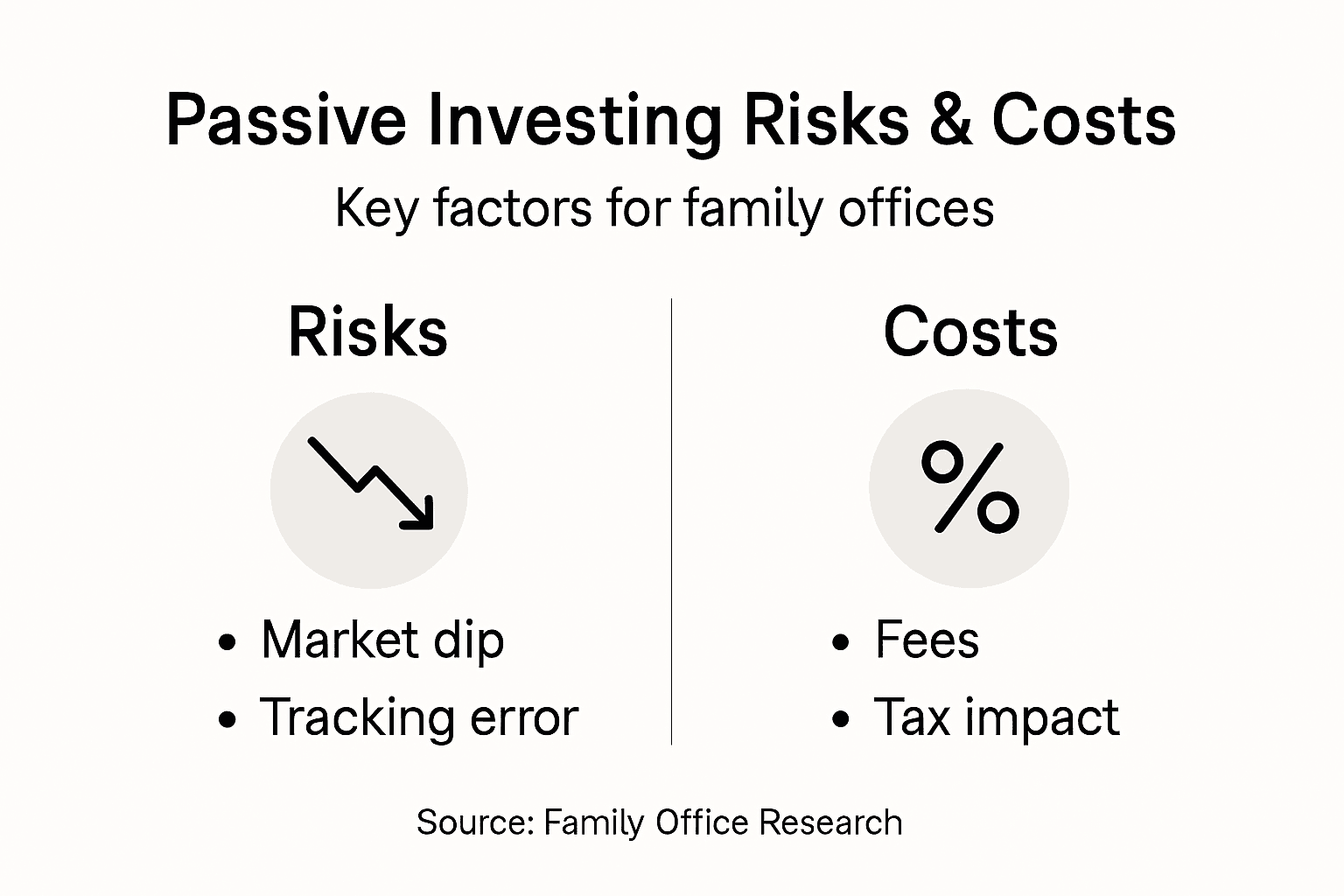
Below is a summary of key risks and additional cost considerations for passive investing:
| Risk/Cost Factor | Description | Potential Impact |
|---|---|---|
| Market Concentration | Overexposure to certain sectors | Increased vulnerability to downturns |
| Tracking Errors | Fund may deviate from index | Returns may differ from benchmark |
| Liquidity Concerns | Less trading of underlying stocks | Difficulty buying or selling shares |
| Hidden Expenses | Unseen transaction and rebalancing costs | Reduced net returns |
Family offices should implement comprehensive risk management frameworks that assess passive investment risks holistically. This involves regularly monitoring portfolio concentration, understanding potential liquidity constraints, and maintaining flexibility to adjust allocations based on evolving market conditions. By maintaining a sophisticated, analytical approach, families can leverage passive investing’s advantages while mitigating inherent systemic risks.
Pro tip: Conduct periodic stress testing on your passive investment portfolio to identify potential vulnerabilities and maintain robust risk management protocols.
Optimize Your Family Office Passive Investing Strategy Today
Navigating the complexities of passive investing requires more than just understanding index funds and ETFs. The article highlights challenges such as managing market concentration, tracking errors, and maintaining diversification while controlling costs. These pain points can impact your family office portfolio’s stability and long-term wealth growth. At Future Family Office, we empower ultra-high-net-worth families to overcome these obstacles by providing a centralized platform where you can connect with trusted service providers, access cutting-edge industry insights, and leverage expert knowledge tailored to passive investing strategies.

Discover how to build resilient, well-balanced portfolios that align with your specific goals through our extensive directory and networking tools. Visit Future Family Office now to engage with the global family office community and take actionable steps toward refining your passive investment approach. Start optimizing your portfolio with resources and connections designed to reduce risk and boost performance in today’s markets.
Frequently Asked Questions
What is passive investing?
Passive investing is a strategy where investors create portfolios to mirror specific market indexes with minimal trading activity. It focuses on tracking benchmark performance, primarily through index funds or exchange-traded funds (ETFs).
How do index funds and ETFs work in passive investing?
Index funds and ETFs are designed to replicate market indexes, providing diversified exposure. Index funds are mutual funds that track specific indexes, while ETFs trade like stocks, offering liquidity and flexibility.
What are the benefits of passive investing for family offices?
Passive investing provides long-term wealth accumulation, lower transaction costs, diversification, and enhanced tax efficiency. It allows family offices to achieve stable, predictable returns by capturing overall market growth.
What are potential risks associated with passive investing?
Potential risks include market concentration, tracking errors, and liquidity concerns. It’s important for family offices to monitor their portfolios regularly and assess these risks to mitigate potential impacts on their investments.
Recommended
- Family Offices Take the Wheel in Private Investments – Future Family Office
- Complete Guide to Family Office Investment Strategies – Future Family Office
- Where Family Offices Are Investing Their Wealth – Future Family Office
- Family Office Investments Surge in February – Future Family Office
- Hoe verdien je passief inkomen – Ondernemers Plaza Online