


Most American family offices and UHNW investors face growing complexity as global markets shift and new risks emerge. Wealth preservation is not simply about chasing returns but about building a disciplined strategy that truly reflects your unique objectives. Research shows that disciplined portfolio diversification can reduce annual volatility by up to 30 percent. Here you will find a clear, practical roadmap to define, diversify, and protect your capital across market cycles.
Table of Contents
- Step 1: Assess Financial Objectives And Risk Tolerance
- Step 2: Select Asset Classes For Diversification
- Step 3: Allocate Capital Across Selected Investments
- Step 4: Implement Portfolio Management Practices
- Step 5: Evaluate And Adjust Investment Performance
Quick Summary
| Key Insight | Explanation |
|---|---|
| 1. Define financial goals clearly | Outline specific objectives like retirement or wealth building to guide your investment choices. |
| 2. Assess risk tolerance accurately | Evaluate your emotional and financial capacity for market fluctuations to align with investment strategy. |
| 3. Choose diverse asset classes | Select a mix of stocks, bonds, and alternatives to build a resilient investment portfolio. |
| 4. Implement disciplined capital allocation | Strategically distribute your investments according to risk profile and goals for better performance. |
| 5. Regularly review and adjust portfolio | Conduct frequent performance evaluations to ensure alignment with financial objectives and market conditions. |
Step 1: Assess financial objectives and risk tolerance
Charting your investment journey starts with a clear understanding of your financial landscape and personal risk boundaries. This critical first step involves deep self reflection and honest evaluation of what you want to achieve financially and how much market uncertainty you can comfortably withstand.
Begin by mapping out your specific financial goals. Are you saving for retirement, building generational wealth, funding a major purchase, or seeking consistent income generation? Each objective carries different investment implications. A comprehensive review of financial risk tolerance suggests that socio demographic factors like age, income, and personal experiences significantly influence how you perceive and manage investment risks.
To systematically assess your risk profile, create a detailed inventory of your current financial situation. Calculate your total assets, existing investments, income streams, and outstanding liabilities. Consider your investment time horizon carefully. Younger investors with decades before retirement can typically tolerate more market volatility, while those closer to retirement might prefer more conservative strategies. Evaluate your emotional capacity for potential investment fluctuations by honestly asking yourself how you would react to a 20 percent portfolio decline. Would market turbulence cause significant stress, or can you maintain a disciplined long term perspective?
Work through a structured risk assessment questionnaire that explores your financial comfort zones, past investment experiences, and psychological resilience. Many financial institutions offer sophisticated risk tolerance evaluation tools that can provide nuanced insights into your investment personality. These assessments help match your investment strategy with your genuine risk appetite.
Pro tip: Update your risk assessment annually, as personal circumstances and financial goals evolve over time, requiring periodic recalibration of your investment approach.
Step 2: Select asset classes for diversification
Selecting the right asset classes is crucial for building a robust investment portfolio that balances risk and potential returns. This step involves strategically choosing investments that work together to create a resilient financial strategy.
Start by understanding the core asset class categories and their unique characteristics. Traditional asset classes include stocks, bonds, and cash equivalents, while alternative investments encompass real estate, commodities, private equity, and hedge funds. Each asset class responds differently to market conditions. Stocks typically offer growth potential, bonds provide stability and income, while alternative investments can serve as portfolio shock absorbers during market volatility.
Develop a strategic allocation approach that matches your risk tolerance and financial goals. A well diversified portfolio might include a mix of 50 percent stocks, 30 percent bonds, and 20 percent alternative investments. Consider global diversification to reduce regional economic risks. Look for assets that have low correlation with each other, meaning when one investment declines, another might remain stable or increase. This approach helps smooth out portfolio performance and reduces overall investment risk.
Research each potential asset class thoroughly. Examine historical performance, understand the underlying economic drivers, and assess how each investment might fit into your broader financial strategy. Pay attention to factors like liquidity, transaction costs, and potential tax implications. Some alternative investments like real estate or private equity might require longer investment horizons and have different risk profiles compared to more traditional stock and bond investments.
Here’s a summary of how different asset classes can contribute to a diversified portfolio:
| Asset Class | Main Benefit | Typical Risk Level | Liquidity |
|---|---|---|---|
| Stocks | Long-term growth | Moderate to high | High |
| Bonds | Income and stability | Low to moderate | High |
| Real Estate | Inflation hedge | Moderate | Low to moderate |
| Commodities | Diversification value | Moderate to high | Moderate |
| Cash Equivalents | Safety and flexibility | Very low | Very high |
Pro tip: Rebalance your portfolio annually to maintain your target asset allocation and adapt to changing market conditions and personal financial circumstances.
Step 3: Allocate capital across selected investments
Allocating your investment capital strategically is the critical bridge between planning and actual wealth generation. This step transforms your diversification strategy from theoretical concept to practical implementation.

Begin by understanding the capital allocation process and its fundamental principles. Think of your investment portfolio like a well-designed ecosystem where each asset plays a specific role. Start by determining precise percentage allocations based on your risk tolerance and financial goals. For instance, if you have identified stocks, bonds, real estate, and commodities as your chosen asset classes, you might allocate 40 percent to stocks, 30 percent to bonds, 20 percent to real estate, and 10 percent to commodities.
Implement a disciplined approach to capital distribution. Consider using dollar cost averaging to spread your investments over time, reducing the risk of investing everything at a potentially unfavorable market moment. Evaluate each investment opportunity through multiple lenses including potential returns, risk profile, liquidity, and alignment with your overall financial objectives. Pay close attention to transaction costs, tax implications, and the specific entry points for each investment vehicle. Some assets like private equity or real estate might require larger upfront capital commitments, while stocks and bonds offer more flexible investment thresholds.
Monitor and adjust your allocations regularly. Market conditions, personal financial circumstances, and economic trends can shift quickly. Develop a systematic review process to assess how your investments are performing relative to your initial expectations. Be prepared to rebalance your portfolio periodically to maintain your target asset allocation and respond to changing market dynamics.
Pro tip: Use digital portfolio tracking tools to get real time insights into your asset allocation and quickly identify when your investment mix drifts from your original strategy.
Step 4: Implement portfolio management practices
Implementing effective portfolio management practices transforms your investment strategy from a theoretical plan into a dynamic, responsive financial system. This crucial stage requires a systematic approach to monitoring, analyzing, and adjusting your investments.
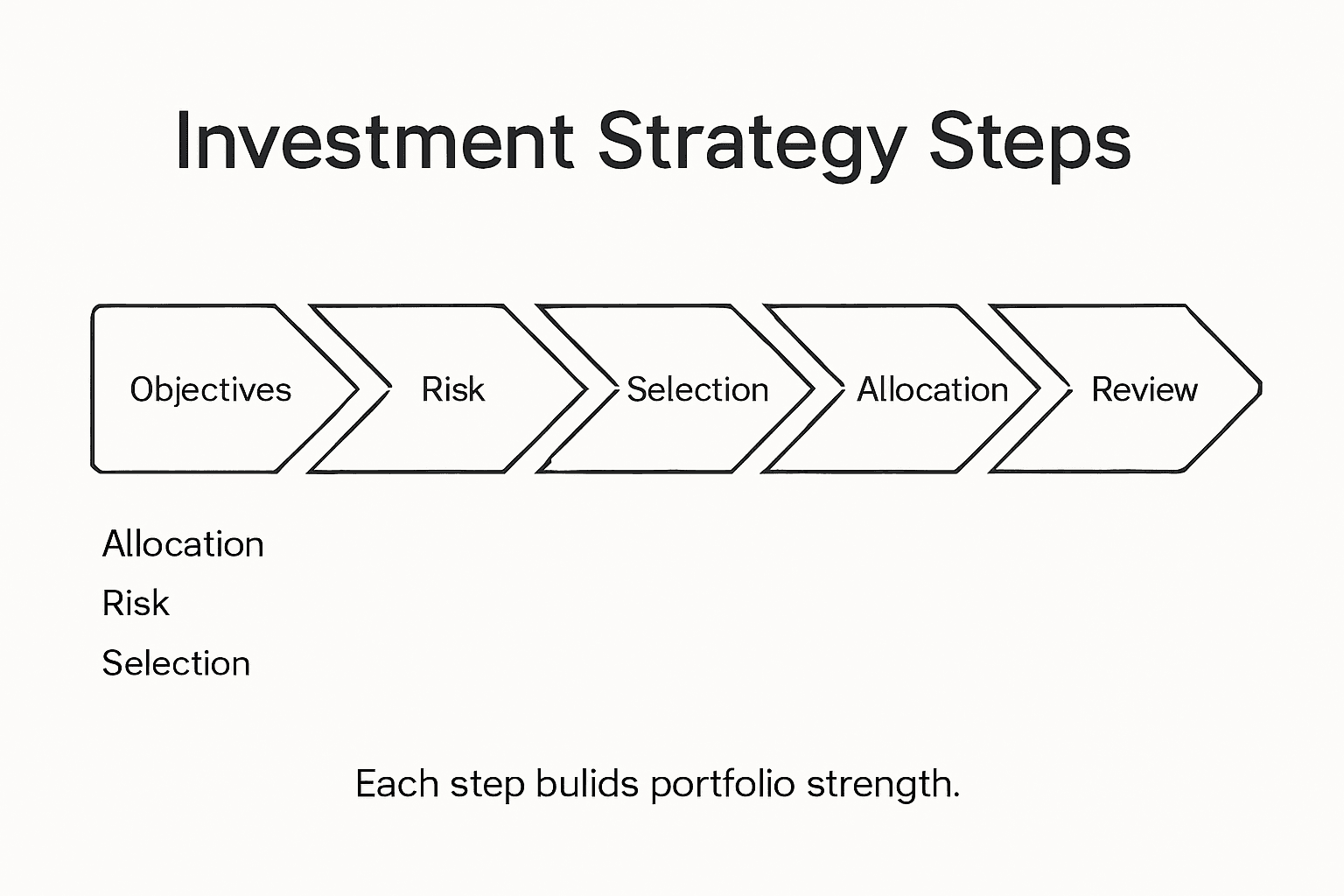
Start by establishing a comprehensive portfolio management framework that aligns with your overall financial objectives. Create a structured governance process that includes regular performance reviews, risk assessments, and strategic realignment. Develop a detailed tracking system that monitors key performance indicators for each asset class, including returns, volatility, correlation, and individual asset performance. This approach allows you to make data driven decisions and quickly respond to market changes.
Establish a consistent review schedule to evaluate your portfolio’s performance. Many successful investors conduct quarterly deep dive assessments and monthly quick check ins. During these reviews, analyze how each investment is performing relative to its benchmark and your initial expectations. Look for opportunities to rebalance your portfolio, taking into account changes in market conditions, your personal financial situation, and long term investment goals. Pay attention to tax efficiency, transaction costs, and the potential impact of rebalancing on your overall investment strategy.
Develop a robust risk management approach that goes beyond simple performance tracking. This includes stress testing your portfolio under different market scenarios, maintaining a diversified asset allocation, and setting clear risk tolerance limits for each investment. Consider using professional portfolio management tools that can provide advanced analytics and predictive insights. These tools can help you identify potential risks and opportunities before they become significant market movements.
The following table outlines common portfolio review practices and their purposes:
| Review Type | Frequency | Key Purpose |
|---|---|---|
| Deep Dive | Quarterly | Spot strategic changes, rebalance |
| Quick Check | Monthly | Track short-term performance |
| Benchmarking | Annually | Compare with market standards |
| Stress Test | As needed | Assess risk under scenarios |
Pro tip: Create a detailed investment policy statement that outlines your specific investment goals, risk tolerance, and decision making criteria to provide a clear framework for your portfolio management approach.
Step 5: Evaluate and adjust investment performance
Evaluating and adjusting your investment performance is a critical ongoing process that transforms static investments into a dynamic financial strategy. This step requires systematic analysis and strategic recalibration to ensure your portfolio continues meeting your financial objectives.
Begin by conducting a comprehensive investment performance analysis that goes beyond simple return calculations. Develop a multi dimensional assessment framework that examines risk adjusted returns, comparing each investment against appropriate benchmarks. Calculate key metrics such as the Sharpe ratio, which measures return relative to risk, and track your portfolio’s performance against relevant market indices. Pay close attention to how individual assets correlate and contribute to overall portfolio stability.
Implement a structured review process that allows for meaningful performance insights. Conduct quarterly deep dive assessments and monthly quick check ins to monitor your investments. During these reviews, evaluate each asset class and individual investment against your original financial objectives. Look for investments that consistently underperform or no longer align with your strategic goals. Be prepared to make informed adjustments, which might include rebalancing asset allocations, replacing underperforming investments, or shifting strategy based on changing market conditions and personal financial circumstances.
Develop a disciplined approach to performance tracking that considers both quantitative and qualitative factors. Beyond numerical returns, assess how investments align with your broader financial goals, risk tolerance, and personal values. Consider tax efficiency, transaction costs, and the potential long term implications of any portfolio changes. Use advanced portfolio management tools that provide predictive analytics and scenario modeling to help you make more informed decisions.
Pro tip: Create a standardized performance tracking spreadsheet with clear performance metrics, benchmarks, and review dates to systematize your investment evaluation process.
Take Control of Your Investment Journey With Expert Support
Building a diversified investment portfolio requires clear financial goals, disciplined capital allocation, and ongoing performance evaluation. This article highlights common challenges like defining risk tolerance, selecting the right asset classes, and implementing active portfolio management. If you are seeking to navigate these complex steps with confidence and access quality resources designed for ultra-high-net-worth investors, Future Family Office is your ideal partner.

Discover a vibrant global community dedicated to private wealth management at Future Family Office. Gain access to expert insights, trusted service providers, and collaboration opportunities tailored for sophisticated family offices and UHNW individuals. Start building your personalized investment strategy today by connecting with industry leaders and leveraging exclusive news and tools that help you stay ahead in a changing market. Visit Future Family Office now to unlock transparent solutions that elevate your portfolio management process.
Frequently Asked Questions
What are the first steps in developing a step-by-step investment strategy for diversified growth?
Start by assessing your financial objectives and risk tolerance. Map out your specific financial goals, inventory your current financial situation, and evaluate how much market uncertainty you can handle. Take time to reflect on your needs to align your investment strategies accordingly.
How can I choose the right asset classes for my investment portfolio?
To select the appropriate asset classes, understand the core categories like stocks, bonds, and alternative investments. Aim for a balanced allocation that matches your risk tolerance; for example, you might consider a mix of 50% stocks, 30% bonds, and 20% alternative investments to promote diversification.
What is the importance of allocating capital across selected investments?
Allocating capital ensures your investment strategy transitions from plan to execution. Determine the exact percentage for each asset class according to your financial goals, such as allocating 40% to stocks and 30% to bonds, to effectively balance risk and returns in your portfolio.
How often should I evaluate my investment performance?
Conduct a thorough evaluation of your investment performance at least quarterly, with quick monthly check-ins. Look at how each investment aligns with your financial goals and make adjustments as necessary to maintain a balanced approach.
What practices should I implement for effective portfolio management?
Establish a structured portfolio management framework, including regular performance reviews and risk assessments. Develop a tracking system that monitors key performance indicators for each asset class, allowing you to make informed decisions based on data.
How can I adjust my investment strategy over time?
Regularly reassess your investments following each market review or significant life changes. Be prepared to rebalance your portfolio, swapping out underperforming assets or adjusting allocations to stay aligned with your long-term financial objectives.
Recommended
- Portfolio Diversification Step by Step for Smarter Investing – Future Family Office
- Why Diversify Assets: Complete Guide for Investors – Future Family Office
- Mastering the Portfolio Diversification Workflow for Success – Future Family Office
- Understanding Why Diversify Family Office Portfolio – Future Family Office
- Waste Reduction for SMEs: Practical UK Strategies for 2025 – Venture Waste