


Most family office investment managers spend over eighty percent of their time manually screening deals, yet key risks often go unnoticed until it’s too late. Whether managing an American portfolio or multinational assets, upgrading your investment screening workflow directly impacts performance and risk control. This guide highlights proven steps that help you convert scattered data into actionable intelligence and ensure consistent, objective decision making for every opportunity.
Table of Contents
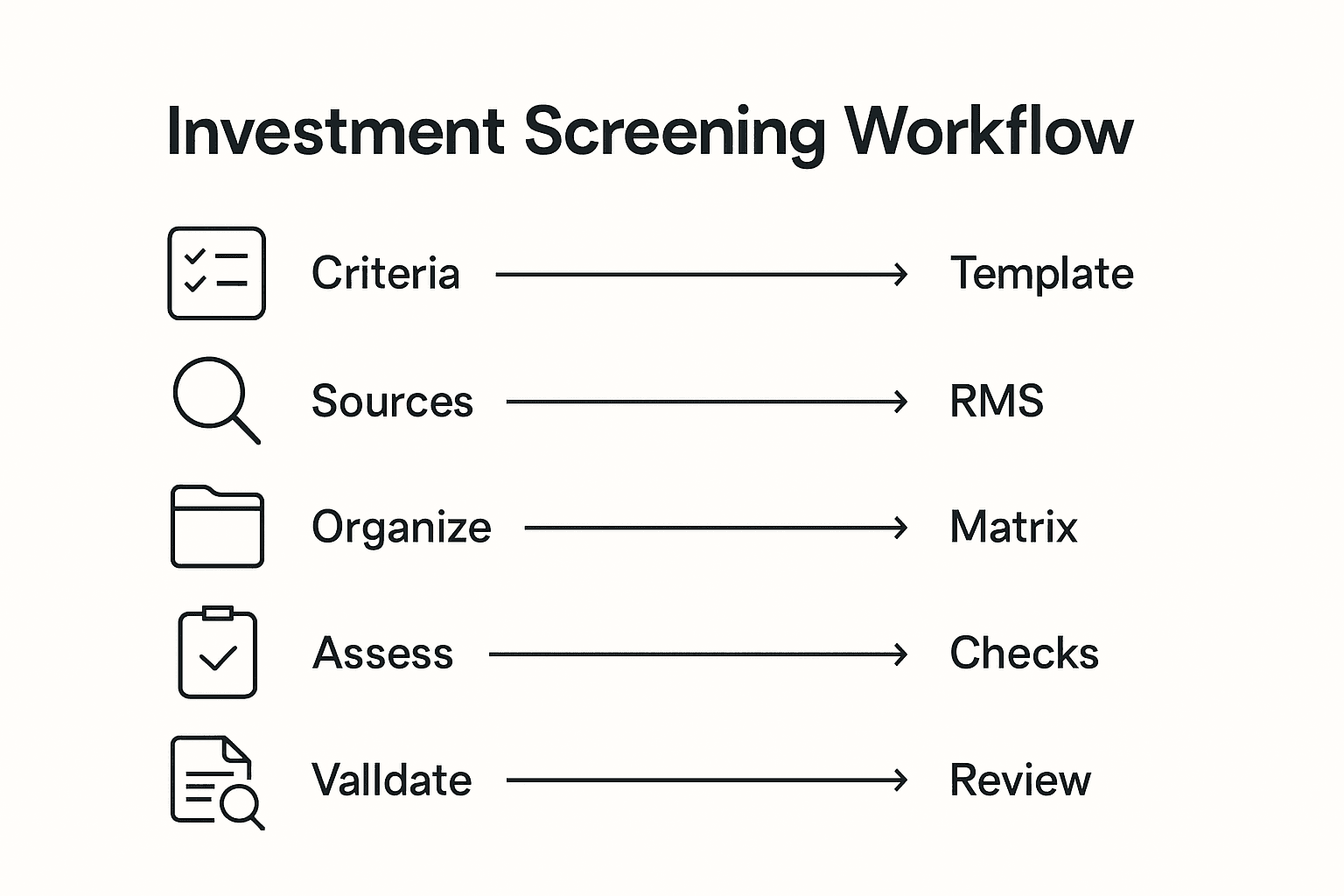
- Step 1: Establish Key Screening Criteria And Data Sources
- Step 2: Collect And Organize Prospective Investment Information
- Step 3: Assess Opportunities Using Standardized Evaluation Tools
- Step 4: Conduct Thorough Due Diligence And Risk Checks
- Step 5: Validate And Document Final Investment Decisions
Quick Summary
| Key Insight | Explanation |
|---|---|
| 1. Define Clear Screening Criteria | Establish specific parameters to filter investment opportunities effectively based on your family office’s strategy. |
| 2. Organize Investment Information | Use systematic workflows and digital management tools to consolidate diverse investment data for easier analysis. |
| 3. Implement Standardized Assessment Tools | Create customizable scorecards for objective evaluation, incorporating both quantitative and qualitative factors for thorough analysis. |
| 4. Conduct Comprehensive Due Diligence | Develop a checklist for risk assessment that includes financial, legal, and operational evaluations to identify potential hazards. |
| 5. Document Investment Decisions Thoroughly | Maintain a structured record of investment rationales and decisions to support accountability and future strategy refinement. |
Step 1: Establish key screening criteria and data sources
Successfully screening investment opportunities requires creating a robust framework that identifies your family office’s precise strategic requirements. Your screening process will transform raw data into actionable insights by defining clear parameters and selecting authoritative information sources.
Begin by mapping out comprehensive screening criteria that align with your investment philosophy. This means developing specific filters across multiple dimensions such as financial performance, governance standards, technological innovation, and potential risk exposure. The United Nations Conference on Trade and Development (UNCTAD) Investment Policy Monitor recommends establishing transparent procedural rules that capture nuanced evaluation metrics beyond traditional financial indicators. Consider creating weighted scoring systems that assign different importance levels to factors like management team quality, market positioning, sustainability practices, and regulatory compliance.
Next, curate a diverse portfolio of reputable data sources that provide comprehensive and current intelligence. Prioritize platforms offering granular insights such as specialized financial databases, regulatory filing repositories, industry research reports, and real time market intelligence services. Cross reference information from multiple sources to validate data accuracy and reduce potential screening biases. Your goal is building a dynamic intelligence ecosystem that continuously updates and refines your investment screening approach.
Pro Tip: Create a standardized screening template with predefined criteria weightings to ensure consistent and objective evaluation across potential investment opportunities.
Step 2: Collect and organize prospective investment information
Collecting and organizing investment information requires a strategic approach that transforms scattered data into a cohesive intelligence system. Your goal is to create a structured repository that enables rapid analysis and informed decision making across your family office’s investment landscape.

Start by implementing a comprehensive information gathering strategy that leverages multiple research channels. PwC’s Global Family Office Deals Study recommends developing robust methodologies for collecting and managing investment data across different asset classes and geographic regions. This involves establishing a systematic workflow that captures critical information from diverse sources such as financial databases, industry reports, regulatory filings, market intelligence platforms, and direct networking channels. Prioritize sources that offer verified, real time data and maintain a consistent approach to information validation and cross referencing.
To streamline your information management, consider adopting a digital Research Management System that centralizes and categorizes investment intelligence. Modern platforms offer advanced features like automated research tracking, collaborative annotation tools, and integrated document management. These systems enable your team to store, tag, and quickly retrieve investment related documents while maintaining strict access controls and maintaining a comprehensive audit trail of your research process.
Pro Tip: Develop a standardized tagging and categorization protocol for your investment research to ensure consistent information retrieval and reduce time spent searching for critical documents.
Step 3: Assess opportunities using standardized evaluation tools
Developing a systematic approach to opportunity assessment transforms subjective investment decisions into disciplined, repeatable strategies. Your goal is to create a robust evaluation framework that objectively measures potential investments across multiple critical dimensions.
Countercyclical’s investment research guide highlights the importance of developing comprehensive judgment frameworks that integrate scenario analysis and sophisticated risk identification techniques. Begin by constructing a customizable scorecard that allows for nuanced assessment across different asset classes. This scorecard should incorporate quantitative metrics like financial performance indicators, market positioning, growth potential, and liquidity alongside qualitative factors such as management quality, competitive landscape, and strategic alignment with your family office’s investment philosophy.
Leverage institutional grade evaluation processes that provide structured comparison methods. The PwC Global Family Office Deals Study recommends implementing template driven reviews that enable consistent and fair opportunity assessments. Develop a multi tiered evaluation approach that includes initial screening, detailed due diligence, and comparative analysis. Integrate stress testing scenarios to understand potential investment performance under various market conditions, ensuring your assessment methodology provides comprehensive insights beyond surface level financial metrics.
Comparison of qualitative versus quantitative investment assessment factors:
| Assessment Type | Typical Factors | Example Impact |
|---|---|---|
| Quantitative | ROI, liquidity, growth rates | Measure potential returns objectively |
| Qualitative | Team quality, alignment, governance | Identify long-term strategic fit |
Pro Tip: Create a weighted scoring matrix that automatically calculates overall investment potential, allowing for quick comparative analysis across diverse investment opportunities.
Step 4: Conduct thorough due diligence and risk checks
Thorough due diligence represents the critical gateway between potential investment opportunities and strategic asset allocation. Your objective is to transform preliminary investment insights into a comprehensive risk assessment that protects your family office’s financial interests.
Alvarez & Marsal’s governance report emphasizes the critical importance of formalized due diligence policies that systematically evaluate potential risks across financial, legal, and operational dimensions. Begin by developing a structured checklist that covers comprehensive background investigations of potential investment targets. This should include detailed financial statement analysis, leadership team background checks, regulatory compliance verification, and assessment of potential conflicts of interest. Focus on uncovering hidden risks that might not be immediately apparent through standard financial reporting.
Simple’s Family Office Security & Risk Report recommends implementing a multi layered risk assessment framework that categorizes and prioritizes potential vulnerabilities. Develop a dynamic risk monitoring system that goes beyond initial screening to provide ongoing evaluation. This approach should integrate scenario planning techniques that model potential market disruptions, regulatory changes, and operational challenges. Implement robust cyber security protocols, verify third party relationships, and establish clear mechanisms for continuous risk reassessment.
Pro Tip: Create a standardized risk scoring matrix that automatically flags potential red flags and assigns risk weightings across different investment dimensions.
Step 5: Validate and document final investment decisions
Validating and documenting investment decisions transforms your strategic thinking into a clear institutional record that supports accountability and future strategic planning. Your goal is to create a comprehensive narrative that captures the rationale, potential risks, and expected outcomes of each investment opportunity.
Mercer’s guidance emphasizes the critical importance of formally documenting investment philosophies through structured governance frameworks. Develop a standardized investment decision template that systematically captures key elements such as initial investment thesis, detailed risk assessment, expected return projections, alignment with overall portfolio strategy, and potential exit scenarios. This documentation should include quantitative metrics, qualitative observations, and a clear explanation of how the investment fits within your family office’s broader investment philosophy and risk tolerance.
Create a robust validation process that requires multiple levels of review and signoff. This should involve a cross functional team that critically evaluates the investment recommendation from different perspectives including financial analysis, strategic alignment, risk management, and long term portfolio impact. Implement a formal decision log that tracks the entire investment evaluation journey, including dissenting opinions, alternative scenarios considered, and the ultimate rationale for moving forward. Ensure that your documentation is both comprehensive and accessible, allowing for future review and potential learning.
Pro Tip: Establish a quarterly review process that reassesses documented investment decisions against actual performance, creating a feedback loop for continuous improvement of your investment strategy.
Here’s a quick summary of essential steps in the investment screening process:
| Step | Main Objective | Key Tools or Methods |
|---|---|---|
| 1. Screening Criteria | Define evaluation parameters | Weighted filters, trusted sources |
| 2. Data Collection | Gather and organize intelligence | Research management systems |
| 3. Assessment | Evaluate opportunities | Custom scorecards, stress tests |
| 4. Due Diligence | Uncover and monitor risks | Checklists, dynamic risk monitoring |
| 5. Validation | Finalize and document decisions | Multi-level reviews, decision logs |
Streamline Your Investment Screening with Future Family Office
Investment screening for family offices demands precision when defining criteria, gathering data, assessing risks, and validating decisions. This process can feel overwhelming without the right tools and access to a trusted network. If you are striving to create objective evaluation frameworks, maintain reliable data sources, and conduct thorough due diligence as emphasized in “Optimize Your Investment Screening Workflow for Family Offices” you understand the need for an intelligent, connected platform.
Discover how Future Family Office can elevate your investment screening through comprehensive service provider listings and a vibrant global community dedicated to family office success. Our platform offers curated resources and expert insights to support your development of standardized scorecards, risk assessment matrices, and validation processes. By joining our network you gain not only timely market intelligence but also direct connections to specialized consultants and software firms designed to make your investment workflow more transparent and efficient.

Transform your screening challenges into strategic advantages today. Start building your trusted ecosystem and access essential tools by visiting Future Family Office. Leverage expert articles, industry reports, and networking opportunities to validate and document your investments confidently. Take the next step in optimizing your family office’s screening process now.
Frequently Asked Questions
What screening criteria should I consider for investment opportunities in my family office?
To effectively screen investment opportunities, focus on criteria that align with your investment philosophy, such as financial performance, governance standards, and risk exposure. Create specific filters across these dimensions to refine your evaluation process.
How can I organize investment information effectively for my family office?
Implement a comprehensive information gathering strategy that utilizes multiple research channels to collect and organize investment data. Develop a digital repository that categorizes and centralizes your investment intelligence for easy access and rapid analysis.
What tools can help me assess potential investment opportunities systematically?
Use a customizable scorecard to evaluate investment opportunities across both quantitative and qualitative factors. This structured approach helps ensure disciplined and repeatable assessments of potential investments.
What steps should I include in my due diligence process?
Conduct thorough due diligence by developing a structured checklist that covers financial analysis, background checks, and regulatory compliance. This ensures that you identify any hidden risks before making investment decisions.
How can I validate and document my investment decisions?
Develop a standardized investment decision template that captures critical elements like risk assessments and expected returns. Ensure that multiple levels of review validate your decisions, creating a clear audit trail for future reference.