


More than 60 percent of American family offices have experienced a significant privacy challenge in the last year. As wealth management grows more complex, the risks surrounding sensitive information multiply fast. For families entrusted with generational assets, safeguarding privacy means much more than locking down documents. Explore how modern American strategies weave together technology, legal measures, and discreet practices to create true protection in a rapidly evolving world.
Table of Contents
- Defining Privacy In Family Offices Today
- Strategic Components Of Family Office Privacy
- Types Of Confidentiality Structures Used
- Key Confidentiality Structure Characteristics
- Legal And Regulatory Pressures On Privacy
- Key Privacy Regulatory Considerations
- Common Privacy Risks And Cyber Threats
- Key Cyber Threat Categories
- Best Practices For Data Protection Strategies
- Key Data Protection Framework Elements
Key Takeaways
| Point | Details |
|---|---|
| Privacy Strategies | Family offices require comprehensive privacy strategies that include advanced cybersecurity, legal protections, and reputation management to safeguard sensitive information. |
| Confidentiality Structures | Utilizing specialized legal frameworks like Family Limited Partnerships can enhance privacy and control over family assets, adapting to unique needs and complexities. |
| Regulatory Compliance | Evolving regulatory environments necessitate dynamic compliance strategies and risk assessments to meet stringent data protection standards. |
| Cyber Threat Management | Implementing multilayered cybersecurity defenses and continuous education for personnel is essential to mitigate the risk of cyber threats targeted at family offices. |
Defining Privacy in Family Offices Today
Privacy in family offices represents a multifaceted strategic approach to protecting sensitive financial and personal information. Beyond traditional confidentiality measures, modern family offices recognize privacy as a comprehensive shield encompassing digital security, legal protections, and strategic discretion.
Family offices implement sophisticated cybersecurity measures to safeguard complex financial networks and personal data. These strategies involve multiple layers of protection, including advanced encryption technologies, restricted digital access protocols, and rigorous verification processes. Technological defenses are complemented by legal frameworks designed to prevent unauthorized information disclosure, ensuring that sensitive details about wealth, investments, and family structures remain confidential.
The privacy landscape for family offices has evolved dramatically with digital transformation. Cybersecurity threats, data breaches, and sophisticated digital intrusion techniques have made privacy protection more complex than ever. Wealthy families now require comprehensive privacy strategies that extend beyond traditional boundaries, incorporating digital forensics, reputation management, and proactive risk mitigation. This holistic approach demands continuous adaptation, ongoing education, and strategic investments in cutting-edge security technologies.
Pro Tip: Privacy Protection Strategy: Conduct annual comprehensive privacy audits that assess technological vulnerabilities, review digital access protocols, and update security infrastructure to stay ahead of emerging cyber threats and protect your family’s sensitive information.
Strategic Components of Family Office Privacy
Key Privacy Protection Elements:
- Advanced encryption technologies
- Restricted digital access protocols
- Legal information protection frameworks
- Comprehensive cybersecurity monitoring
- Reputation management strategies
- Continuous security training and awareness
Types of Confidentiality Structures Used
Confidentiality structures in family offices represent sophisticated legal and organizational frameworks designed to protect sensitive financial information and maintain strategic privacy. These intricate arrangements go beyond simple legal protections, serving as comprehensive mechanisms for managing wealth, controlling information flow, and preserving family autonomy.

Family offices frequently utilize specialized legal structures like General Partnerships and Family Limited Partnerships to balance operational efficiency with robust confidentiality requirements. These structures provide multiple layers of protection, enabling families to manage ownership, control decision-making processes, and limit external visibility of their financial operations. General Partnerships allow for flexible governance, while Family Limited Partnerships create additional barriers between family assets and potential external scrutiny.
The selection of an appropriate confidentiality structure depends on multiple strategic considerations, including family size, wealth complexity, investment portfolio diversity, and specific privacy requirements. Some families opt for complex trust arrangements, while others prefer more direct corporate structures with embedded privacy protocols. Key considerations include tax implications, legal jurisdictions, inheritance planning, and the potential for future generational wealth transfer. Advanced structures might incorporate international legal entities, offshore arrangements, and multi-layered ownership models to enhance privacy and asset protection.
Pro Tip: Structure Selection Strategy: Consult specialized legal experts who understand both your family’s unique dynamics and the nuanced landscape of privacy protection to design a tailored confidentiality framework that evolves with your family’s changing needs.
Key Confidentiality Structure Characteristics
Recommended Privacy Protection Structures:
Here is a comparison of common confidentiality structures used by family offices:
| Structure Type | Main Advantage | Typical Use Case |
|---|---|---|
| General Partnership | Flexible management and governance | Operating businesses or joint ventures |
| Family Limited Partnership | Asset protection and estate planning | Family asset consolidation |
| Discretionary Trust | Control of asset distribution | Succession and inheritance planning |
| Hybrid Corporate Entity | Combines corporate perks with privacy | Complex investments and holdings |
| Offshore Legal Arrangement | International privacy and tax optimization | Cross-border wealth structuring |
| Multigenerational Wealth Vehicle | Long-term preservation across generations | Family legacy and next-gen transfers |
- General Partnerships
- Family Limited Partnerships
- Discretionary Trusts
- Hybrid Corporate Entities
- Offshore Legal Arrangements
- Multigenerational Wealth Transfer Vehicles
Legal and Regulatory Pressures on Privacy
Regulatory landscapes surrounding family office privacy have become increasingly complex, reflecting the global challenge of protecting sensitive financial information in an era of unprecedented digital transparency. Legal frameworks now demand sophisticated approaches to data protection that balance institutional transparency with individual privacy rights.
The emergence of large-scale data collection systems presents significant challenges to individual privacy frameworks, compelling family offices to develop more nuanced privacy protection strategies. These evolving regulatory environments require comprehensive risk assessment mechanisms that go beyond traditional compliance models. Governments worldwide are implementing stricter data protection regulations, forcing family offices to continuously adapt their privacy protocols to meet emerging legal standards.
Advanced privacy management now incorporates sophisticated frameworks like the Five Safes model, which provides a structured approach to assessing and mitigating disclosure risks. This approach evaluates privacy protection across multiple dimensions: safe data, safe projects, safe people, safe settings, and safe outputs. Family offices must now implement multi-layered compliance strategies that account for technological, legal, and ethical considerations of data privacy. This involves not just protecting financial information, but also managing digital footprints, controlling information access, and maintaining comprehensive audit trails.
Pro Tip: Compliance Evolution Strategy: Develop a dynamic privacy compliance framework that includes regular legal reviews, technology assessments, and proactive adaptation to emerging regulatory requirements across different jurisdictions.
Key Privacy Regulatory Considerations
Critical Compliance Elements:
- Comprehensive data protection protocols
- Cross-jurisdictional legal compliance
- Advanced risk assessment frameworks
- Digital information management systems
- Ethical data handling procedures
- Continuous regulatory monitoring
Common Privacy Risks and Cyber Threats
Cyber risks in family offices represent a complex and evolving landscape of digital vulnerabilities that threaten the confidentiality and integrity of sensitive financial information. These threats range from sophisticated external hacking attempts to internal data management failures, creating a multidimensional challenge for wealth preservation strategies.
Family offices are increasingly implementing comprehensive cybersecurity measures to maintain discretion and protect financial and personal information. The most prevalent cyber threats include targeted phishing attacks, ransomware infiltrations, social engineering schemes, and sophisticated digital espionage tactics designed to exploit potential weaknesses in technological infrastructure. Cybercriminals specifically target family offices due to their substantial financial resources and potentially less rigorous security protocols compared to traditional financial institutions.
The digital threat landscape demands a proactive and holistic approach to cybersecurity. Modern family offices must develop multilayered defense strategies that encompass technological solutions, human capital training, and continuous threat monitoring. This includes implementing advanced encryption technologies, conducting regular security audits, establishing strict access control protocols, and developing comprehensive incident response plans. Advanced threat detection mechanisms, artificial intelligence-driven security systems, and real-time monitoring tools have become essential components of a robust privacy protection strategy.
Pro Tip: Threat Mitigation Strategy: Implement a continuous cybersecurity education program for all family office personnel, emphasizing the importance of recognizing potential digital threats and maintaining rigorous security protocols in all digital interactions.
Key Cyber Threat Categories
Primary Digital Vulnerability Areas:
The following table summarizes key privacy risks faced by family offices and their potential impact:
| Cyber Threat | Typical Impact on Family Offices | Mitigation Focus |
|---|---|---|
| Phishing/Social Engineering | Unauthorized data access or financial losses | Continuous staff training |
| Ransomware | Business disruption and data unavailability | Regular back-ups, rapid response |
| Data Breach | Exposure of sensitive financial information | Encryption, access controls |
| Internal Leakage | Accidental or intentional insider disclosure | Strict access policies |
| Vendor Security Gaps | Compromised third-party access to systems | Vendor vetting, monitoring |
| Device Compromise | Loss or theft leading to information leaks | Endpoint protection measures |
- Phishing and social engineering attacks
- Ransomware infiltrations
- Data breach vulnerabilities
- Internal information leakage risks
- Third-party vendor security gaps
- Personal digital device compromises
Best Practices for Data Protection Strategies
Data protection represents a critical strategic imperative for family offices, requiring comprehensive and proactive approaches that transcend traditional cybersecurity measures. The evolving digital landscape demands sophisticated, multilayered strategies that anticipate and mitigate potential vulnerabilities across technological, human, and procedural domains.
The Privacy by Design framework provides a robust approach to integrating privacy protections throughout the entire information management process. This holistic methodology emphasizes embedding privacy considerations into every stage of data handling, from initial collection to final disposition. Family offices must implement default privacy settings, minimize data collection, ensure transparent user consent mechanisms, and maintain comprehensive data governance protocols that protect sensitive financial information from potential breaches or unauthorized access.
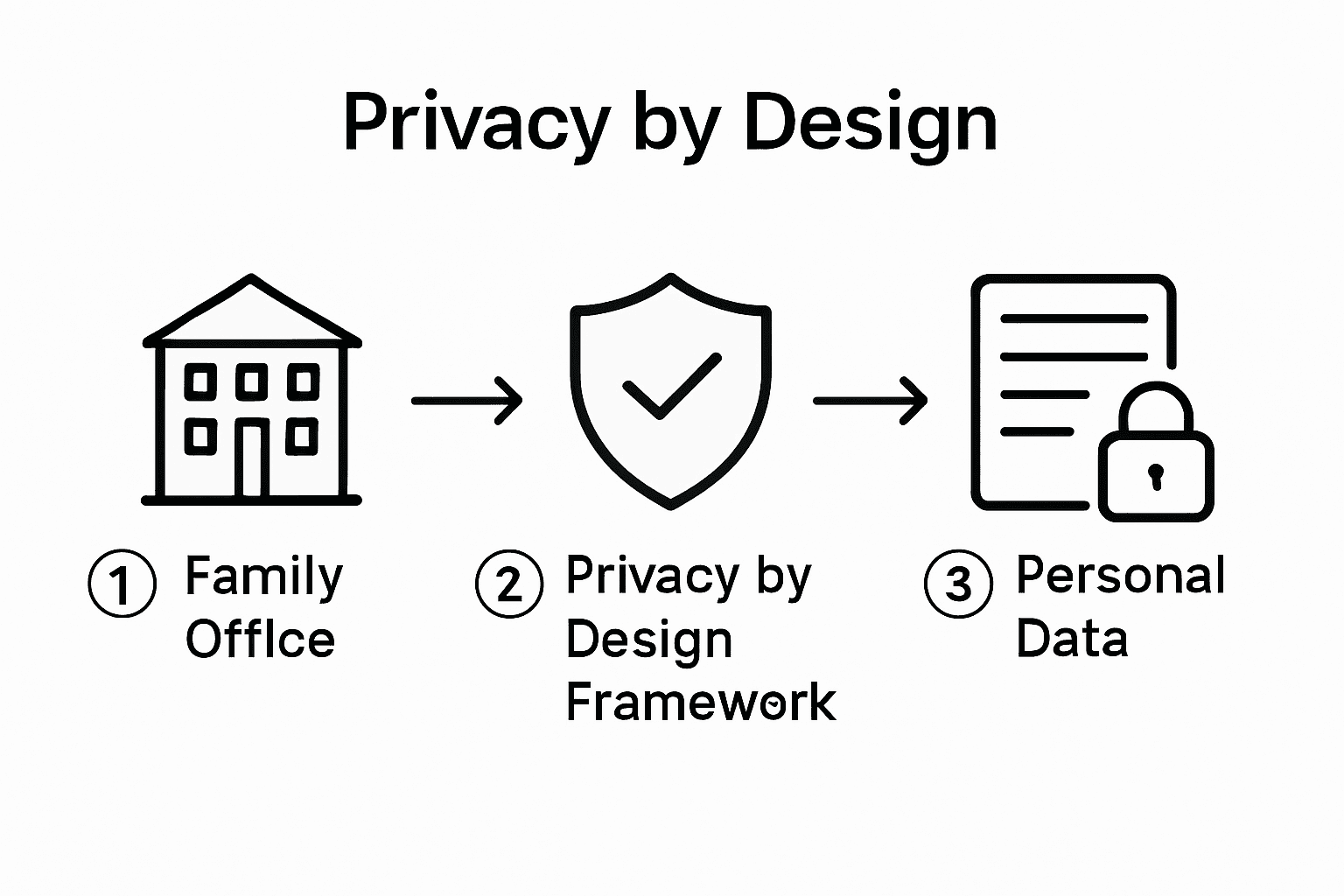
A systematic approach to protecting Personally Identifiable Information (PII) requires developing advanced flow-based models that comprehensively represent and safeguard sensitive data. This involves creating detailed data mapping strategies, implementing strict access controls, utilizing advanced encryption technologies, and establishing robust authentication protocols. Modern family offices must adopt a zero-trust security model, where every access request is thoroughly verified regardless of its origin, and continuously monitor data interactions to detect potential anomalies or unauthorized access attempts.
Pro Tip: Data Governance Strategy: Develop a comprehensive data inventory that meticulously tracks all sensitive information, documenting its origin, storage location, access protocols, and retention requirements to create a transparent and manageable data protection ecosystem.
Key Data Protection Framework Elements
Essential Protection Strategies:
- Comprehensive data mapping
- Zero-trust authentication protocols
- Advanced encryption technologies
- Continuous access monitoring
- Transparent consent mechanisms
- Proactive vulnerability assessments
Strengthen Your Family Office Privacy with Future Family Office
Protecting your family’s wealth and identity requires more than basic security measures. This article reveals how advanced encryption, legal confidentiality structures, and proactive cybersecurity training are essential to meet evolving privacy challenges. At the heart of these strategies lies the need for a centralized community where family offices, experts, and service providers collaborate to stay ahead of cyber threats and regulatory changes.

Discover how Future Family Office serves as your trusted partner by providing access to a comprehensive directory of privacy-focused service providers, industry-leading insights, and a supportive network tailored for ultra-high-net-worth investors. Take control of your privacy strategy today by connecting with specialized professionals, exploring expert articles, and engaging with peers who understand the critical importance of maintaining confidentiality. Visit our platform now to empower your family office with the knowledge and tools it needs to safeguard your legacy.
Explore more about protecting your family office privacy by visiting Future Family Office and start building your privacy defense network.
Frequently Asked Questions
What are the main privacy challenges faced by family offices today?
Family offices encounter various privacy challenges, including cybersecurity threats, data breaches, and complex digital intrusion techniques that demand sophisticated protection strategies.
What strategies can a family office implement to protect sensitive information?
Family offices can protect sensitive information by employing advanced encryption technologies, implementing restricted digital access protocols, conducting regular security audits, and establishing comprehensive reputation management strategies.
How do confidentiality structures enhance privacy in family offices?
Confidentiality structures, such as General Partnerships and Family Limited Partnerships, provide multiple layers of legal and organizational protection, enabling families to manage wealth while controlling information flow and maintaining privacy.
What are the best practices for ensuring compliance with privacy regulations?
Best practices include developing a dynamic privacy compliance framework, conducting regular legal reviews, implementing comprehensive risk assessment mechanisms, and staying updated on emerging regulatory requirements.