


More than $100 billion is allocated annually by American investors seeking to make a real difference through philanthropic investing. While many traditional methods focus on one-time donations, this strategic approach empowers capital to drive long-term social change alongside measurable financial results. If you are looking to understand how American philanthropic investing works and how it stacks up against conventional investing, you will gain a clear view of its core concepts, models, and the unique value it brings to society.
Table of Contents
- Defining Philanthropic Investing and Core Concepts
- Types of Philanthropic Investment Approaches
- How Philanthropic Investing Generates Impact
- Financial, Legal, and Tax Considerations
- Risks, Limitations, and Common Pitfalls
- Comparing Philanthropic and Traditional Investing
Key Takeaways
| Point | Details |
|---|---|
| Philanthropic Investing Strategy | Focus on generating social impact alongside financial returns through strategic resource allocation. |
| Core Approaches | Employ various investment approaches such as Program-Related Investments and Impact First Investments to address societal challenges. |
| Impact Measurement | Develop robust frameworks for measuring both financial and social outcomes to ensure meaningful philanthropic contributions. |
| Risk Management | Implement comprehensive due diligence processes to navigate complex legal and financial landscapes in philanthropic investments. |
Defining Philanthropic Investing and Core Concepts
Philanthropic investing represents a strategic approach to generating positive social impact while simultaneously pursuing financial returns. Unlike traditional charitable giving, this methodology seeks to create sustainable change through purposeful resource allocation. At its core, philanthropic investing transforms capital into a powerful tool for addressing complex societal challenges.
The landscape of philanthropic investing encompasses multiple dimensions, with three core approaches to effective philanthropy emerging as foundational models. These approaches range from direct charitable contributions to more sophisticated investment strategies that prioritize both financial performance and measurable social outcomes. Philanthropic investors distinguish themselves by viewing financial resources not merely as donations, but as strategic investments capable of generating transformative social value.
Key characteristics of philanthropic investing include deliberate capital deployment, rigorous impact measurement, and a commitment to systemic change. Investors in this space typically focus on several critical domains:
- Social enterprise support
- Impact-driven venture capital
- Nonprofit capacity building
- Sustainable development initiatives
- Long-term social innovation programs
Understanding these nuanced approaches requires recognizing that philanthropic investing goes beyond traditional wealth management paradigms. It represents a holistic strategy that integrates financial acumen with a profound commitment to addressing global challenges through strategic resource allocation.
Pro Investor Tip: Develop a comprehensive impact measurement framework before initiating philanthropic investments to ensure your capital generates meaningful, quantifiable social outcomes beyond traditional financial metrics.
Types of Philanthropic Investment Approaches
Philanthropic investment strategies encompass a diverse range of approaches that enable investors to generate meaningful social impact while maintaining financial sustainability. Strategic investment approaches have evolved to address complex societal challenges through targeted financial mechanisms designed to create sustainable change.
Five primary philanthropic investment approaches emerge as critical frameworks for impact-driven investors:
- Program-Related Investments (PRIs): Direct financial support to nonprofits with minimal return expectations
- Impact First Investments: Prioritizing social outcomes over financial returns
- Market-Rate Investments: Seeking competitive financial performance alongside social impact
- Mission-Related Investments: Aligning investment portfolios with organizational social missions
- Donor-Advised Fund Strategies: Providing flexible philanthropic investment channels
Each approach offers unique advantages and considerations. Three core approaches to effective philanthropy demonstrate that successful philanthropic investing requires nuanced understanding of capital deployment, measuring social returns, and creating systemic change. Sophisticated investors recognize that these strategies are not mutually exclusive but can be strategically combined to maximize both financial and social performance.
Here’s a concise comparison of key philanthropic investment approaches:
| Approach | Primary Focus | Typical Return Expectation | Example Use Case |
|---|---|---|---|
| Program-Related Investment | Nonprofit support | Below-market or capital return | Funding nonprofit expansion |
| Impact First Investment | Social outcome | Modest or variable returns | Affordable housing for low-income |
| Market-Rate Investment | Social & financial balance | Competitive, market-level returns | Renewable energy projects |
| Mission-Related Investment | Aligned with organization | Mixed, mission-dependent | Green tech aligned with mission |
| Donor-Advised Fund | Flexible giving strategy | Tax-efficient, flexible grants | Multi-year grantmaking |
The complexity of philanthropic investment demands a holistic approach that integrates financial expertise with deep social impact understanding. Investors must develop robust frameworks that balance rigorous financial analysis with meaningful social outcome metrics, moving beyond traditional investment paradigms.
Pro Investor Tip: Develop a comprehensive due diligence process that evaluates both financial performance metrics and quantifiable social impact indicators before committing capital to philanthropic investment strategies.
How Philanthropic Investing Generates Impact
Philanthropic investing transforms traditional capital deployment by creating measurable social change through strategic financial interventions. Philanthropic impact investing generates profound societal impact by supporting innovative solutions that address systemic challenges while maintaining financial sustainability.
The impact generation process involves multiple critical mechanisms:
- Capacity Building: Providing financial resources and strategic guidance to nonprofit organizations
- Social Enterprise Support: Enabling sustainable economic models for mission-driven enterprises
- Innovation Acceleration: Funding breakthrough solutions to complex social problems
- Systemic Change Facilitation: Creating infrastructure for long-term societal transformation
- Collaborative Ecosystem Development: Fostering partnerships across sectors
Applying venture capital principles to philanthropic investments allows investors to move beyond traditional charitable giving. This approach prioritizes scalable, sustainable solutions that create measurable social outcomes while maintaining financial discipline. Sophisticated impact investors recognize that generating meaningful change requires a comprehensive strategy that integrates financial performance with social value creation.

Successful philanthropic investing demands a holistic approach that balances quantitative metrics with qualitative social transformation potential. Investors must develop robust frameworks that assess both financial sustainability and potential societal impact, creating a nuanced approach to capital deployment that transcends traditional investment paradigms.
Pro Investor Tip: Design rigorous impact measurement frameworks that track both financial returns and substantive social outcomes, ensuring your philanthropic investments create genuine, measurable value beyond traditional financial metrics.
Financial, Legal, and Tax Considerations
Philanthropic investing requires sophisticated navigation of complex financial, legal, and tax landscapes that demand meticulous strategic planning. Impact investing financial instruments present unique challenges and opportunities that require comprehensive understanding of regulatory frameworks and tax implications.
Key financial and legal considerations for philanthropic investors include:
- Compliance Requirements: Adhering to IRS regulations and nonprofit governance standards
- Tax Optimization Strategies: Structuring investments to maximize potential tax benefits
- Regulatory Monitoring: Tracking evolving legal frameworks affecting philanthropic investments
- Risk Management: Developing comprehensive due diligence protocols
- Reporting Transparency: Maintaining rigorous documentation of financial activities
Donor-advised funds represent a critical financial mechanism that offers sophisticated investors flexible philanthropic investment channels. These vehicles provide strategic tax advantages while maintaining significant control over charitable contributions, enabling investors to optimize their philanthropic impact while managing complex financial considerations.
Successful philanthropic investing demands a holistic approach that integrates financial expertise, legal acumen, and tax strategy. Investors must develop nuanced frameworks that balance regulatory compliance, financial performance, and social impact objectives, creating multidimensional investment strategies that transcend traditional philanthropic models.
Pro Investor Tip: Engage specialized legal and tax professionals with deep expertise in philanthropic investing to develop comprehensive strategies that optimize both financial returns and social impact while ensuring rigorous regulatory compliance.
Risks, Limitations, and Common Pitfalls
Philanthropic investing confronts sophisticated investors with multifaceted challenges that require strategic risk management and nuanced understanding. Impact investing risk assessment strategies reveal complex limitations that demand comprehensive evaluation beyond traditional investment frameworks.
Primary risks and potential pitfalls in philanthropic investing include:
- Mission Drift: Losing focus on original social impact objectives
- Financial Performance Volatility: Potential inconsistent returns
- Impact Measurement Challenges: Difficulty quantifying social outcomes
- Regulatory Complexity: Navigating evolving legal landscapes
- Unintended Consequences: Potential negative secondary impacts
Trust-based philanthropy approaches introduce additional layers of complexity by challenging traditional accountability mechanisms. These strategies require investors to balance reduced reporting requirements with meaningful impact verification, creating a delicate equilibrium between trust and rigorous performance assessment.
Successful philanthropic investors must develop sophisticated risk mitigation strategies that transcend conventional investment approaches. This demands creating flexible frameworks that can adapt to changing social landscapes while maintaining disciplined financial and impact evaluation protocols. Investors need to cultivate a holistic perspective that integrates financial analysis, social impact assessment, and proactive risk management.
Pro Investor Tip: Implement a comprehensive due diligence framework that includes rigorous impact measurement methodologies, ongoing performance monitoring, and adaptive risk assessment strategies to navigate the complex philanthropic investment ecosystem.
Comparing Philanthropic and Traditional Investing
Philanthropic investing fundamentally reimagines capital deployment by introducing a paradigm that transcends traditional financial performance metrics. Philanthropic impact investing distinguishes itself by prioritizing social transformation alongside financial returns, creating a nuanced approach that challenges conventional investment strategies.
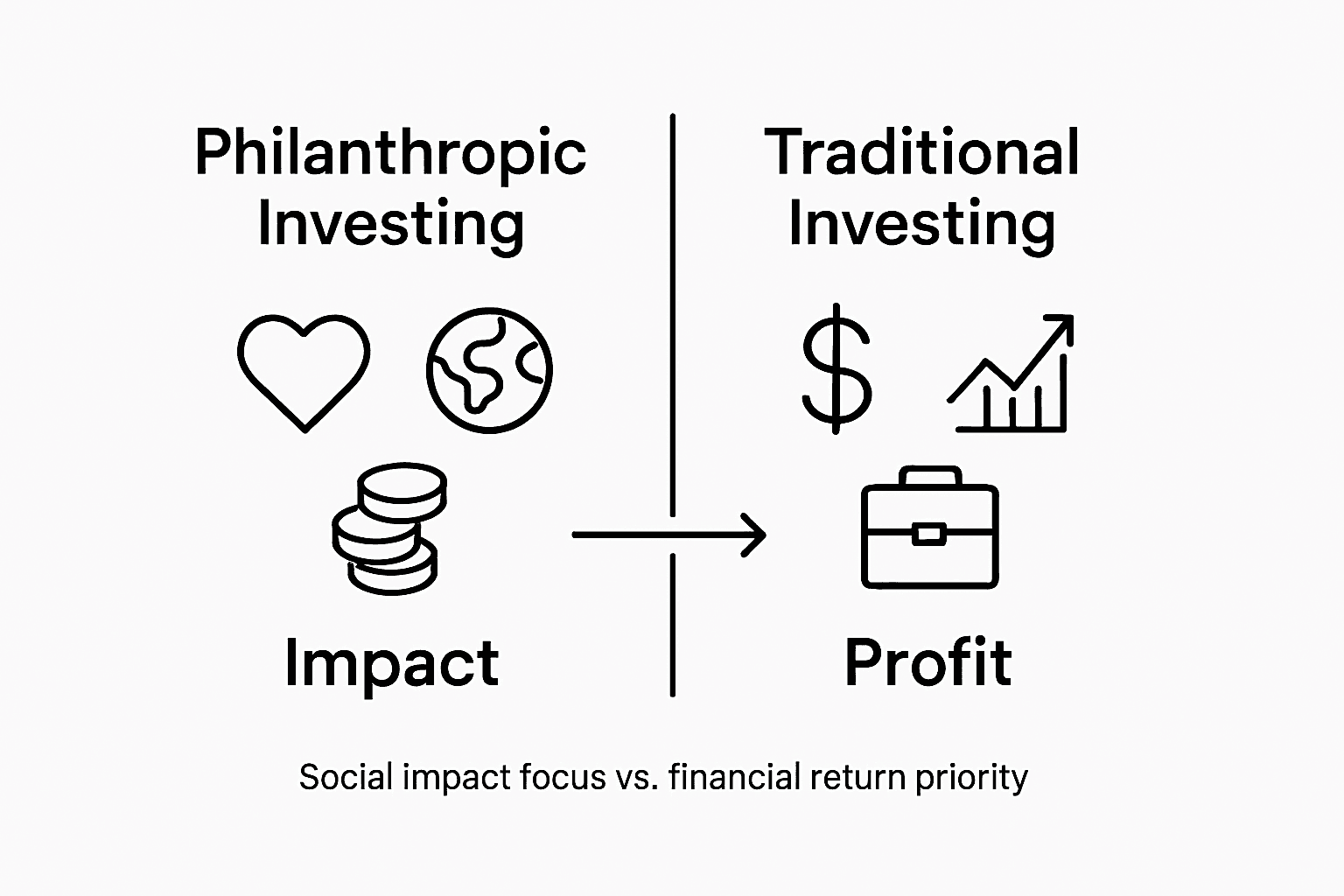
Key differences between philanthropic and traditional investing emerge across multiple dimensions:
This summary highlights critical differences between philanthropic and traditional investing:
| Dimension | Philanthropic Investing | Traditional Investing |
|---|---|---|
| Primary Goal | Social and financial gains | Financial returns only |
| Measurement Focus | Impact and money metrics | Profit and ROI metrics |
| Time Horizon | Long-term systemic change | Short-to-medium term gains |
| Risk Perspective | Higher tolerance for risk | Focus on minimizing loss |
- Primary Objective: Social impact versus pure financial returns
- Risk Tolerance: Higher acceptance of below-market returns
- Performance Metrics: Dual evaluation of financial and social outcomes
- Investment Horizon: Long-term systemic change versus short-term financial gains
- Success Measurement: Holistic impact assessment versus monetary performance
Philanthrocapitalism represents a sophisticated approach that bridges traditional investment principles with social innovation. This model applies rigorous business strategies to generate meaningful societal outcomes, demonstrating that financial acumen and social impact are not mutually exclusive but potentially synergistic objectives.
Sophisticated investors recognize that philanthropic investing requires a multidimensional perspective. Successful strategies integrate financial discipline, deep social understanding, and innovative approaches to capital deployment, moving beyond binary distinctions between charitable giving and traditional investment models.
Pro Investor Tip: Develop a comprehensive investment framework that equally weighs financial performance and potential social impact, utilizing advanced metrics that capture both monetary returns and transformative societal outcomes.
Unlock the Full Potential of Philanthropic Investing with Future Family Office
Philanthropic investing demands a strategic balance between financial returns and meaningful social impact. You may face challenges like crafting rigorous impact measurement frameworks, navigating complex legal and tax considerations, or avoiding mission drift while pursuing sustainable transformation. Understanding approaches like program-related investments, impact-first strategies, and market-rate investments is only the beginning. The key to success is access to a community and resources that empower you to execute these nuanced strategies confidently.

Discover how Future Family Office can help you overcome these challenges by connecting you with expert service providers, insightful industry reports, and a global network of family offices and impact-driven investors. Whether you want to build a due diligence process or find trusted advisors for structuring donor-advised funds, our platform offers comprehensive solutions tailored to your philanthropic investment goals. Start transforming your wealth into measurable impact today by visiting Future Family Office and explore tools designed to boost your social and financial outcomes.
Frequently Asked Questions
What is philanthropic investing?
Philanthropic investing is a strategic approach that combines the pursuit of financial returns with generating positive social impact, using capital to address complex societal challenges.
What are the main types of philanthropic investment approaches?
The primary philanthropic investment approaches include Program-Related Investments (PRIs), Impact First Investments, Market-Rate Investments, Mission-Related Investments, and Donor-Advised Fund Strategies, each focusing on different aspects of social impact and financial performance.
How can philanthropic investing generate measurable social impact?
Philanthropic investing generates measurable social impact by supporting capacity building for nonprofits, financing social enterprises, facilitating systemic changes, and driving innovation in solving societal challenges while maintaining financial sustainability.
What are some common risks associated with philanthropic investing?
Common risks include mission drift, financial performance volatility, challenges in impact measurement, regulatory complexities, and potential unintended consequences that could arise from the investments.
Recommended
- What is Philanthropic Planning? A Deep Dive into Its Importance – Future Family Office
- Impact Investing VS Investing With Impact – Future Family Office
- Global Trends and Strategic Time Horizons in Family Philanthropy 2020 – Future Family Office
- Impact Investing Explained: Strategies, Types, and Risks – Future Family Office