


Most American families today face far more complexity in wealth management than previous generations. With over 60 percent of high-net-worth families concerned about transferring wealth smoothly, it is clear that old approaches rarely match modern needs. Holistic planning goes beyond simple investment choices, weaving personal values and generational goals into a single financial strategy that actually fits real American lives.
Table of Contents
- Defining Holistic Wealth Planning Principles
- Key Pillars In Wealth Planning Approaches
- Tailoring Strategies For Family Office Needs
- Risks, Costs, And Future Trends In Practice
Key Takeaways
| Point | Details |
|---|---|
| Holistic Wealth Planning Emphasizes Integration | This approach unites various financial aspects such as investments, tax strategies, and estate planning into a cohesive strategy that reflects personal values and goals. |
| Strategic Governance is Essential | Effective wealth management requires clear decision-making frameworks that ensure financial strategies are aligned with family values and objectives. |
| Technological Engagement Enhances Oversight | Implementing advanced digital tools is crucial for real-time financial monitoring and adapting strategies to changing environments. |
| Proactive Risk Management is Critical | Developing comprehensive risk strategies can safeguard wealth against market volatility and regulatory changes. |
Defining Holistic Wealth Planning Principles
Holistic wealth planning represents a comprehensive approach to financial management that transcends traditional investment strategies. Instead of viewing financial assets in isolation, this methodology considers the entire ecosystem of an individual’s or family’s financial world, integrating multiple dimensions of wealth preservation, growth, and strategic transfer.
At its core, holistic wealth planning recognizes that financial success is not merely about accumulating assets, but about creating a synchronized strategy that aligns personal values, long-term objectives, and generational aspirations. Exploring Islamic financial planning principles reveals how comprehensive approaches can integrate spiritual and economic goals, demonstrating that wealth management extends beyond monetary metrics.
Key principles of holistic wealth planning include:
- Integrated Financial Perspective: Examining investments, tax strategies, risk management, estate planning, and philanthropy as interconnected components
- Generational Consciousness: Developing strategies that provide sustainable financial frameworks for current and future family members
- Dynamic Adaptability: Creating flexible plans that can evolve with changing economic landscapes, family dynamics, and personal circumstances
- Comprehensive Risk Management: Proactively addressing potential financial vulnerabilities across multiple dimensions of wealth
Pro Tip – Holistic Strategy Development: Engage a multidisciplinary team of financial advisors, tax experts, legal professionals, and family governance specialists to create a truly comprehensive wealth management approach that addresses all potential dimensions of your financial ecosystem.
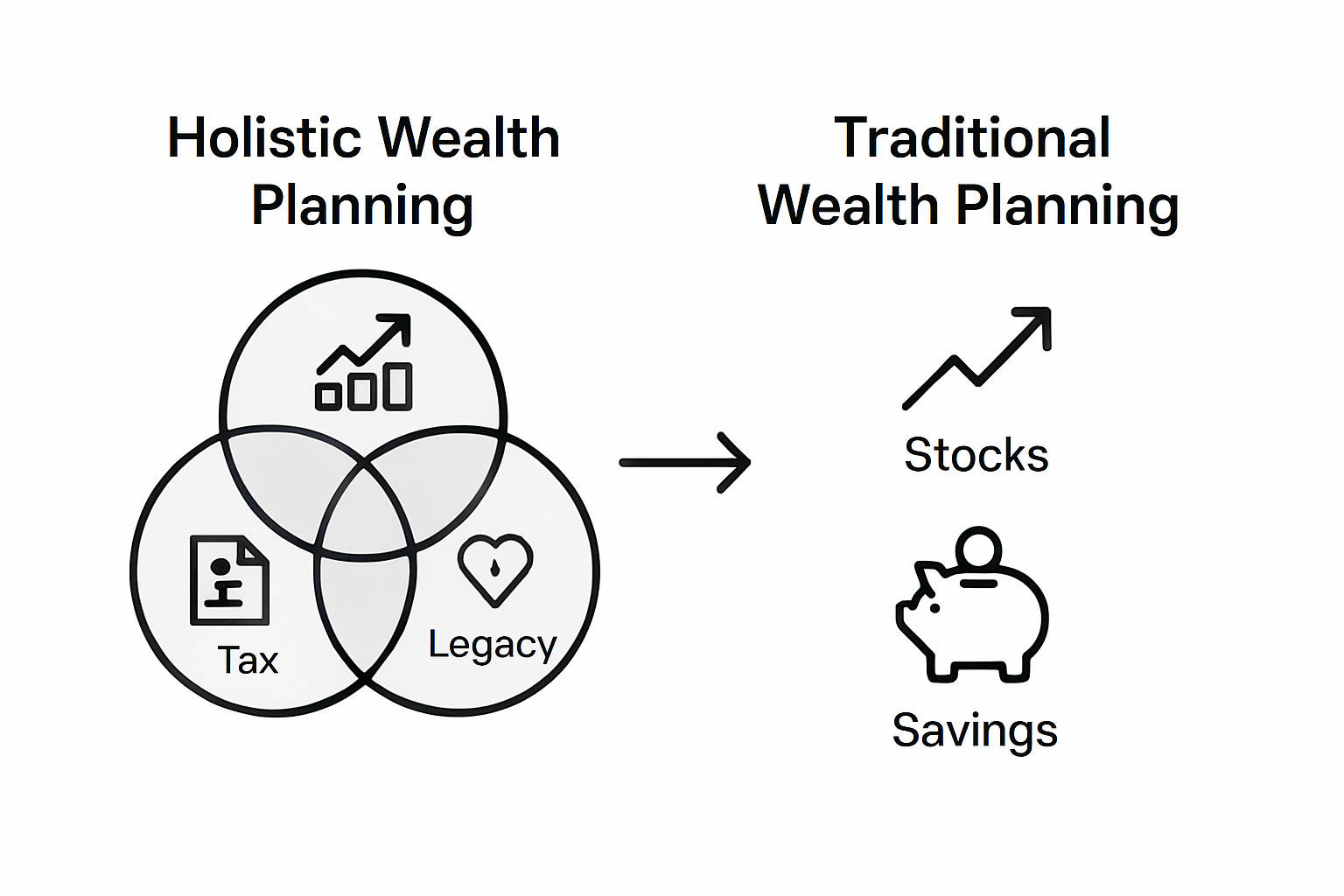
Here’s how holistic and traditional wealth planning differ:
| Aspect | Holistic Wealth Planning | Traditional Wealth Planning |
|---|---|---|
| Approach | Integrates all financial aspects | Focuses on individual financial products |
| Role of Values | Aligns strategy with personal values | Typically value-neutral in design |
| Family Involvement | Considers multiple generations | Primarily centers on individual clients |
| Flexibility | Adapts to changing family needs | Often fixed or periodic review only |
| Team Structure | Multidisciplinary specialists | Usually a single advisor or narrow team |
Key Pillars in Wealth Planning Approaches
Wealth planning approaches have evolved significantly, moving beyond traditional financial management to encompass a more holistic and strategic framework. Modern wealth strategies recognize that financial success requires a multifaceted approach that addresses complex interconnected dimensions of personal and family financial ecosystems.
Key pillars of wealth management for the future highlight a sophisticated approach that transcends conventional investment methodologies. These pillars include comprehensive governance structures, advanced investment capabilities, cutting-edge technological integration, and nuanced human guidance that collectively create a robust wealth preservation and growth strategy.
The fundamental pillars of effective wealth planning include:
- Strategic Governance: Establishing clear decision-making frameworks and protocols for financial management
- Investment Diversification: Creating resilient investment portfolios that balance risk and potential returns across multiple asset classes
- Technology Integration: Leveraging advanced digital tools for real-time financial monitoring, analysis, and strategic planning
- Risk Management: Developing comprehensive strategies to protect and preserve wealth against potential economic uncertainties
- Generational Knowledge Transfer: Ensuring financial literacy and strategic insights are systematically passed between family generations
Pro Tip – Strategic Wealth Architecture: Develop a dynamic, flexible wealth planning approach that can adapt to changing economic landscapes while maintaining a consistent core strategy focused on long-term family financial resilience.
Tailoring Strategies for Family Office Needs
Family office strategy represents a sophisticated approach to wealth management that goes far beyond traditional financial planning. Each family office requires a unique blueprint that reflects its distinct financial landscape, generational objectives, risk tolerance, and complex interpersonal dynamics.

Future-focused wealth management strategies demonstrate that successful family offices must integrate multiple strategic dimensions to create comprehensive and adaptive financial ecosystems. This involves developing customized frameworks that balance sophisticated investment approaches with robust governance structures and forward-thinking technological capabilities.
Key considerations for tailoring family office strategies include:
- Personalized Governance Structures: Designing decision-making protocols that align with specific family values and communication styles
- Flexible Investment Frameworks: Creating dynamic investment portfolios that can quickly adapt to changing economic environments
- Generational Transition Planning: Developing comprehensive knowledge transfer mechanisms to preserve financial wisdom across family generations
- Technological Integration: Implementing advanced digital platforms that provide real-time insights and strategic financial monitoring
- Comprehensive Risk Management: Constructing multifaceted risk mitigation strategies that protect family wealth across different potential scenarios
Pro Tip – Strategic Customization: Conduct thorough family financial assessments that explore not just monetary assets, but also familial goals, individual risk profiles, and long-term vision to create truly personalized wealth management approaches.
The following table summarizes how key family office priorities address future challenges:
| Priority Area | Business Impact | Example Solution |
|---|---|---|
| Governance | Improves clarity and conflict resolution | Family charters and protocols |
| Succession | Preserves wealth and insights | Structured knowledge transfer programs |
| Technology | Enables real-time oversight | Secure digital dashboards |
| Risk Mitigation | Reduces financial vulnerabilities | Proactive scenario planning |
| Customization | Meets unique family goals | Tailored portfolio strategies |
Risks, Costs, and Future Trends in Practice
Family office wealth management stands at a critical intersection of technological innovation and strategic financial planning. The evolving landscape demands sophisticated approaches that balance potential opportunities with comprehensive risk mitigation strategies, recognizing the increasingly complex global financial environment.
Transformative financial planning through AI technologies reveals significant challenges and opportunities, particularly around managing systemic risks and information asymmetries. Modern family offices must develop nuanced strategies that leverage technological advancements while maintaining robust protective mechanisms against potential vulnerabilities.
Key considerations in navigating contemporary wealth management risks include:
- Technological Integration Risks: Understanding potential cybersecurity threats and data privacy challenges
- Portfolio Volatility Management: Developing adaptive strategies to address market unpredictability
- Regulatory Compliance: Maintaining rigorous adherence to evolving financial regulations and reporting requirements
- Information Security: Implementing advanced protection protocols for sensitive financial data
- Technological Infrastructure: Investing in scalable and secure digital platforms that support comprehensive wealth management
Pro Tip – Risk Mitigation Strategy: Conduct regular, comprehensive risk assessments that incorporate both technological and human factors, creating a dynamic framework that can quickly adapt to emerging financial challenges and opportunities.
Unlock the Full Potential of Holistic Wealth Planning for Your Family Office
Navigating the complexity of holistic wealth planning requires more than isolated financial strategies. This article highlights critical challenges such as integrating governance, generational knowledge transfer, risk management, and technological innovation into a unified family office approach. If you aim to build a flexible, values-aligned, and adaptive wealth ecosystem that stands the test of time you need access to expert guidance and a trusted community that supports your unique goals and long-term vision.

Discover how Future Family Office can empower your family office journey by connecting you with specialized service providers, advanced technological solutions, and industry thought leadership. Visit Future Family Office today to explore tailored resources and build strategic partnerships that elevate your wealth planning impact. Don’t wait to transform your financial ecosystem — start creating resilience and clarity now with expert support at Future Family Office.
Frequently Asked Questions
What is holistic wealth planning?
Holistic wealth planning is a comprehensive approach to financial management that integrates various aspects of wealth preservation, growth, and strategic transfer, while aligning with personal values and generational goals.
How does holistic wealth planning differ from traditional wealth planning?
Unlike traditional wealth planning, which often focuses on individual financial products, holistic wealth planning considers the entire financial ecosystem, including investments, tax strategies, risk management, and family dynamics.
What are key principles of holistic wealth planning?
Key principles include an integrated financial perspective, generational consciousness, dynamic adaptability to change, and comprehensive risk management to address potential vulnerabilities across multiple dimensions of wealth.
Why is personalized governance important in family office strategies?
Personalized governance structures are crucial because they align decision-making processes with specific family values and communication styles, which can improve clarity and reduce conflicts among family members.
Recommended
- Understanding the Role of Estate Planning for Wealth Management – Future Family Office
- The Essential Guide to Wealth Transfer Planning – Future Family Office
- 7 Wealth Management Best Practices for Success – Future Family Office
- 7 Practical Examples of Wealth Strategies for Investors – Future Family Office
- Designing a Multi-Generational Home That Works for Everyone – Henley Contracting Ltd.