


Over ninety percent of affluent American families cite a lack of clear strategy as the top obstacle to preserving wealth across generations. Building a sustainable family office is not just about investment returns or sophisticated structures. It is the process of defining objectives, implementing robust systems, and selecting trusted advisors that creates security and clarity. This practical guide reveals actionable steps every American family can use to turn complex financial ambitions into measurable, long-term results.
Table of Contents
- Step 1: Define Objectives And Strategy
- Step 2: Establish Governance Structure
- Step 3: Select Advisors And Partners
- Step 4: Implement Operational Systems
- Step 5: Verify Compliance And Performance
Quick Summary
| Key Insight | Explanation |
|---|---|
| 1. Define clear objectives | Create specific and measurable wealth goals that reflect family values and long-term aspirations. This provides direction for all wealth management efforts. |
| 2. Establish governance structures | Implement formal frameworks like councils and committees to outline decision-making processes and responsibilities, ensuring accountability in wealth management. |
| 3. Select aligned advisors | Choose advisors who understand your family dynamics and can offer personalized services tailored to your financial goals and investment philosophy. |
| 4. Implement operational systems | Develop integrated systems for investment management, accounting, and reporting, designed for flexibility and scalability to manage family wealth effectively. |
| 5. Verify compliance and performance | Regularly monitor investments and regulatory adherence with detailed audits and performance evaluations to ensure strategic effectiveness and accountability. |
Step 1: Define objectives and strategy
Defining clear objectives and strategy forms the critical foundation for your family office’s success and long-term sustainability. This step transforms abstract family wealth goals into concrete, actionable plans that will guide your entire wealth management approach.
Begin by conducting a comprehensive family wealth assessment that goes beyond simple financial metrics. Explore strategic frameworks that create multi-generational legacies by mapping out not just monetary objectives, but also your family’s deeper values and aspirations. This means sitting down together and having honest conversations about what wealth means to your family. Are you focused on preservation? Aggressive growth? Philanthropic impact? Each family’s vision will be unique.
Your strategic planning should encompass multiple dimensions: investment management, risk mitigation, tax optimization, and intergenerational wealth transfer. Create a living document that outlines specific goals with measurable benchmarks. For instance, instead of a vague goal like “grow wealth,” define precise targets such as “achieve 7% annual portfolio growth while maintaining 60% capital preservation.” This granular approach ensures everyone understands the family office’s mission and can track progress systematically.
Pro tip: Schedule periodic strategy reviews. Wealth dynamics and family circumstances evolve, so your strategy must remain flexible and adaptive. Plan to reassess your objectives at least annually, and be prepared to make intelligent adjustments as market conditions and family priorities shift.
With clear objectives defined, you are now ready to build the operational infrastructure that will transform your strategic vision into reality.
Step 2: Establish governance structure
Establishing a robust governance structure is fundamental to creating a successful family office. This critical step will define how decisions are made, who makes them, and how accountability is maintained across your family’s wealth management ecosystem.

Start by designing comprehensive governance frameworks that align with your family’s unique values and objectives. This typically involves creating formal structures like family councils, investment committees, and advisory boards. Consider establishing clear roles and responsibilities for each family member involved in governance. For example, you might have specific committees focused on investment strategy, philanthropic initiatives, and generational wealth transfer.
Your governance structure should include transparent decision making processes, clearly defined voting mechanisms, and conflict resolution protocols. Document everything meticulously to ensure consistency and prevent potential misunderstandings. This means creating formal charters that outline each committee’s scope, authority levels, meeting frequencies, and reporting requirements.
Pro tip: Build flexibility into your governance model. Family dynamics evolve, and your governance structure should adapt alongside changing family circumstances, wealth management needs, and generational shifts. Schedule periodic reviews to reassess and recalibrate your governance approach.
With a solid governance framework in place, you are now prepared to develop the operational policies that will guide your family office’s daily functions and long-term strategy.
Step 3: Select advisors and partners
Selecting the right advisors and partners represents a pivotal moment in establishing your family office. This crucial step will determine the quality and effectiveness of your wealth management strategy, requiring meticulous evaluation and alignment with your family’s unique financial goals.
Navigate the selection process by understanding that personalized services are fundamental to successful family office partnerships. Look beyond standard credentials and seek professionals who demonstrate deep understanding of your specific family dynamics, investment philosophy, and long-term objectives. Conduct comprehensive due diligence that includes reviewing potential partners’ track records, understanding their expertise in your specific wealth management domains, and assessing their ability to provide customized solutions.
Develop a rigorous screening framework that evaluates potential advisors across multiple dimensions. Consider factors like technical expertise, communication style, fiduciary commitment, technological capabilities, and cultural compatibility. Create a detailed scorecard that weights these attributes according to your family’s priorities. Interview multiple candidates, request comprehensive proposals, and do not hesitate to ask for references or case studies demonstrating their ability to manage complex wealth scenarios.
Pro tip: Trust your instincts alongside empirical assessment. Technical competence matters, but so does personal chemistry and shared vision. A technically brilliant advisor who cannot communicate effectively or understand your family’s unique values may not be the right long-term partner.
With carefully selected advisors and partners in place, you are now ready to begin developing a comprehensive operational strategy for your family office.
Step 4: Implement operational systems
Implementing robust operational systems is the backbone of a successful family office, transforming strategic vision into practical daily management. This critical phase bridges the gap between planning and execution, ensuring your family’s wealth management operates with precision and efficiency.
Comprehensive operational systems encompass multiple critical functions including investment management, accounting, tax planning, reporting, and lifestyle administration. Begin by mapping out each operational domain and identifying the specific technological tools and processes required to support your family’s unique needs. This means selecting integrated software platforms that can handle complex wealth management tasks while providing real time reporting and seamless communication across different functional areas.
Design your operational infrastructure with scalability and flexibility as core principles. Implement modular systems that can adapt to changing family dynamics and evolving financial strategies. Prioritize solutions that offer robust security protocols, comprehensive data integration, and customizable reporting capabilities. Consider creating standardized workflows for key processes like investment approvals, expense tracking, risk assessment, and compliance monitoring. Develop clear protocols for data management, including secure document storage, access controls, and confidentiality measures.
Pro tip: Technology alone is not enough. Invest significant time in training your team and family members on these new operational systems. The most sophisticated software becomes ineffective if users do not understand how to leverage its full capabilities.
With operational systems now in place, you are prepared to move toward developing comprehensive financial strategies that will drive your family office’s long term success.
Step 5: Verify compliance and performance
Verifying compliance and performance is the critical checkpoint that ensures your family office operates with the highest standards of financial integrity and strategic effectiveness. This step transforms your carefully crafted plans into measurable, accountable results.
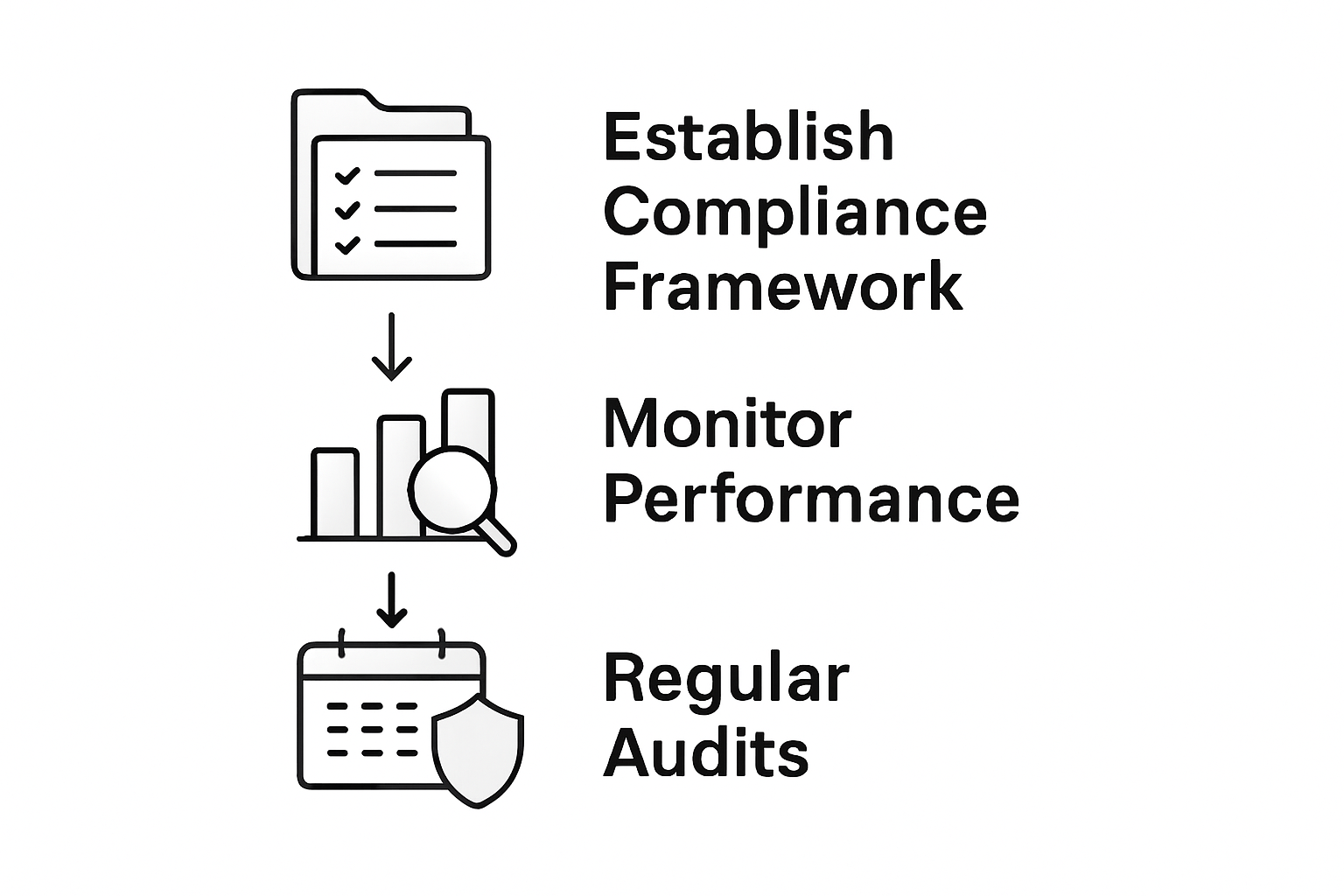
Establish comprehensive governance frameworks that include robust control plans for monitoring investments and regulatory adherence. Develop a multi layered verification process that includes regular performance audits, compliance checks, and detailed reporting mechanisms. This means creating systematic approaches to track investment performance, assess risk management strategies, and ensure strict alignment with your family’s established financial objectives and regulatory requirements.
Implement a comprehensive performance verification system that goes beyond traditional financial metrics. Create detailed scorecards that evaluate not just monetary returns, but also alignment with your family’s broader strategic goals, risk tolerance, and long term vision. This involves setting clear key performance indicators (KPIs) across multiple dimensions including financial growth, risk management, tax efficiency, and alignment with family values. Conduct quarterly and annual reviews that provide transparent, in depth analysis of your family office’s performance, allowing for timely adjustments and strategic refinements.
Pro tip: Build redundancy into your compliance verification processes. No single point of review is foolproof. Implement multiple layers of oversight, including external audits, independent reviews, and cross functional verification to create a comprehensive compliance safety net.
With compliance and performance thoroughly verified, you are now prepared to enter the final stages of establishing a world class family office that can adapt and thrive across generations.
Build Your Family Office with Confidence and Clarity
Setting up a family office requires clear objectives, a strong governance structure, trusted advisors, and seamless operational systems. The challenges of defining strategic goals and ensuring compliance can feel overwhelming as you strive to protect and grow your family legacy. This detailed guide highlights the importance of clear benchmarks, flexible governance, and rigorous partner selection to transform your vision into lasting success.
Take the complexity out of building your family office by connecting with experts and resources designed specifically for ultra-high-net-worth investors. At Future Family Office, you gain exclusive access to a global community offering a comprehensive directory of service providers, in-depth industry insights, and tailored tools. Whether you are looking for advisors who understand your family values or cutting-edge operational solutions, our platform supports every phase of your family office journey.

Explore trusted partners and proven strategies that align with your unique family goals. Don’t wait to establish a family office that thrives across generations. Visit Future Family Office today and start building the foundation for sustainable wealth management. Discover how our curated resources and networking opportunities can help you move from planning to execution with confidence.
Frequently Asked Questions
What are the first steps in my family office setup checklist?
Start by defining your objectives and strategy. Conduct a comprehensive family wealth assessment and have discussions with family members to clarify your wealth goals such as preservation, growth, or philanthropy.
How do I create a governance structure for my family office?
Design a governance framework that includes formal bodies like family councils or investment committees. Clearly outline roles, responsibilities, decision-making processes, and documentation to ensure consistency and accountability.
What criteria should I use to select advisors and partners for my family office?
Evaluate potential advisors based on technical expertise, communication style, and alignment with your family’s values. Create a scorecard to assess these factors and conduct rigorous interviews and reference checks to ensure a good fit.
What operational systems are crucial for effective family office management?
Implement operational systems that cover investment management, accounting, tax planning, and reporting. Choose scalable and flexible software solutions that can provide real-time reporting and integrate across different functions.
How can I verify compliance and performance in my family office?
Establish a verification process that includes regular performance audits and compliance checks. Create scorecards with key performance indicators to evaluate monetary returns and alignment with your family’s broader strategic goals, and conduct reviews regularly.
How often should I reassess the objectives of my family office?
Plan to reassess your objectives at least annually. This allows your strategy to adapt to evolving family dynamics and market conditions, ensuring that your goals remain relevant and actionable.
Recommended
- 7 Essentials for a Complete Family Office Governance Checklist – Future Family Office
- Master Your Estate Planning Workflow: Step-by-Step Guide – Future Family Office
- Family Office Compliance Checklist for Effective Risk Management – Future Family Office
- Optimize Your Family Office Investment Workflow Efficiently – Future Family Office