


Building a strong investment pipeline is the cornerstone of every successful american family office. With more than eighty percent of family offices increasing their allocations to alternative assets in recent years, the competition for quality deals has never been fiercer. Defining clear investment criteria and goals not only protects your legacy but also transforms complex financial ambitions into practical action. This guide shows how a structured approach leads to smarter decisions and sustained wealth.
Table of Contents
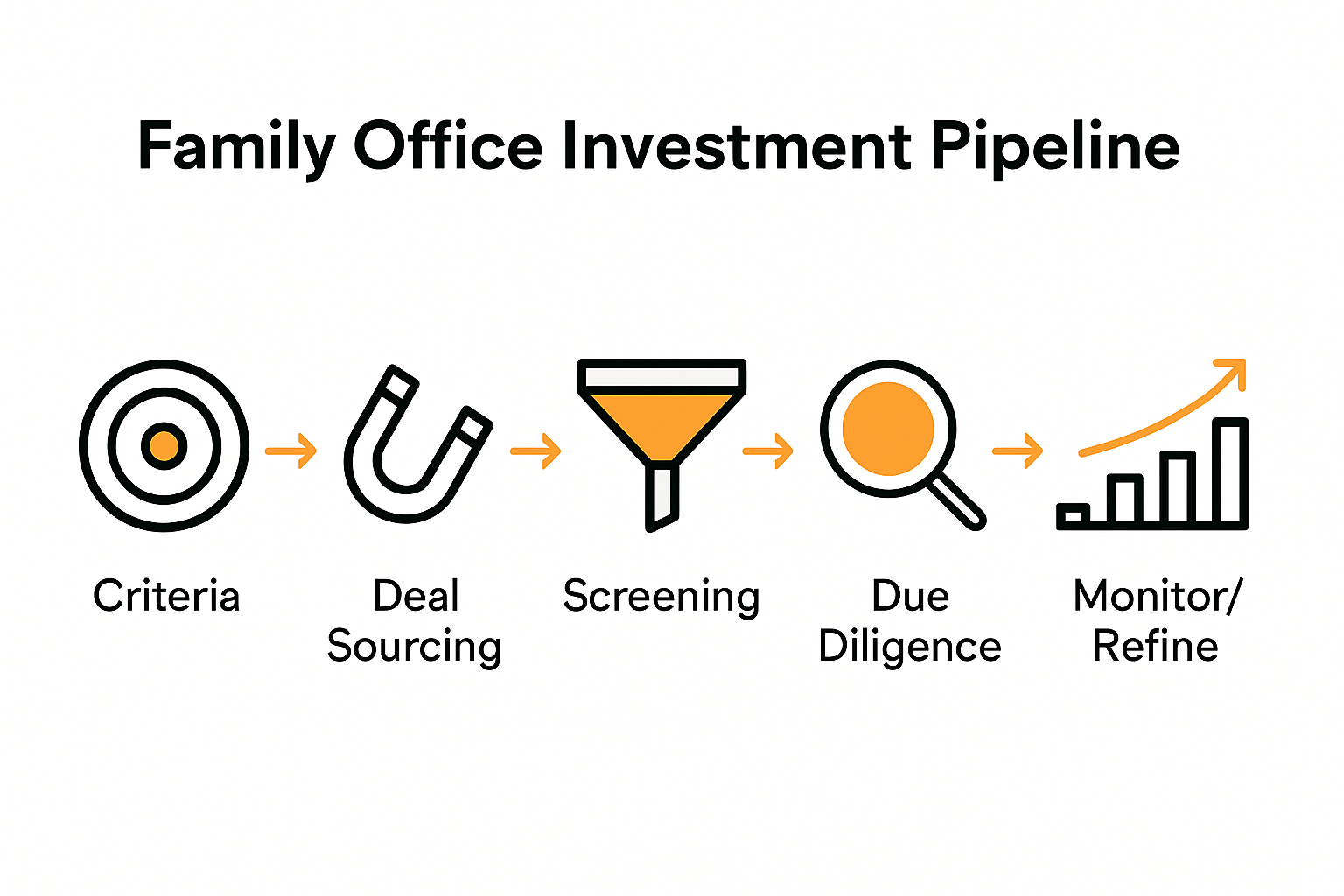
- Step 1: Define Investment Criteria And Goals
- Step 2: Identify And Source Quality Deal Flow
- Step 3: Screen And Prioritize Potential Opportunities
- Step 4: Conduct Due Diligence And Validate Deals
- Step 5: Monitor And Refine Pipeline Performance
Quick Summary
| Key Insight | Explanation |
|---|---|
| 1. Define clear investment goals | Establish precise financial objectives to guide investment decisions. Evaluating risk tolerance and return expectations forms the basis of your strategy. |
| 2. Source diverse investment opportunities | Utilize multiple channels for deal flow, including referrals and industry events. A diverse sourcing strategy increases your chances of finding quality investments. |
| 3. Implement a structured screening process | Create an evaluation matrix to assess potential investments based on financial metrics and strategic fit. This systematic approach helps prioritize the best opportunities. |
| 4. Conduct thorough due diligence | Meticulously examine all aspects of potential investments to uncover risks and validate assumptions. This step ensures informed decision-making and risk mitigation. |
| 5. Monitor and adapt investment performance | Regularly track investment outcomes against set benchmarks. Continuous evaluation and adjustment are crucial for responding to market changes and optimizing returns. |
Step 1: Define investment criteria and goals
Building a robust investment pipeline for your family office starts with crystal clear investment criteria and goals. This foundational step transforms abstract financial aspirations into a strategic roadmap that guides every investment decision.
A comprehensive family investment policy translates your family’s shared values and financial objectives into precise allocation guidelines. Begin by gathering key family stakeholders and conducting an honest assessment of collective financial priorities. Ask critical questions: What is our risk tolerance? What returns are we targeting? Do we want steady income or aggressive growth?
Your investment criteria should encompass multiple strategic dimensions. Consider asset allocation percentages across different investment classes like stocks, bonds, real estate, and alternative investments. Determine specific sector preferences whether technology, healthcare, or emerging markets. Define geographic boundaries are you focused on domestic opportunities or seeking global diversification?
Pro Tip: Document your investment policy as a living framework that can evolve with changing family dynamics and market conditions. Review and update annually to ensure continued alignment with your evolving financial landscape.
Once your investment criteria are established, you will have a powerful strategic compass that transforms scattered investment impulses into a disciplined, purposeful approach to wealth generation and preservation.
Step 2: Identify and source quality deal flow
Sourcing exceptional investment opportunities requires a strategic and systematic approach that goes beyond traditional networking. Family offices are increasingly recognizing the importance of developing robust deal flow mechanisms to uncover promising investments across various sectors.

The investment landscape has dramatically shifted, with venture capital investments expanding significantly from 17% to 38% of total family office investments between 2015 and 2022. To build a compelling deal flow pipeline, diversify your sourcing strategies by leveraging multiple channels: industry conferences, specialized investment networks, startup accelerators, academic innovation centers, and professional referral networks.
Develop a clearly articulated investment philosophy that guides your deal evaluation process. This means establishing precise screening criteria that align with your family office’s risk tolerance, return expectations, and strategic objectives. Create a structured evaluation framework that helps you quickly assess potential opportunities, focusing on factors like market potential, team expertise, competitive landscape, and alignment with your investment thesis.
Pro Tip: Cultivate relationships with key ecosystem players like angel investors, venture capitalists, and industry experts who can provide consistent deal flow and valuable insights.
Successful deal sourcing is an ongoing process of relationship building, continuous learning, and strategic positioning in dynamic investment ecosystems.
Step 3: Screen and prioritize potential opportunities
Transforming a raw deal flow into strategic investment opportunities requires a disciplined and systematic approach. Your goal in this critical stage is to develop a robust screening framework that efficiently filters potential investments and identifies the most promising prospects.
A comprehensive Investment Policy Statement acts as the foundational document for professionalizing your investment management process. Develop a structured evaluation matrix that includes quantitative and qualitative assessment criteria. This matrix should encompass financial metrics like potential return on investment, risk profile, liquidity, and alignment with your established investment philosophy.
Your screening process should incorporate multiple dimensions of opportunity evaluation, including team expertise, market potential, competitive landscape, and strategic fit with your existing portfolio. Create a scoring system that assigns weighted values to different evaluation criteria, allowing you to objectively rank and compare potential investments.
Pro Tip: Implement a tiered screening approach where opportunities undergo progressively more rigorous assessment, moving from initial quick screening to in-depth due diligence for top candidates.
Successful opportunity screening is about balancing analytical rigor with strategic intuition, ensuring that each potential investment receives comprehensive and objective evaluation.
Step 4: Conduct due diligence and validate deals
Due diligence represents the critical checkpoint where promising investment opportunities transform into potentially viable strategic assets. Your mission is to meticulously examine every aspect of a potential investment, moving beyond surface level evaluations to uncover hidden risks and validate fundamental assumptions.
Establishing a well-defined governance framework drives your investment strategy and increases your ability to formulate and execute investment goals systematically. This involves comprehensive financial analysis, including deep dives into financial statements, market positioning, competitive landscape, management team capabilities, intellectual property status, and potential growth trajectories.
Documenting core investment objectives ensures your due diligence process remains aligned with specific parameters like return expectations, risk tolerance, liquidity requirements, and investment time horizons. Develop a standardized due diligence checklist that covers financial, legal, operational, and strategic dimensions to maintain consistency and thoroughness across different investment opportunities.
Pro Tip: Engage external experts like industry specialists, legal consultants, and technical advisors to supplement your internal due diligence capabilities and provide objective third party perspectives.
Successful due diligence transforms potential investments from speculative opportunities into well-understood strategic assets with clear risk profiles and growth potential.
Step 5: Monitor and refine pipeline performance
Successful family office investment management goes far beyond initial deal selection it requires ongoing performance tracking, strategic reassessment, and dynamic portfolio optimization. Your goal is to create a responsive system that continuously evaluates investment performance against established benchmarks and adapts to changing market conditions.
Monitoring investment activity and market trends provides critical insights into your pipeline’s effectiveness. Implement a comprehensive performance tracking framework that includes quantitative metrics like return on investment, risk adjusted performance, and comparative analysis against relevant market indices. Develop a quarterly review process that systematically assesses each investment opportunity against original investment hypotheses and current market dynamics.
Regularly reviewing and documenting your investment philosophy ensures your investment pipeline remains agile and aligned with evolving family objectives. Create a dynamic scorecard that captures both financial performance and strategic alignment, allowing you to make data driven decisions about portfolio rebalancing, exit strategies, and future investment opportunities.
Pro Tip: Establish a formal feedback loop that includes periodic stakeholder consultations to validate investment strategies and incorporate diverse perspectives from family members and external advisors.
Effective pipeline monitoring transforms investment management from a static process into a living strategic capability that continuously learns and adapts to complex market ecosystems.
Build a Stronger Investment Pipeline with Expert Support
Navigating the complex steps of defining investment goals, sourcing quality deals, and conducting thorough due diligence is a challenge many family offices face. This article highlights key pain points like maintaining a disciplined investment philosophy and monitoring pipeline performance to protect and grow your wealth effectively. If you seek to overcome these hurdles with greater clarity and access to a collaborative community, the right tools and connections are essential.

Discover how Future Family Office empowers you to transform your investment pipeline strategy by connecting you with global family offices, trusted service providers, and industry experts all in one place. Access curated resources, stay updated on market trends, and engage with professionals who understand your need for a structured yet agile approach. Don’t wait to strengthen your investment pipeline — start building lasting relationships and strategic insights today by visiting Future Family Office and explore our community focused on family office excellence.
Frequently Asked Questions
What are the first steps in building an investment pipeline for a family office?
To build an investment pipeline, start by defining clear investment criteria and goals. Gather key family stakeholders to assess collective financial priorities and document this into an investment policy.
How can I find quality investment opportunities for my family office?
You can identify quality investment opportunities by diversifying your sourcing strategies. Utilize channels like industry conferences, investment networks, and startup accelerators to build a robust deal flow pipeline.
What should I include in an investment screening framework?
An investment screening framework should include both quantitative and qualitative assessment criteria. Develop a scoring system based on key factors like potential return, risk profile, and alignment with your investment philosophy to prioritize opportunities effectively.
How do I conduct due diligence on potential investments?
Conduct due diligence by thoroughly examining all aspects of a potential investment, including financial analysis and market positioning. Create a standardized checklist to ensure all critical dimensions—financial, legal, operational—are consistently evaluated.
How often should I monitor and refine my investment pipeline?
You should monitor and refine your investment pipeline regularly, ideally on a quarterly basis. Establish a performance tracking framework to assess investments against benchmarks and adapt strategies based on current market conditions.
What role does family involvement play in investment decisions?
Family involvement is crucial as it ensures that investments align with shared values and financial objectives. Establish a feedback loop with family members to validate investment strategies and incorporate diverse perspectives into decision-making.
Recommended
- How To Build A Family Office Deal Flow Pipeline – Future Family Office
- 3 Tips To Effectively Connect And Raise Investment From Family Offices. – Future Family Office
- Optimize Your Family Office Investment Workflow Efficiently – Future Family Office
- How to Structure Co-Investments for Family Offices – Future Family Office